“Mist-blanketed rivers with crocodiles have tales to tell, I’m sure.” – Heather Lind.
The mist in Oribi Gorge, just like in the rainforest. PHOTO BY: HEATHER LIND
October 16, 2024
More than a decade ago, we planted a tree in the rainforest. It was one of those last-minute decisions you make when you’re leaving a beautiful place and wonder how you can leave some sort of mark on it.
We’ve always been free souls who preferred to leave footprints and take only memories. I guess it was a sort of ‘ethical traveller’ decision. It’s the same reason we never rode an elephant or went on those boat tours to see the propeller-etched whale sharks they feed to keep nearby for tourists.
We don’t buy curios most of the time unless the mementoes on sale are directly helping a local person earn a living. In this case, planting the tree was the best of both worlds. We were supporting a local business and, at the same time, contributing to reforesting the badly depleted jungle.
That tree also contributes to the oxygen you and I are breathing at this very moment, 11 years down the line. Yes, we understand that this little side business of the place we stayed at was to make money.
Isn’t it okay to feed your family off the money tourists are willing to pay for a tree-planting exercise? You’re making a living and helping the jungle ecosystem. We even got a ‘plaque’ – a little wooden thing painted with ‘Linds’ on it. They stuck it in the thick mud next to our sapling. I guarantee that plaque is not there today. It was the kind you might recycle later for another tourist by painting over it. That’s okay. The tree, though? I often think about it.
I’ve planted many, many trees since then, particularly on our farm in Oribi Gorge. Hundreds of trees. But I still wonder what that tree looks like now. Is it towering over the little wooden huts with the rickety boardwalk? That boardwalk was really the only way to walk from your hut to the place they served food.
The ground was basically just thick mud up to the knee. Thousands of leeches were also just waiting for you to squelch over there so that they could feast.
I’d still go back to see that tree, but we’re older and wiser now, aren’t we? Imagine what else we would notice ten years on. Mist-blanketed rivers with crocodiles have tales to tell, I’m sure.
“You put your money into the honesty box that’s on the table and then go home with your beautiful plant.”
PHOTO BY PIXABAY
September 25, 2023
When you drive up from the nature reserve, there’s a little table of plants in front of a polocrosse field. I often get strawberry plants and other little flowers from there to spruce up my garden. They have labels with a price or just a sign that says R10 or something. And you put your money into the honesty box that’s on the table and then go home with your beautiful plant.
The boys even bought a little strawberry plant the other day for a local Gogo’s birthday. Their dad helped them deliver it to her door, and the next week she had two fresh strawberries in her pot. They also bought me a blackberry bush so that we can grow our own sweet berries to eat. It’s very prickly and I haven’t found a good place for it yet. Didn’t Farmer McGregor have a blackberry hedge that Peter Rabbit hid behind? Maybe I’ll try that.
If I’m Honest, There’s So Much To See In Oribi Gorge
The honesty table even had a geocache by it a while ago! The boys were very excited to spend an afternoon doing that with their cousins and have found all sorts of little treasures in our area here.
Plus, if we drive slowly enough, we can see the ostriches that live at the polocrosse field, a sight that really excites little imaginations. They’re spectacular birds, though it seems odd to call them that.
They’re nothing like mannikins or the lovely sunbird that’s back making her nest on my porch this year again. They can’t soar over the deep gorge and farmlands like the majestic vulture colonies we adore here. And they don’t sit still in the shadows and blend in with the green like the gorgeous Narina trogons, either.
In any case, seeing ostriches in Oribi Gorge shouldn’t come as a surprise. It’s a place that takes your breath away for many reasons, including the beauty of still being able to have an honesty box in the neighbourhood.
Don’t forget your R10 notes next time you come up here. You might get a flower or shrub for your garden to remind you of this beautiful part of the world.
We are certainly beach people, ever happy with sand between our toes. From Travelinds personal experiences, the following beaches are definitely in our top ten choices from around the world:
10. Blue Lagoon (Bali, Indonesia)
One of the little known Balinese beaches, this secret beach lies over the hill and around the corner from Padang Bai Harbour. Blue Lagoon boasts a fascinating reef just a few steps into the water. Walk to the beach from the harbour by heading up and over the steep hill on the eastern side of Padang Bai Beach Road, then grab a snorkel for a day of underwater relaxation. We even saw eels and turtles in the little reef. Be sure to support the local restaurants (there are two) as these owners keep the beach clean out of their own pockets.
9. Gili Meno (Lombok, Indonesia)
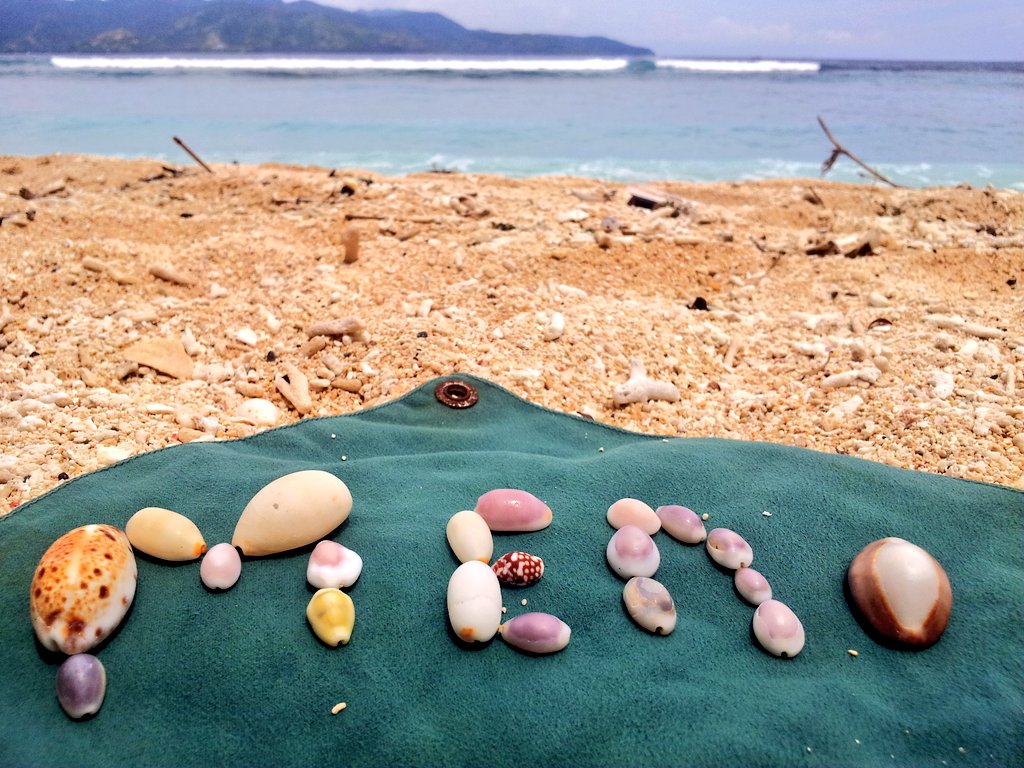
One of our Indonesian favourites, the Gili Meno beach actually runs around the whole island (which is only about 1 x 1.5 kilometres). At almost any point, you can swim out about 10 to 20 metres and hit the reef, so be sure to bring a snorkel and some fins and make the most of it. We swam with turtles, lion fish and schools of fluorescent beauties every single day. Wish we could have stayed longer!
8. Diani Beach (Mombasa, Kenya)
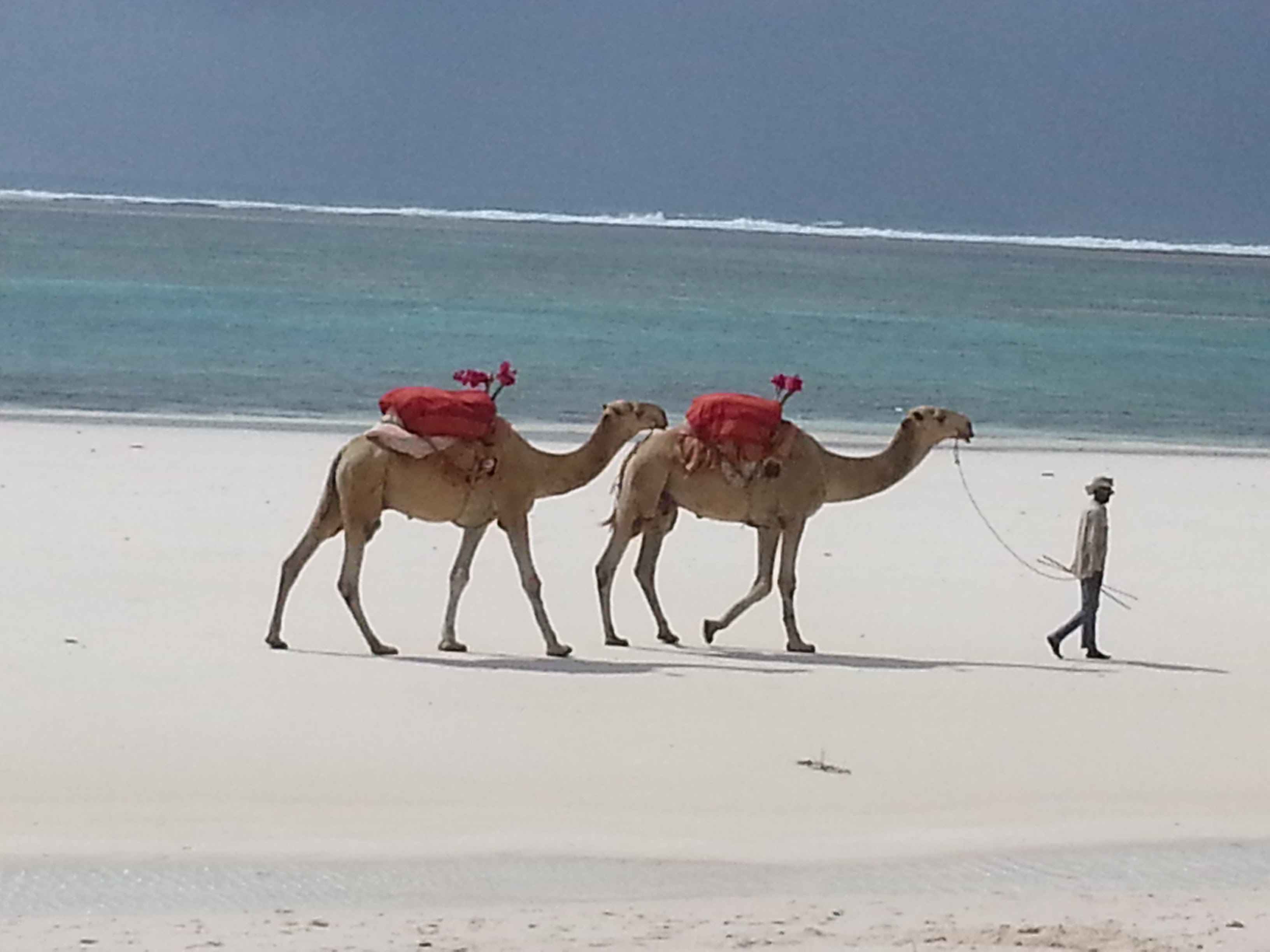
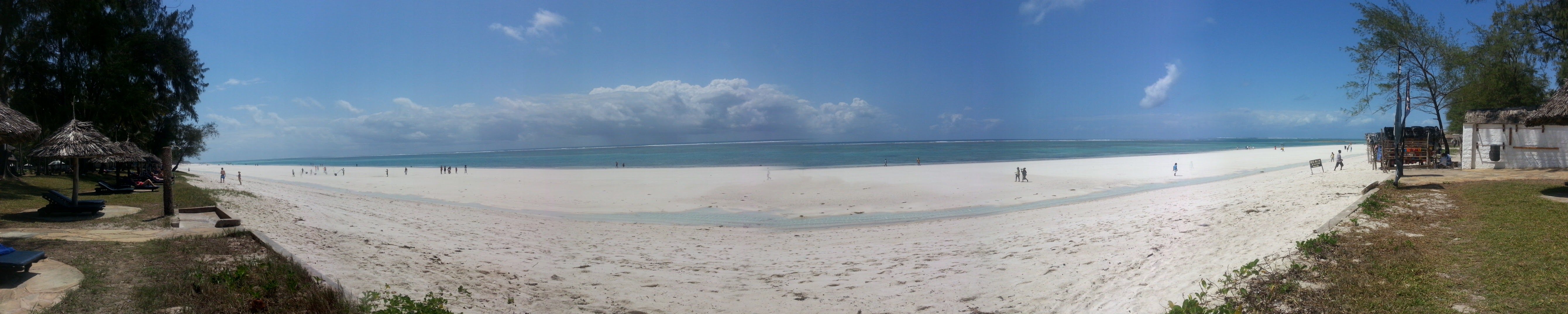
A ten kilometre stretch of fine white sand, gorgeous Diani Beach was definitely our favourite beach in Kenya, with neighbouring Tiwi Beach a close second.
7. Linapacan Islands (Linapacan, Palawan Province, The Philippines)
A whole archipelago of tiny islands somewhere between Coron and Palawan mainland, each island with wondrous beaches and its own reef right off the shore. How could we choose just one beach? Check out some of the names and descriptions from our fantastic four-day island hopping tour on the Brinze Kylene Expedition.
6. Barra Bay (Barra Peninsular, Mozambique)
A Northern beach of Mozambique, there is little about it we did not adore. Warm, flat ocean and stretches of Barra sand with smiling locals and coconuts for sale.
Photo credit: Barra Resorts
5. Anbang Beach (Hoi An, Vietnam)
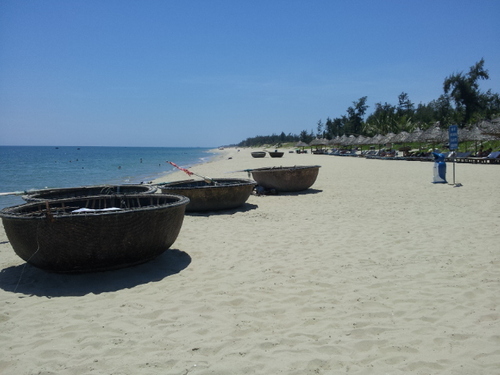
In Central Vietnam, Anbang is a distinctive beach, which is perfect for lazy swimming days and scrumptious lunches at the local chain of restaurants. We cycled over from Hoi An. Buy drinks from the restaurants and have access to lovely thatched umbrellas or wooden booths, especially helpful to escape the midday heat.
4. White Beach (Moalboal, Cebu, The Philippines)
On the western peninsular of Cebu, parallel to a long, beautiful reef, white beach is another gem in central Philippines. Truly, one of the most superb coral reefs in the Philippines, the Moalboal reef (stretching all the way off White Beach to Panagsama) is well worth taking your own snorkel to to swim out whenever you want.
Malapascua Island
3. Mawun Beach (Lombok, Indonesia)
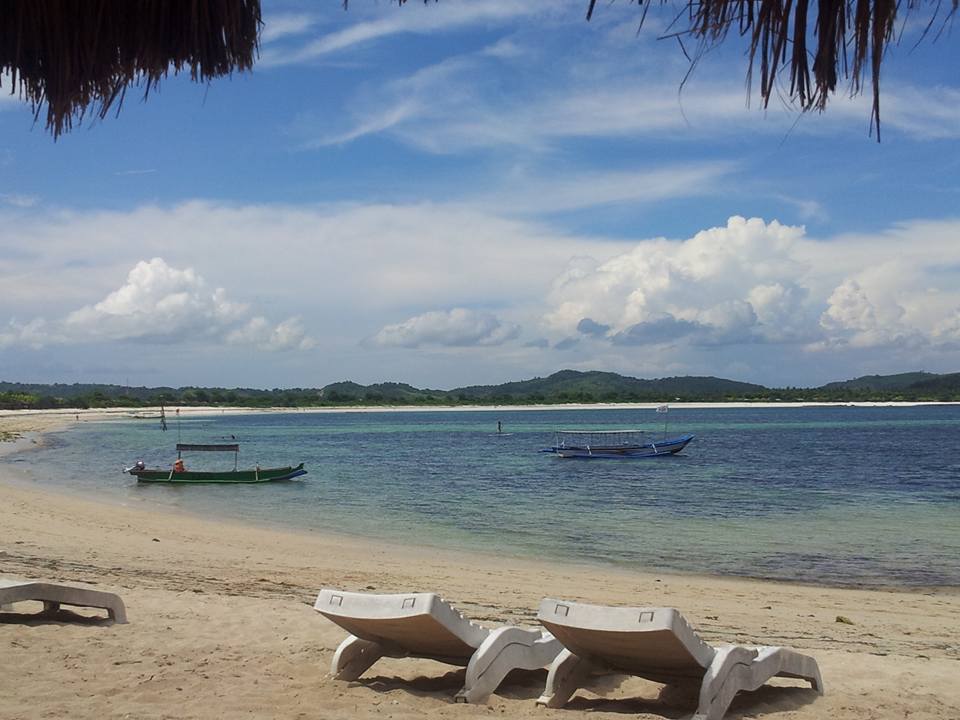
The long stretch of Mawun white sand that lines a peacock-blue bay, perfect for long morning swims. A fleet of tiny fishing boats floats upon sparkling, clear water sits to one side of the bay. Take a motorbike to get there from Kuta and be sure to take some cash to support the local vendors and family restaurants.
2. Sempang Mengayau – Tip of Borneo (Sabah, Malaysia Borneo)
Soft white sand borders the Sulu Sea of the Sabah Dog’s left ear. A secluded stretch of paradise all to ourselves is only one of the beautiful beaches in this area. It was 7 days of bliss.
1. Mabibi (Kwazulu-Natal, South Africa)
The place where Travelinds began their journey together on the Elephant Coast, part of the rugged Kwazulu-Natal coastline in South Africa. Look out for turtles laying their eggs along the dunes and whales passing by the north coast beaches. Walk for kilometres and breathe in pure African air. The Mabibi campsite is rustic, no electricity (except in the cabins) and hot water for showers in the communal ablution block. Nearby, Lake Sibaya is absolutely breathtaking. This is our number one favourite beach in the world – by far!
The waves pound on the soft shoreline, ten kilometres of turquoise ocean framed by black reef and fine white sand. When the tide is up everybody relaxes, but when the tide goes out, it’s party time! The wide beach opens right up allowing jogging, swimming, camel rides, kite-surfing, snorkelling, reef exploration, long walks and even a tiny microlight that zooms in and out using the beach as a runway – parachutes gently touching down on the sand were also a regular fixture of the low tide buzz that is Diani Beach.
Diani Beach Bound
Ukunda town is only about thirty kilometres south of Mombasa for a comfortable taxi ride (with Ukunda airport being a convenient touchdown point for those heading south to Diani Beach, Tiwi Beach or Wasini and Shimoni Island).
Living it up
The number of resorts and restaurants here were surprising, but it is not difficult to see why this is one of Kenya’s best beach tourism destinations – Diani Beach is absolutely stunning!
Since we were in Kenya having a bunch of ‘first’ experiences, like seeing the magical Masaai Mara and adopting baby elephants, it felt like a good time for our first time at an all-inclusive resort. Luxury living is almost impossible to come by on a perpetual traveller’s budget, but Kenya made it happen!
Having perused a few awesome resorts, we settled on a week at Diani Sea Lodge, about five minutes down the beach from the quirky Forty Thieves restaurant. The hotel is set among beautiful coastal forest, tall coconut palms and lush gardens. Whitewashed textured walls under the shady reach of enormous trees, where exquisite black Colobus monkeys shake their bushy white manes and call to each other like motorbikes starting up (as Daphne Sheldrick describes in An African Love Story).
Our days were spent on the beach, by the pool, reading books from the library, playing volleyball, darts and coconut shotput; and having an altogether relaxing holiday.
Curious Wildlife
One of the delightful things around Diani Sea Lodge are the birds and animals that call it home. Colobus, Sykes and Vervet monkeys roam the trees and gardens around, while camels and dogs enjoy their long walks along the beach. Hedgehogs and Bush Babies rule the night and you wake to the sound of twittering birds greeting the punctual equatorial sunrise.
The locals told us that the KiSwahili word for hedgehog is ‘Kidongo Maria’ because, like Mary the Mother of Jesus, they are thought to be humble and gentle.
Cultural Colour
Diani Beach is also home to amazingly diverse and talented people; musicians, artists, beach boys, shop keepers, sports enthusiasts and many others, too. The bargaining platform with persistent sellers seems wide open to interpretation and the banter is all part of the greater struggle against poverty. Tuk-tuks and bora-boras (motorbikes) crowd the market places in hopes of a good day.
Shawls and sarongs line the bamboo shelves and budding artists create against a backdrop of rhythmic dance and the lifesong of Kenya’s musical people.
One such character was Mr. Christopher Odinga, a local artist and sculptor who makes his living through sand sculptures, tourist-commissioned artworks and if he is lucky, the occasional job sculpting concrete animals for new buildings.
Stirring from a night of solid sleep to the sounds of a thousand different birds, I focused lazily on the rays of orange sunshine streaming through the tent and wondering on which alien planet I had landed. I remembered the crazy rush to book a last minute flight with an hour to get to the far-off King Shaka airport, paying our entrance fees online on the way to the airport, the flight from cold South Africa to rainy Ethiopia to sleeping Kenya in the dead of night, the two hours of sleep before the alarm jolted us from our beds and the mad rush to pack nine of us into two cars, heading out of Nairobi at a prompt 6.30 a.m. sunrise.
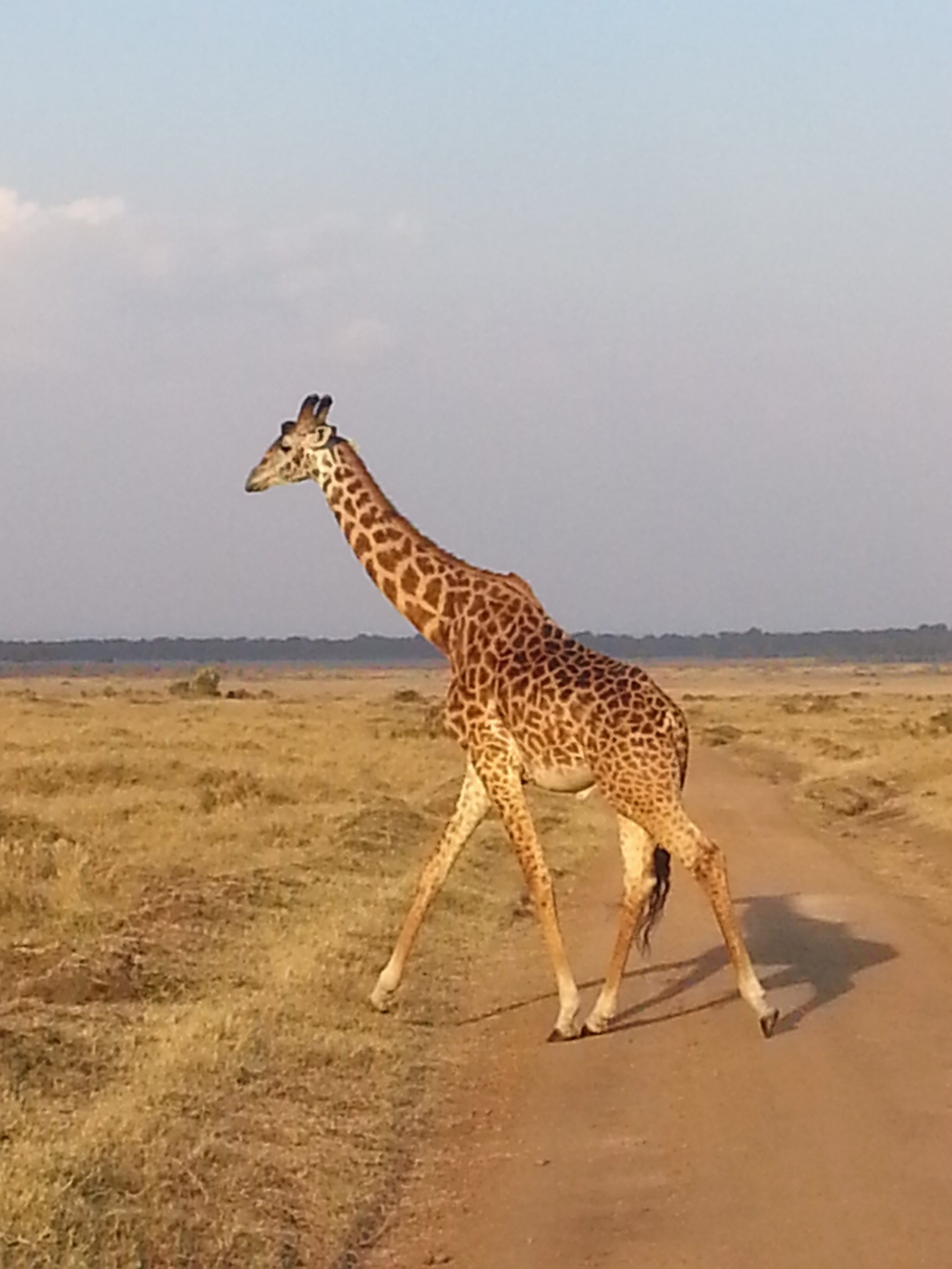
With delight I recalled that we had made it through the six-hour journey, the Great Rift Valley opening up below us with its geothermal steam vents and slow trucks between Uganda and Mombasa, the wheat fields and pockets of livestock mixed with random antelope as we climbed out of the valley of volcanic rocks and trundled on through the dusty bushveld – its acacia trees and euphorbias astoundingly huge and beautiful – and the shocking corrugations on the pothole-infested dirt roads that claimed our entire exhaust fixture on the way home (it survived its trip back to Nairobi tied to the roof racks, but normal conversation pitch during the journey was next to impossible and we roared on home lost in thought and memory of the captivating experience).
I was finally here, somewhere I had dreamed of since childhood, unbelievably happy in an unfenced campsite along the Mara River, in a little tent, in the world-famous Mara Triangle, part of the Masaai Mara National Reserve – and hundreds of thousands of animals were here with us, too.
The Great Migration
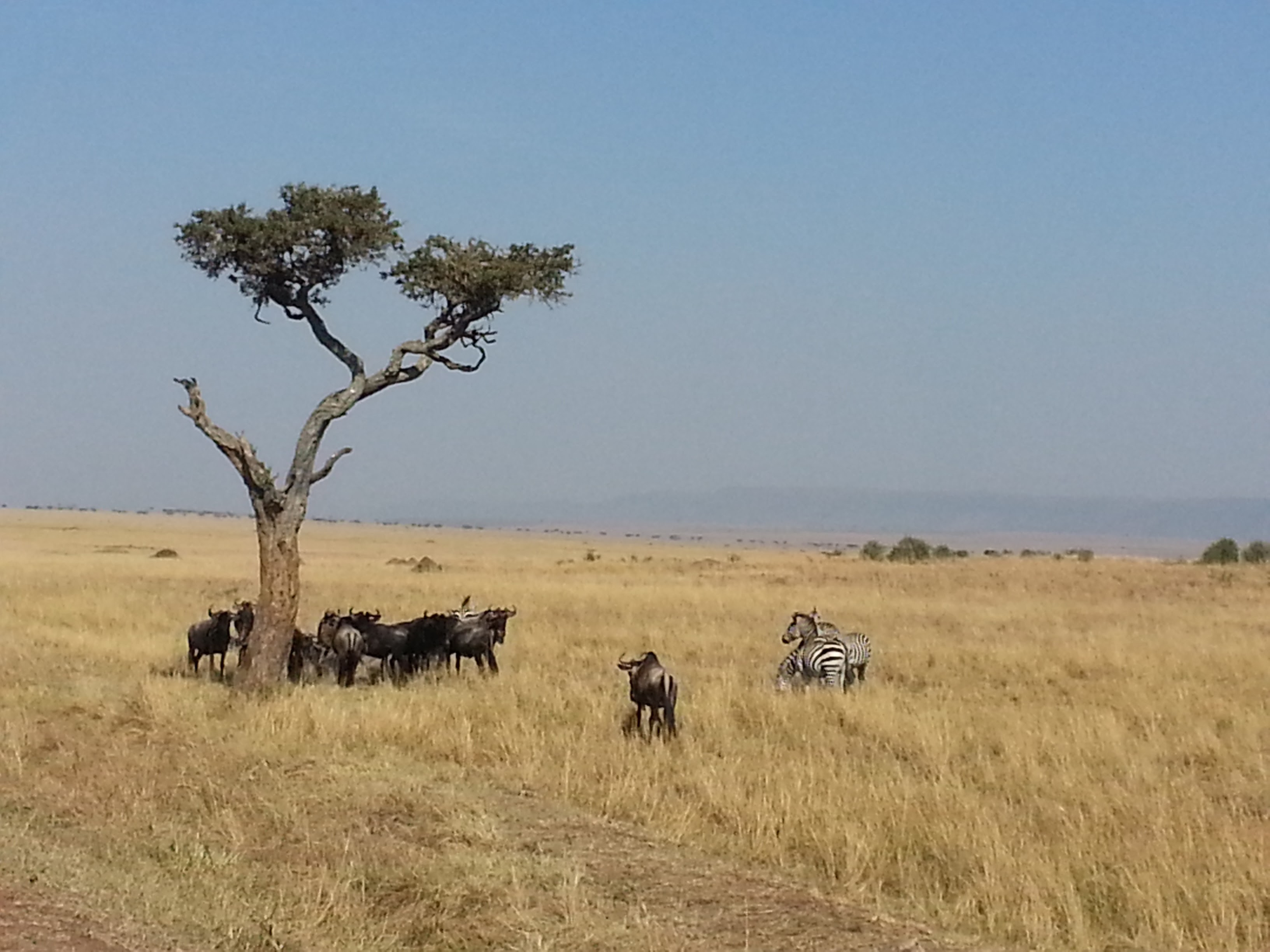
The herds arrived in the Mara Triangle the day before we did and it really is something you need to see with your own eyes to believe it. Beautiful and fascinating!
“Follow-the-leader” took on a new meaning as we watched the blue wildebeest lines stretching all along the base of the majestic Oloololo Escarpment, winding their way towards the Mara River to see if the oat grass really is greener (redder?) on the other side. Apparently following the rain, the wildebeest spend their whole lives moving, an epic circular journey that starts down in the Serengeti of Tanzania and ends on the vast plains of the Masaai Mara in Kenya, where it starts all over again.
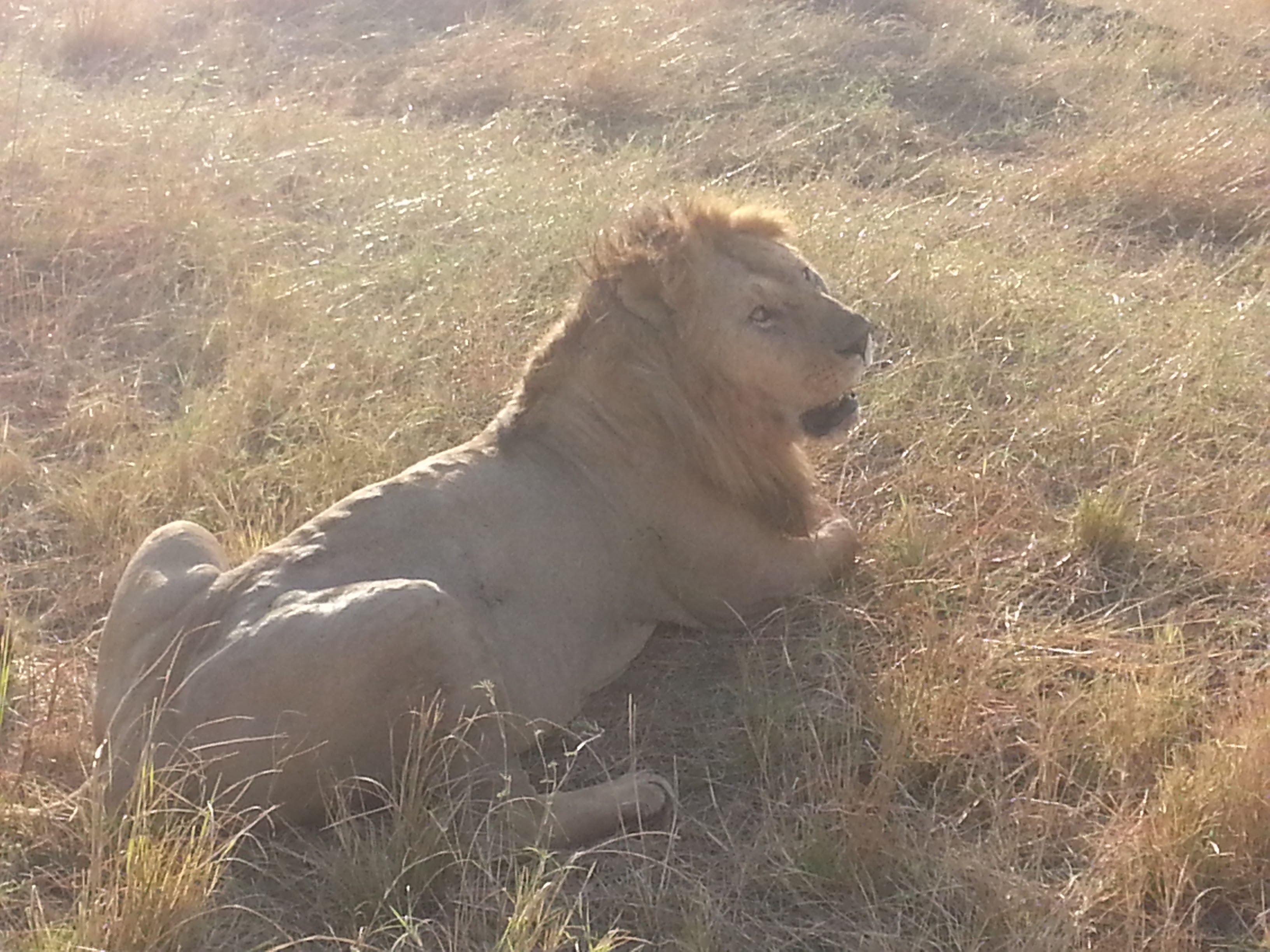
The wildebeest are joined by zebra and tommies (Thompson’s Gazelle) and solemnly face the predators at every step of the journey – an inevitable game of roulette as each night brings certain death, and each dawn a sense of victory at having beaten the odds. Carcasses litter the savanna with evidence of the nocturnal carnage and the rotund lions we saw were too stuffed to bother with anything, eating only the choicest rumps and leaving the rest of it for the scavenger feast. Even the scavengers turn up their noses at the drowned carcasses that fill the rapids of the Mara River after the senseless ‘crossings’, already filled to capacity from the pickings of abundant meat left from the kills.
The animals converge on the river to drink, egging each other on to be the first to brave the threat of crunching jaws of the enormous Nile crocodiles. Twice we watched as a wildebeest fell in, swam wildly to the nearest bank and was assisted by the curious hippos with a nudge towards the relative safety of dry land.
Wild and Free
The zebras with their exquisite black and white (a much cleaner contrast than the brown-smudged South African zebras) gather together to graze, some rolling in the dust, some playing catch; and even a naughty zebra male that suffered a thumping hoof kick (a ‘snotklap’ for you South African readers) from an irate female who had had enough (followed by whoops and giggles from the inhabitants of our vehicle as we cheered her on).
We camped at the private campsite, Dirisha, alongside the Mara River. Leopard, hippo, buffalo and elephant came into our campsite each night (the tent walls seemed thinner then) and the birdlife was amazing, too (including a rare Bar-tailed Trogan right outside our tent). It was a proper bush experience with no ‘facilities’ to speak of, emphasising the fact that we were in the real African bush, humbled by our defenselessness and respectful of the ruthless ferocity in the daily life of wild creatures.
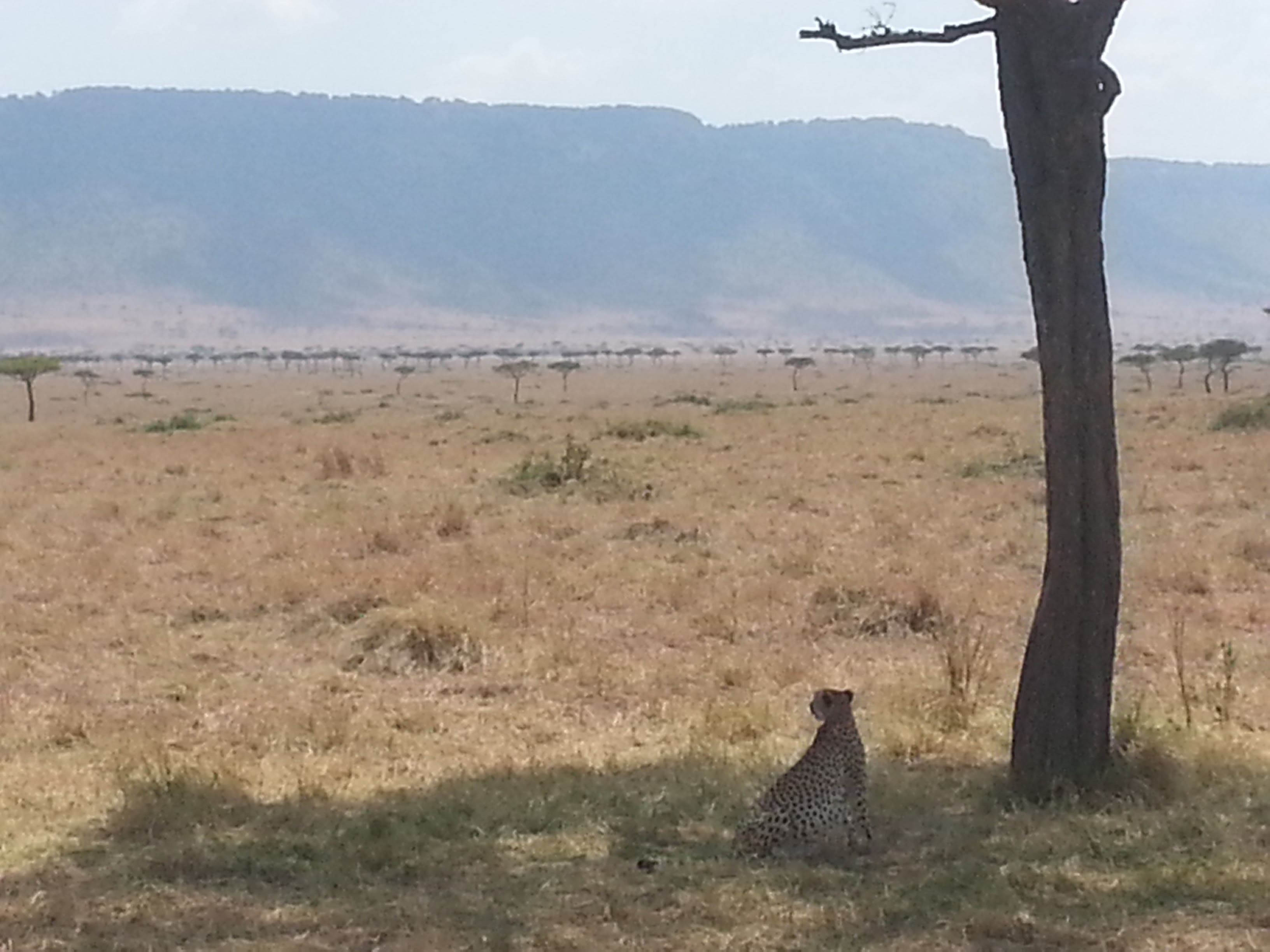
The week’s sightings also included herds as far as the eye could see (estimated between 750,000 and a million wildebeest alone), fat cats and scavengers feasting on carcasses lying everywhere, river crossings galore and even three black rhino fending off a pack of brazen hyenas. One hyena also tried to catch a comical Ground Hornbill, who casually walked away knowing its fearsome beak was enough to deter its attacker.
Little Governor’s
Most evenings we headed to Little Governor’s for sun-downers and water refills (campers cannot afford to be shy about essential needs like drinking water, even if the lodge was as posh as could be). Looking out over a small water catchment, the luxury tents are set in the cool of the forest and can see all the surrounding beauty from their beds. More than once, we were delayed in returning to our campsite by the 7 p.m. curfew because of the elephants that roam about the lodge within hand reach of the restaurant patrons, who are swiftly ushered away to the other side by the staff and have to wait patiently until the giants have moved off.
Once in a lifetime
At the tip of the Mara Triangle map, Little Governor’s is one of many lodges that does hot air balloon rides across the Mara – a spectacular sight as the multicoloured behemoths transport mesmerised passengers silently across the plains, often just a few metres above the herds on the ground below. A future bucket list item for sure!
Honestly, this was one of the best weeks of our lives. To be able to have seen this phenomenon firsthand was an awesome privilege and an unforgettable experience – even for Travelinds who have grown up in the beautiful wild places of South Africa, travelled in tiny boats through the jungles of Borneo and swam with ocean giants.
Travelinds has experienced a range of different beach trips and the following are items that we really cannot go without aside from swimsuits and suncream (*cue drum roll…*):
1. Sarong
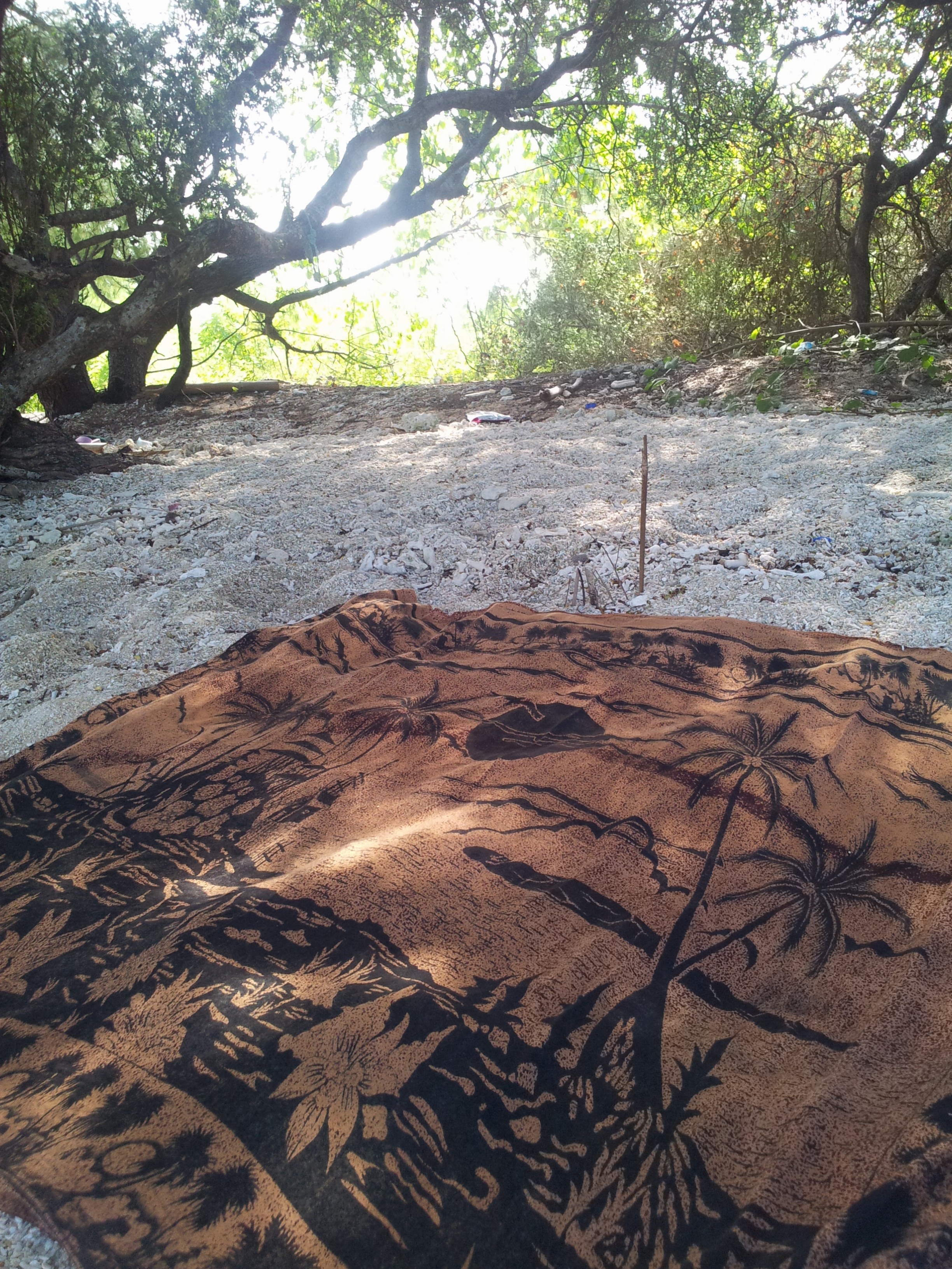
It’s versatile, light-weight and easy to pack into a small space. Sarongs are good as a towel, a sun cover, a beach blanket, clothing and a cover against mosquitoes in the evenings.
2 Hat
Hats are an obvious item, but also one that saves a face from a world of pain and long-term sun damage. Hats can generally be easily replaced if forgotten or lost, except on isolated tropical islands like we visited in the Philippines. Hats protect your face against the sun and rain (and cover a bad hair day, too!).
3. Sunglasses
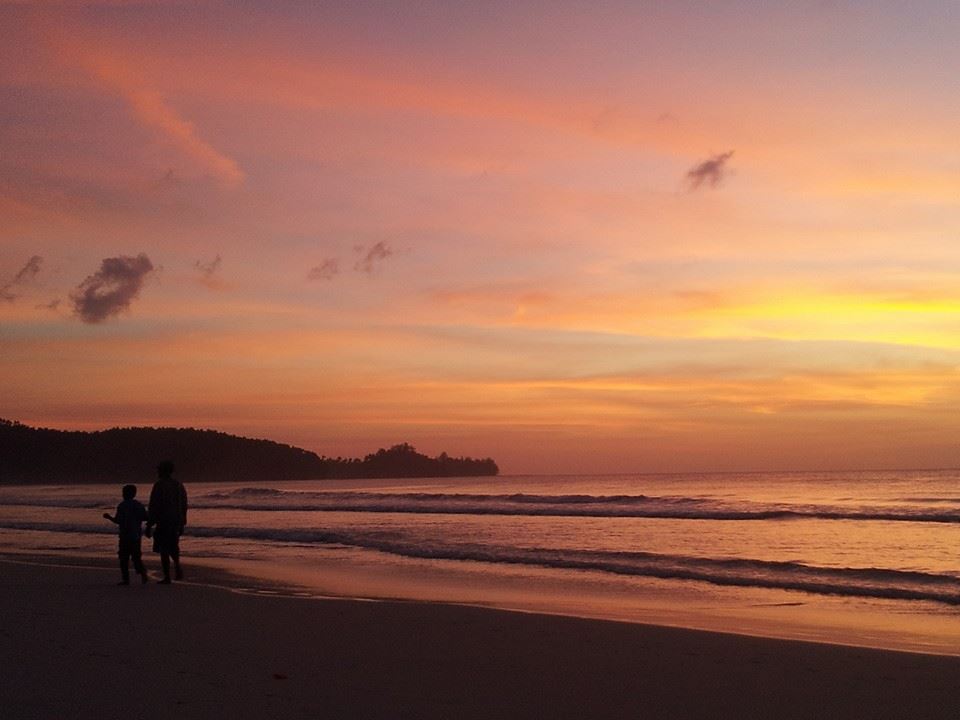
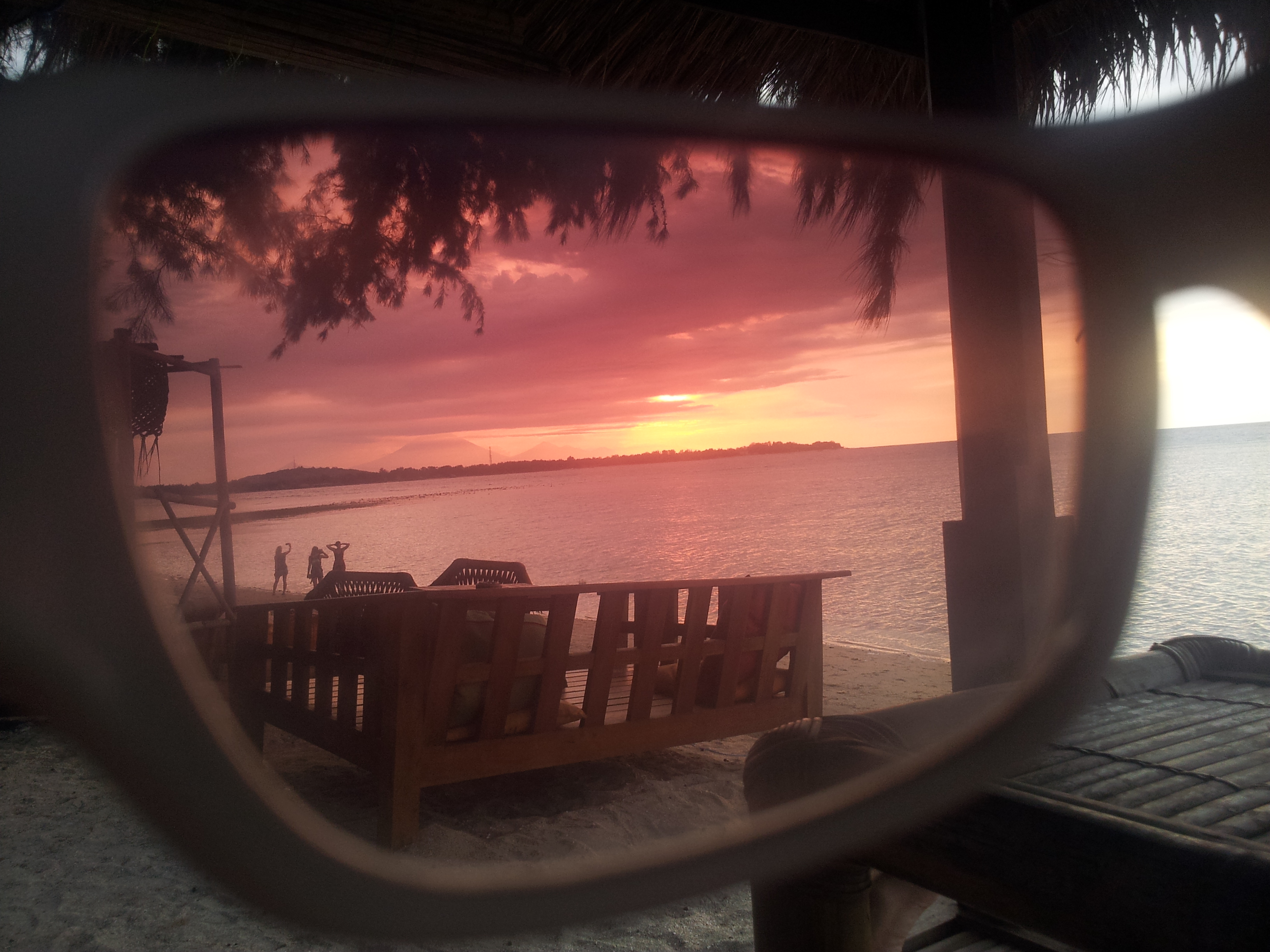
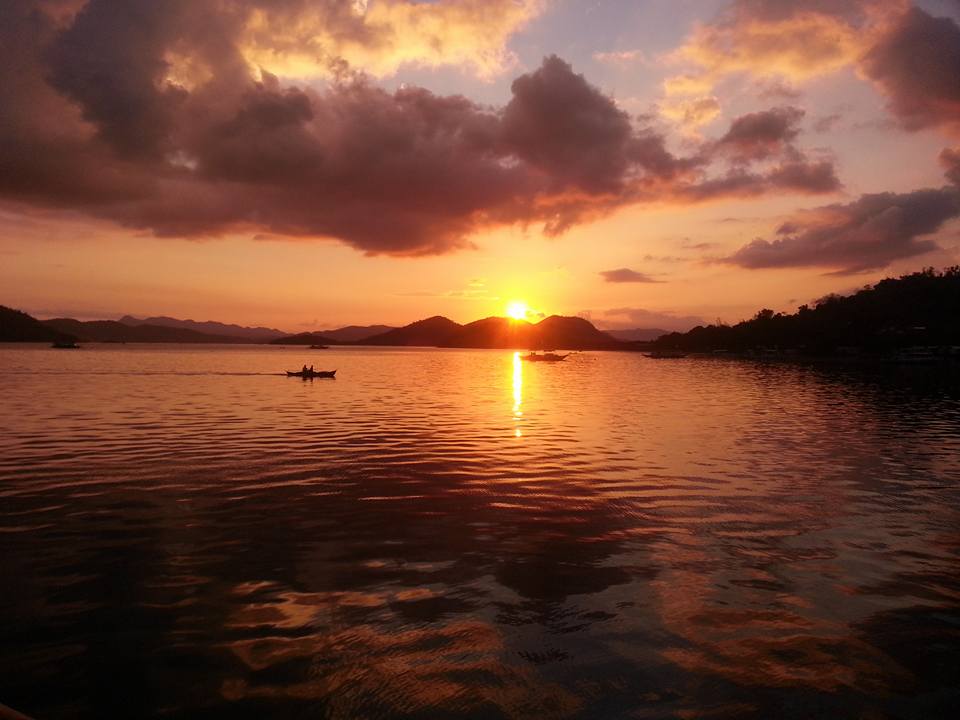
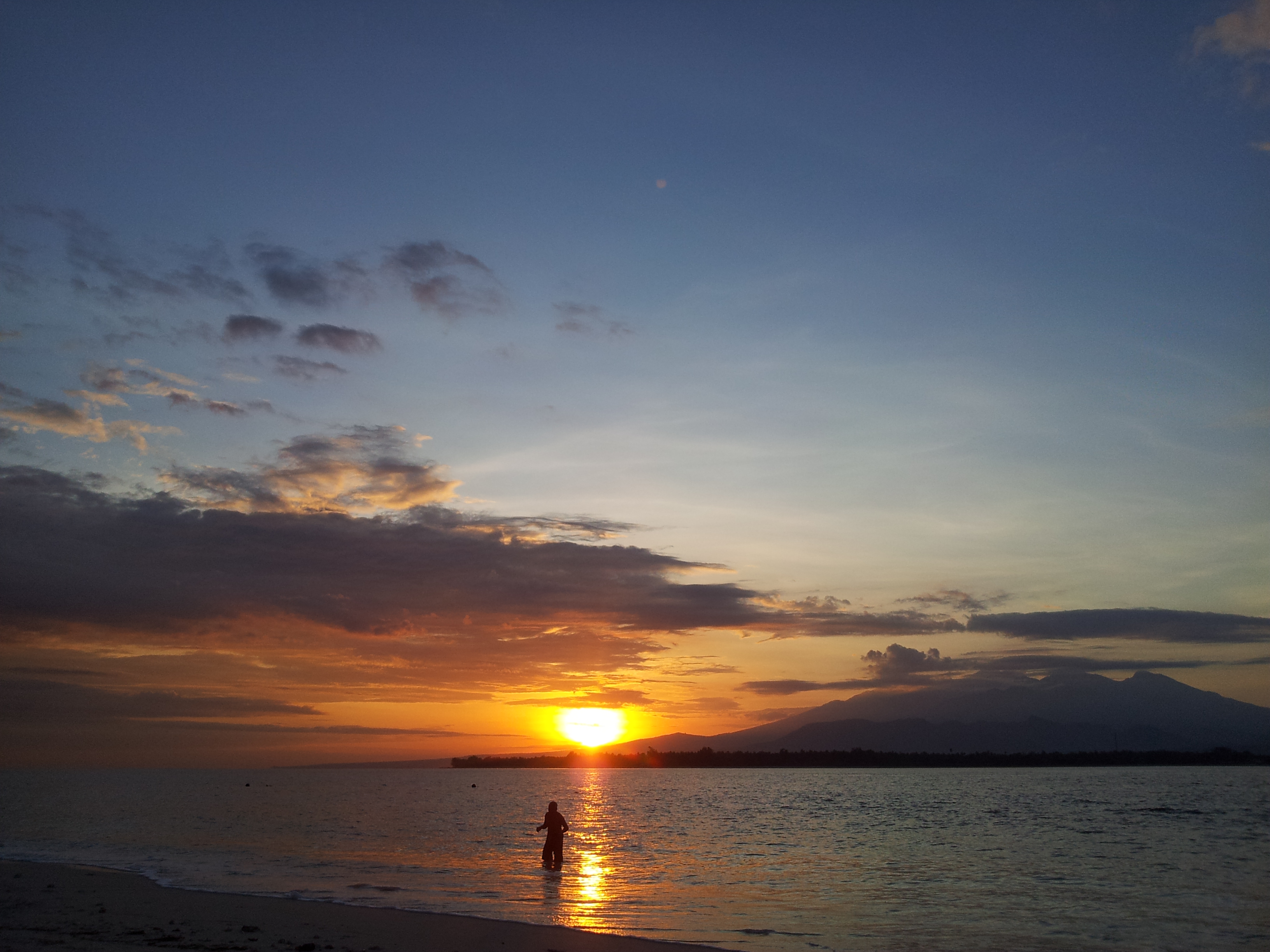
Light-coloured eyes will thank you for some extra protection from the harsh glare of the sun. They are also quite stylish, if you’re into that sort of thing, and, without sunglasses, you wouldn’t be able to take an amazing sunset photo like this one in Gili Air…
4. Rash vest
This is one of the best investments we’ve made for any water activities – good sun protection, as well as an extra guard against stinging water creatures and plants.
5. Hammock
You can sit down, lie down, swing, sleep, read and daydream. It keeps your feet clean, your books out of the sand and a breeze through your hair. You can string it up in the shade, anywhere, anytime. Also, your swimsuit can dry on both sides. What’s not to love?
6. Snorkel and Mask
Having our own snorkel and mask with us has been a great idea. It allows a lot more freedom to explore the underwater surroundings at each beach without having to rent it (or miss out completely). It is also helpful to have some goggles (like the kind you’d use in a pool) as a backup for long swims.
7. Dry Bag
Whether for a boat tour, a water transfer, a ski trip or a dive, the dry bag is usually a good idea to avoid general spray and the odd freak wave soak. Cameras, cellphones, wallets and books will thank you later.
8. Refill water
The amount of plastic in our precious oceans is shocking and disgusting, and we can make a difference every single day. Take your muggy along rather than buying plastic bottles along the way. Being environmentally responsible tourists is a daily choice and one of these decisions is to use water refill stations (or decant from large recyclable refills for the duration of your trip) rather than buying more plastic waste. Incidentally, it will also save you money. For example, on Gili Meno (Indonesia), the price of a 1.5-litre plastic water bottle was 5,000 IRP and the price of a 19-litre (5 gallon) refill water tank was 22,000 IRP (excluding a deposit). That’s a 65% saving on the price per litre if you ditch the 1.5-litre bottles and choose the 19-litre refill instead (about 4 days worth for the two of us).
9. E-reader
This little device has truly changed the way that I read both at home and abroad. Travelling with it is easy and this means I read more wherever I am, at any time of the day or night. Books are still amazing, but an e-reader allows me to carry around my whole library, use it at night in places without electricity and read more than one book at a time without taking up more precious space in my small backpack. The world needs to read more – do your part!
10. Camera
Obviously, a camera is an essential item to capture the beauty of all your travel destinations, like this sunset at the Tip of Borneo. You can share it with others, and refresh your memories as the years go by. Together with a dry bag or sand-friendly cover, keep some extra batteries and a universal adapter so you can recharge it easily.
Armed with Travelinds Top 10: Beach Travel Items you are ready for any beach in the world – and there are some breathtaking beaches out there, no matter where on God’s beautiful green earth you go! Check you on the flip side.
What are you favourite beach travel items? Travelinds would love if you left us a comment below!
If you liked this post, check out Travelinds’ post
Arrival in Coron Busuanga, Palawan awakened a ripple of excitement through the eighty or so passengers on the small twin-propellor plane, as we shuddered over aquamarine bays with beach-lined islands towards the only flat land on Coron Busuanga; the airstrip that opens a gateway to the Caliamanes islands.
Upon arrival the smiling young airhostess kindly requested that we walk around the plane’s wings, collect our baggage and enjoy our stay in Coron. She looked quite relieved to have finished her duties because we had left an hour late due to delays from the Manila air traffic control tower and she had done a lucky draw of some CebGo souvenirs to keep the mood light and the passengers entertained.
What to expect
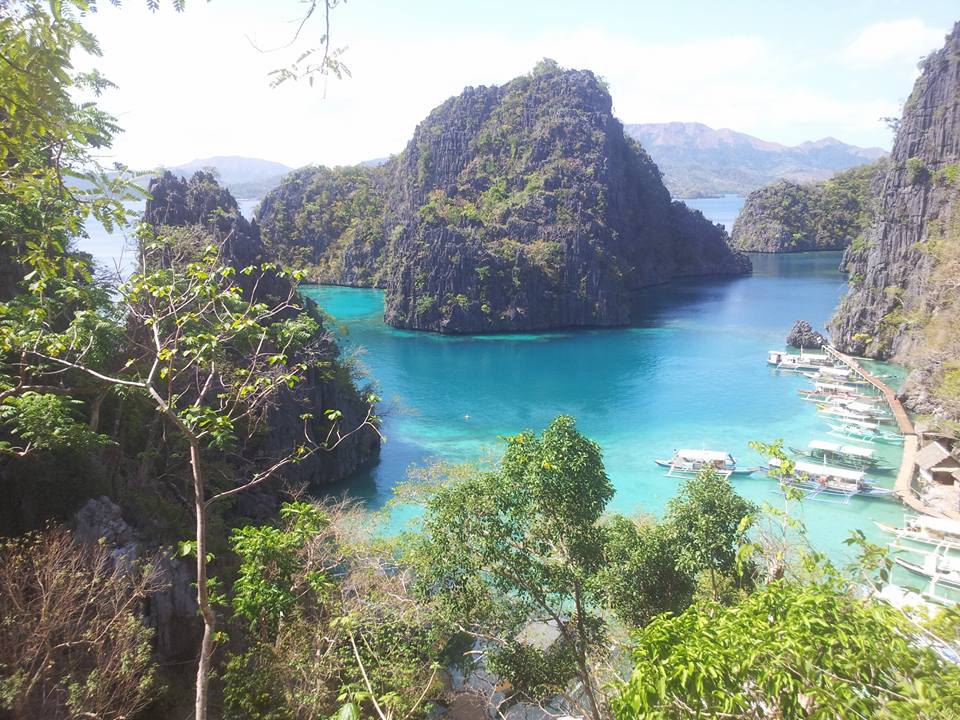
The first impression of Coron Busuanga was of a desert island; brown, bare mountains all around with dusty roads and a couple of herds of livestock scattered around the shade of the few unburnt trees (even a few Brahmans, Dad!). Where are the islands and the lush green coastal vegetation? Well, it turns out that we picked the hottest time of the year to visit this tropical paradise. Everything is brown, there is enough breeze to keep you from keeling over, but an airconditioned room is a precious commodity and a highly appreciated respite from sweaty streets.
That’s one of the Travelinds pair in the bay below Kayangan Lake viewpoint!
It’s also the most beautiful time of the year for sea conditions (snorkelling in the calm blue ocean!) although in some areas we met with some scary and abundant jellyfish (but were able to swim around the few big box jellyfish easily). As far as island hopping goes, the weather is absolutely perfect under a shaded boat – the breeze keeps you cool along with frequent swims and snorkelling throughout the day. Like a technicolour kaleidoscope that draws the eyes from one amazing sight to the next, the sunlight filters down through the pristine waters and illuminates the beautiful reefs and all therein.
Highlights of Coron Busuanga (the town)
Favourite taxi driver: Erwin was phenomenal. We called him all the time, he found us accommodation on the last night, a boat, contacts and cellphone assistance. Call him on
Favourite snacks: Julie’s bakeshop (around the corner from Xpeditions office) serves fresh bread of all varieties daily. It is possible to buy whole bags of deliciousness for under 100 pesos.
The Coron Public Market where we bought most of our fresh produce.
Xpeditions in Coron
Having done some research online and looking at flyers in town, we decided to go on a tour with Caliamanes Expeditions Ecotours. It seemed like an organised, eco-friendly company that was as careful to preserve the environment as to show off Coron’s best assets. We did Tour E and Tour B and were very happy with both of these tours – despite the slightly commercial nature of the tours (where you quite a few other tourist boats and most do the same routes from day to day).
Xpedition Tour B group for Coron Island
Tuktuk Adventures
Erwin and Ricardo were two extremely helpful tuk-tuk operators during our time here but represented the two extremes of Coron’s (and Philippines) service levels. Erwin picked us up and tried to charge us more than double the amount that our hotel mentioned, then dropped us at a ‘delicious local food’ restaurant (after our request for cheap local food), which had prices three times the amount of the real local hangouts. Needless to say, we ditched him the next day.
Ricardo, on the other hand, was a polite, soft-spoken driver who gave us free commentary, great advice, honest information, and standard prices. He showed us real local restaurants, helped us sort out our Globe/Smart SIM card problems, found us another place to stay when we needed to rebook and also came early in the morning to help us look for a cargo boat to Linapacan.
Coron to El Nido
After four days in Coron, we decided to head towards a new (unplanned) destination on our way to El Nido. Having read up about Linapacan (with its 54 islands), we tried for two days to find out how to get there and what to expect. Tao travel agency in Coron (near the bus terminal) was helpful and found out about the shuttle boats (for mostly tourists) for us at 900 pesos per person, leaving at 7.30am on Wednesday. This was for only one company though, which had limited day schedules (but we didn’t know this until later).
Other blogs had mentioned finding a cargo boat (doing deliveries) to catch a lift for a much cheaper fare (anything from 300 pesos up). We tried to find one on the one day, couldn’t and went to speak to the main pier personnel for more information. They informed us that there were boats most days to El Nido (different tour companies) for 800 pesos (purchase the ticket at the terminal at 7 am on the day).
These trips are not guaranteed, as the weather and other factors can cause delays or even cancellations. As always, one needs a flexible schedule and a positive attitude about setbacks when travelling in the Philippines.
All in all, we managed to catch a boat, explore the islands, meet fabulous islanders, attend a local wedding, snorkel on deserted coral reefs and make a lifetime’s worth of cherished memories. Check out the details in Exploring the Islands of Linapacan.
Palawan Mainland
From Linapacan, we took an island-hopping tour boat to Sibaltan to spend our last five days exploring Palawan island. Arriving on the mainland after four days on an island-hopping boat was like travelling to a different planet.
Sibaltan
At Sibaltan there were buildings, shops, basketball courts, hotels and lots of smiling locals. Since we only had five days left in the Philippines, we made our way from here to El Nido and then to Sabang before catching a flight home from Puerto Princesa.
Spending only one night in Sibaltan, we stayed at the new Bayog Beach Campsite in a tent. The museum also had a cheap room open and there were two other lodges along the palm-lined beach, too. Bayog’s friendly owners organised a van for us to El Nido for early the following morning.
On a bamboo platform, the tent had a comfortable double mattress, a place for luggage, a bug sheet, and good ventilation. We looked right out on to the beach a few steps away. The bathroom (shared) was clean and well maintained. The staff was friendly, polite and professional. The tents are placed for privacy from others and a view – with two hammocks, a table, and chairs.
El Nido
El Nido was a totally different place from any we had visited before. It has the beauty of the islands, with the tourism of Boracay and the rugged landscape of Borneo – and a touch of fairyland. An interesting place to keep you occupied, or rested, depending on you. The limestone islands made us think of Krabi, but, it has far more beautiful water colours on the dazzling bays.
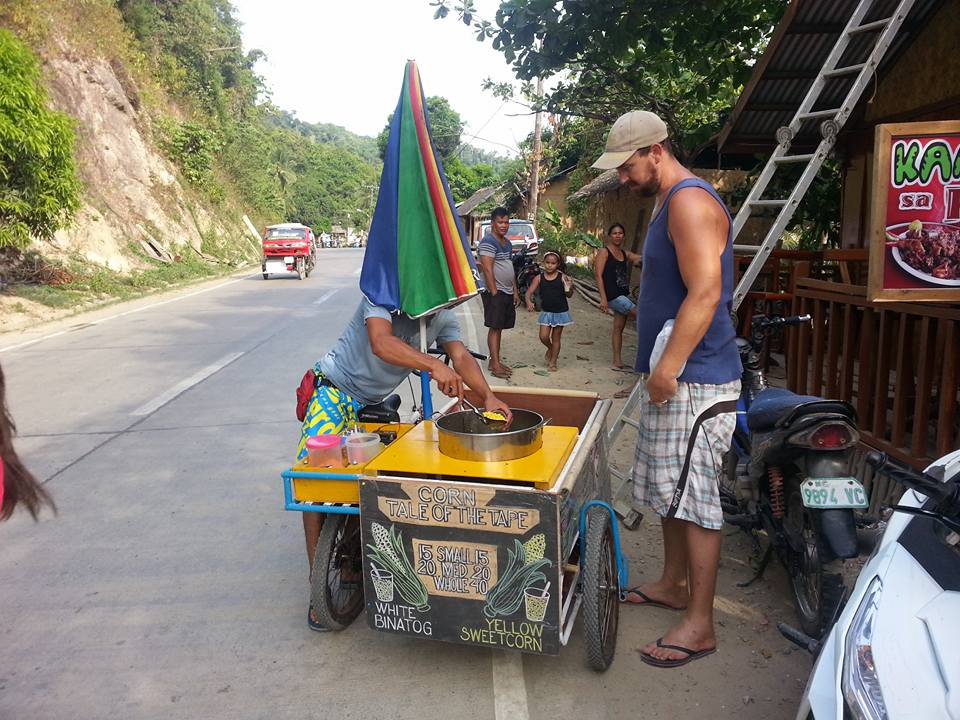
We arrived, found a hotel (Tres Verde), explored the town, met a flamboyant Italian with a zest for life called Fabio, joined up with Fabio for a tour (with a local fisherman that we found on Corong-Corong beach), bought corn from a corn guy, bought pork from a pork barbecue on the side of the road (just pieces of pork), walked the town ragged looking for an ATM (and didn’t find ANY WORKING ones), marvelled at the sunsets and then unfortunately, had to leave to see Sabang on the way to catch our plane home!
Sabang
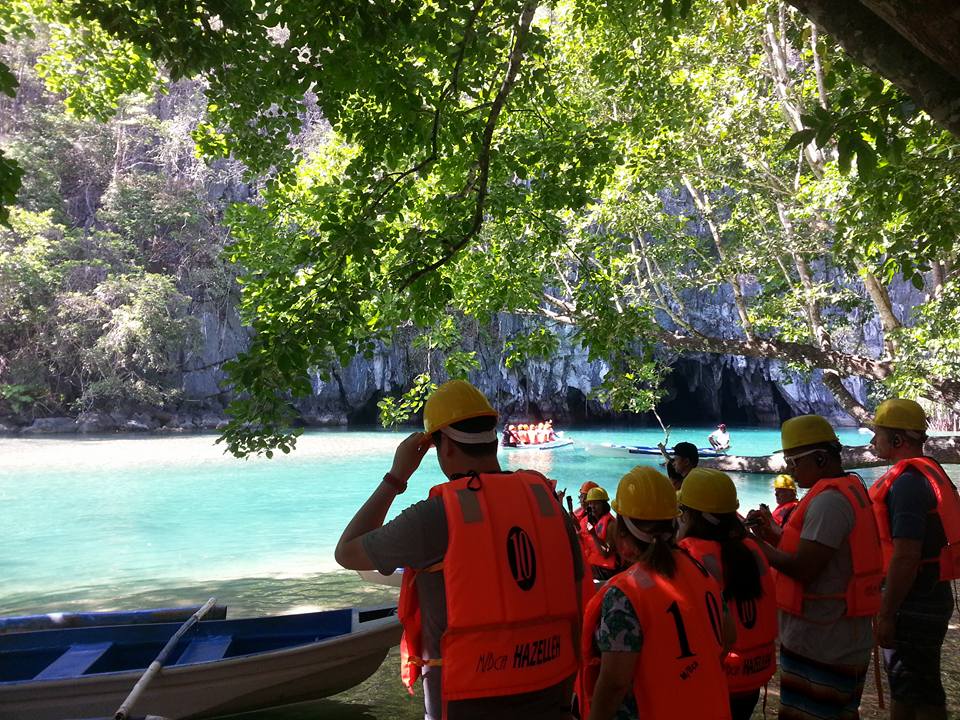
The last stop on the impromptu itinerary was Sabang – most famous for its location alongside the Palawan Underground River – a subterranean river featured on the New Seven Wonders of Nature list. We had already seen Halong Bay (Vietnam), Jeju Island (South Korea) and Table Mountain (South Africa); so it was high up on our list of must-sees while in Palawan.
Sabang is a tiny village whose economy basically revolves around the tourists going in and out of the underground river each day. There is one fancy hotel, a couple of lodges and a few backpackers, small stores, one or two restaurants and a long, sandy beach lined with palm trees and hammocks. As a destination, we would have stayed here even without the subterranean attractions.
Manila Airport
As an aside, this is the first time we’d used Manila airport (April 2016) in eighteen months and we were nervous about our short changeover time between Terminal 3 and 4. Previously it took us a good two hours as we had to exit Terminal 3, catch a taxi (or wait for the 20 pesos unairconditioned shuttle van to fill up) across Manila’s rightly infamous traffic and then rush in to Terminal 4 to do the next three security checks (and that was only if we had our boarding passes already printed). This time was a completely different experience.
We walked through immigration in about three minutes, found the signs (still inside the terminal) for the inter-terminal transfer, picked up a free Globe sim card and drew money at one of the handful of ATMs on the way, signed up at the desk (where she also printed our boarding pass), went through one security gate and waited about fifteen minutes for the shuttle bus. The shuttle bus then took us over the runways to Terminal 4 in about ten minutes and we simply walked in to the domestic terminal. What a breeze!
An amazing end to life on some Philippine islands, our Brinze Kylene expedition took us from San Miguel, Linapacan and ended at Sibaltan on the Palawan mainland. Read about how we came to meet them here.
The Hosts
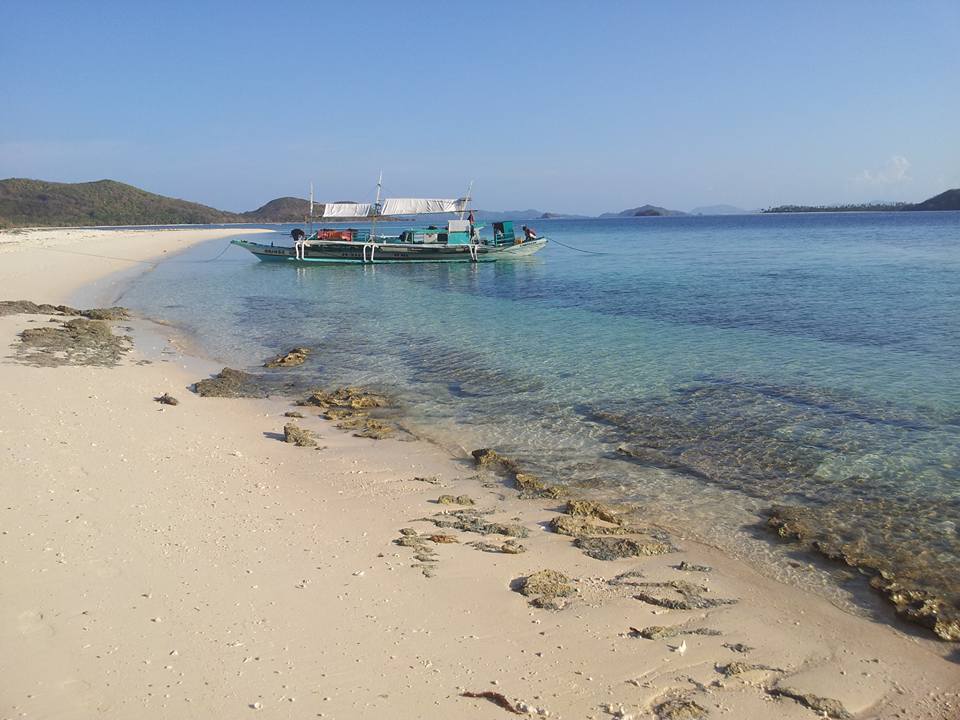
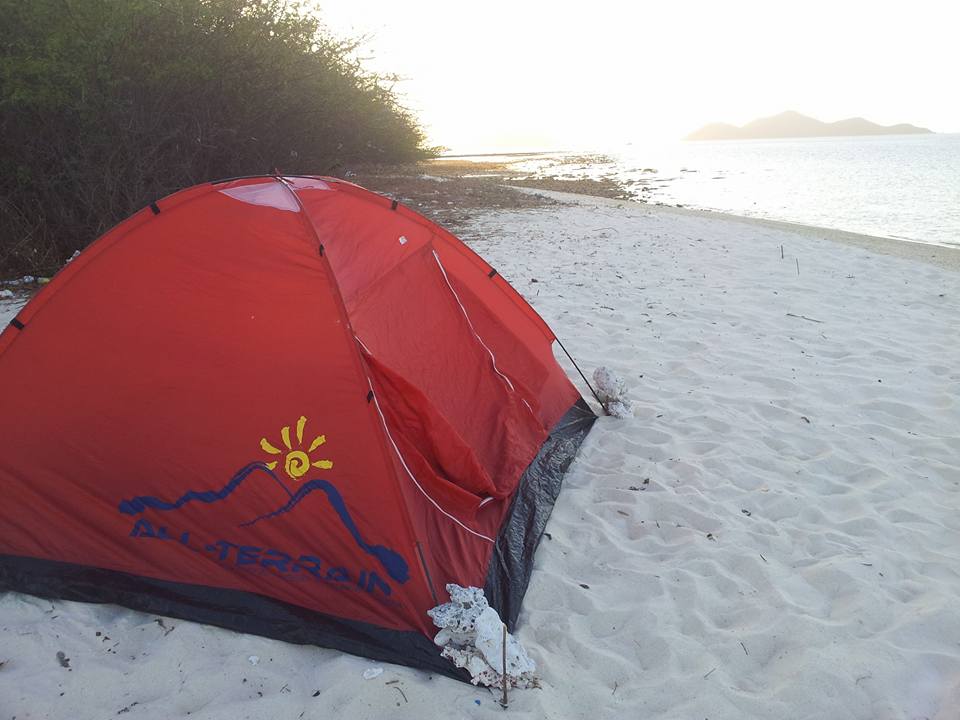
Our hosts Benji and Maileen were entertaining and hospitable, looking after us throughout our stay in Linapacan, as well as on the island hopping tour. Their service was phenomenal and so much fun. Their crew, Midel and Guerrero, seemed to have limitless energy and kept the boat running smoothly through the whole trip. They cooked for us, put up and took down our tent, found us the most exquisite coral reefs along the way and entertained us each night around an impressively large bonfire.
The Boat
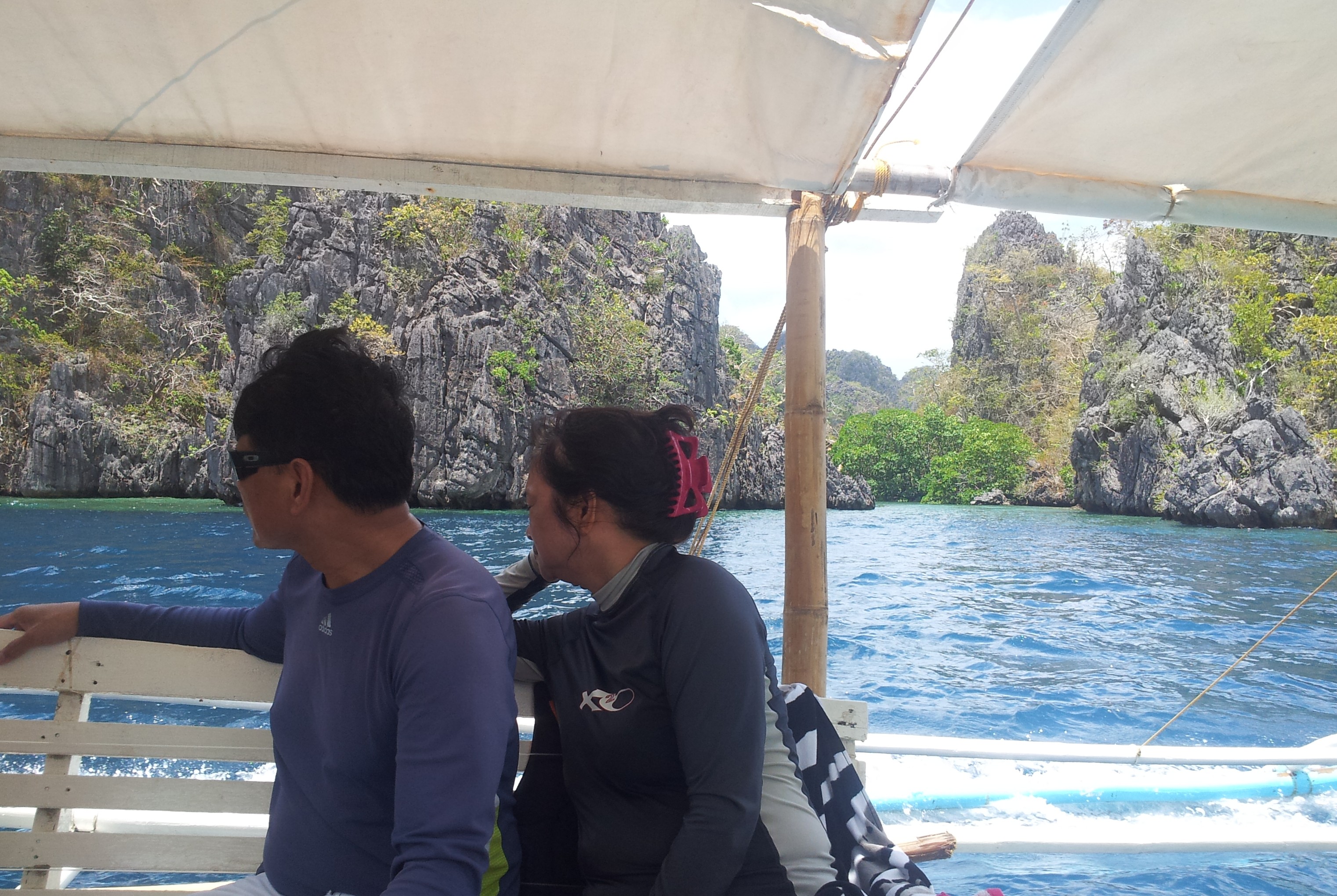
Since we spent most of our time on the boat, it serves that it was rather comfortable and well-equipped for such a simple carrier. Described as a catamaran-style with balancing beams on each side, it had benches, a small cabin, a tarpaulin covering, a ladder to get out of the ocean and a small boxed-in toilet and wash area. Downright luxurious in terms of the local fishing boats!
The Food
Every day in the Philippines is another chance for fish and rice. Different fish, mind you, but fish all the same and rice to fill in the gaps. We loved the fresh seafood and feasted on lapulapu, barracuda, squid, white fish and tuna – all barbecued over a fire and served with a decent portion of sticky white rice. Every now and again we ate the precious commodities called vegetables (cabbage, carrots, tomatoes, peppers and cucumbers) and this was a real treat for the locals and for us as availability is scarce.
The three kilogram barracuda we bought from another fisherman.Lapu Lapu fresh from the ocean.A peacock mantis shrimp that we caught and ate!
And Most Importantly, The Islands
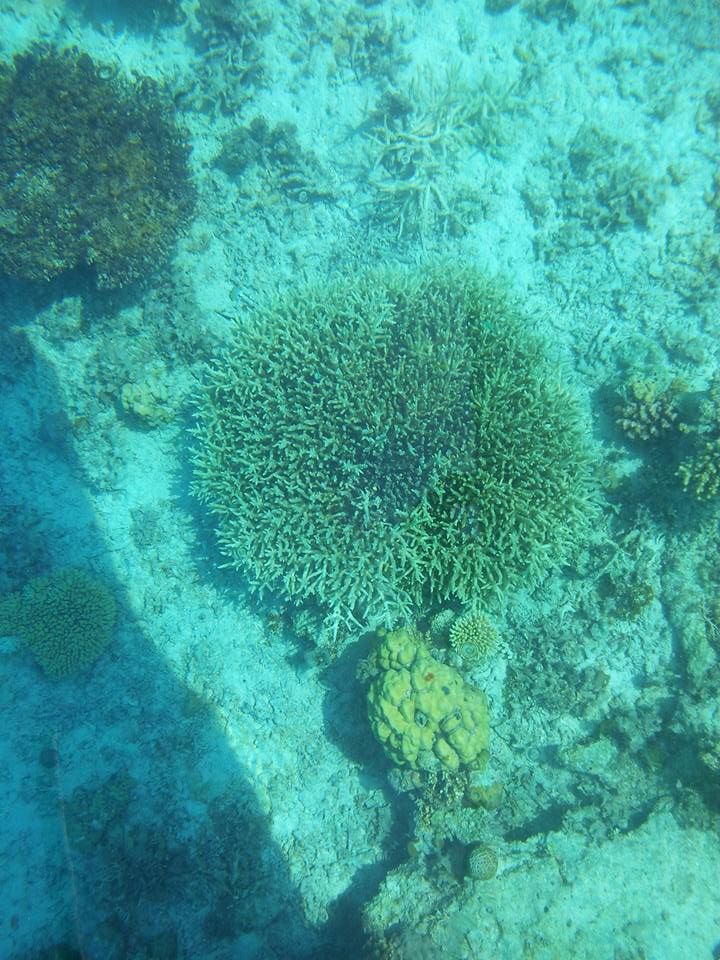
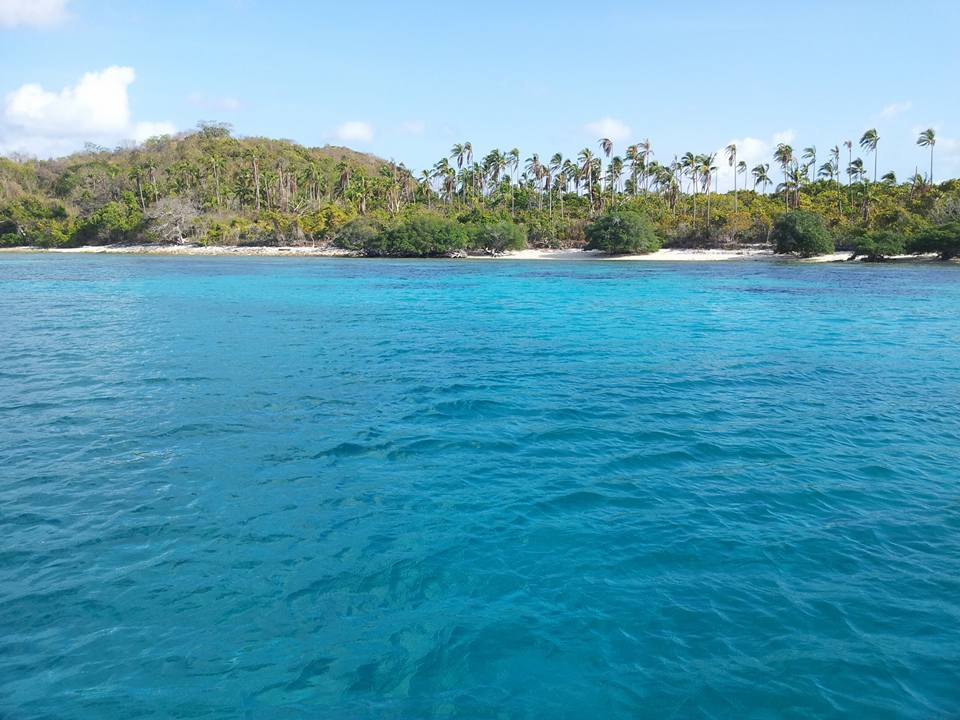
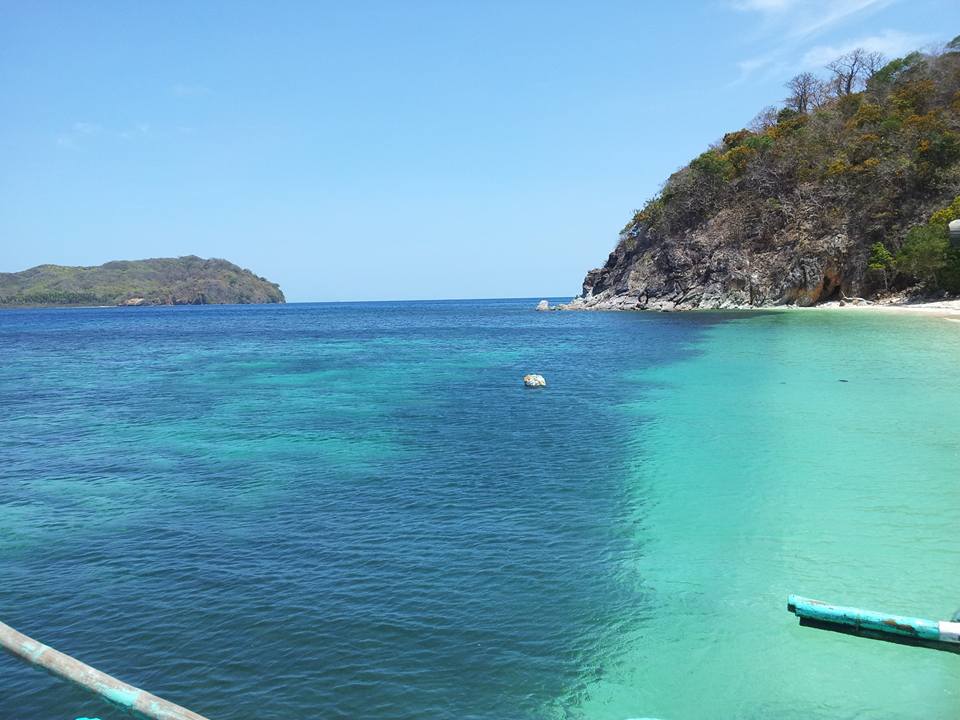
The archipelego of 54 islands is hard to describe because each one is slightly different to the next, sparkly, beautiful, rugged and unspoiled by industrialisation or development. We lost count of exactly how many islands we visited in the end, but managed to go at least 15 islands on during the 4-day trip.
Linapacan is said to have some of “the clearest water in the world” – we believe it! Check it out.
Here was the itinerary:
Day 1: Leaving from San Miguel, to Dimancal (check out Karel’s tent resort here), Bolina, Manligad, Asis and Cagdanao (first island camp spot)
The island across the bay, Balenben, had island huts available for rent at 300 Pesos in a fantastic reef area.
Day 2: Manlihan, Cala-cala (spelt Lacalaca) and Takling (second island camp spot)
Day 3: Calibangbangan and Magransing (third island camp spot – the most beautiful place we have ever seen!)
Day 4: Pical, Mausunon and ending at Sibaltan (mainland Palawan)
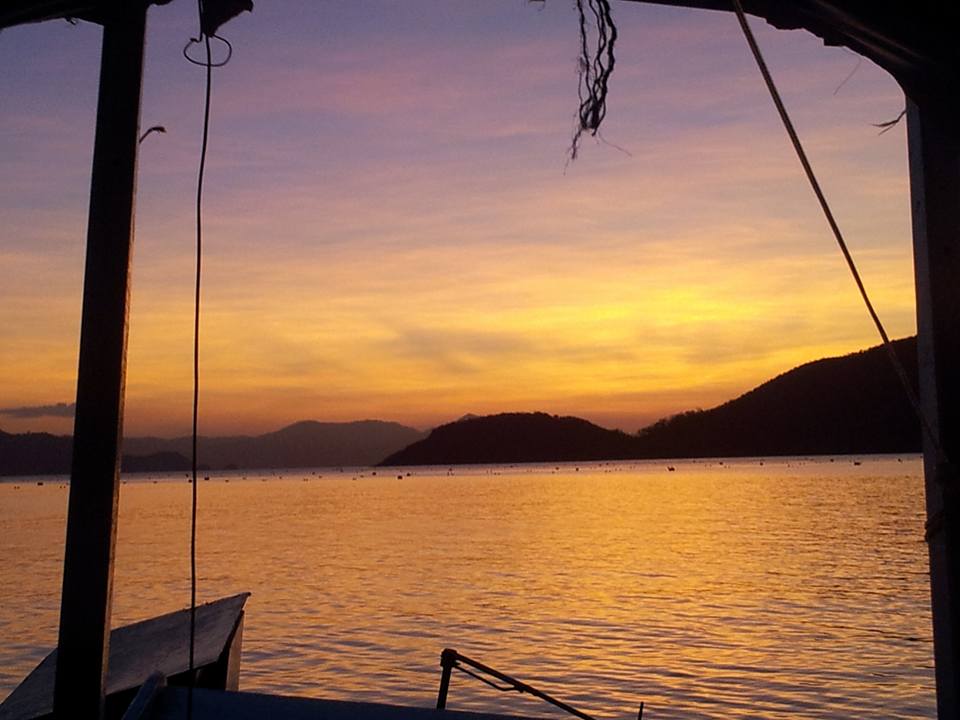
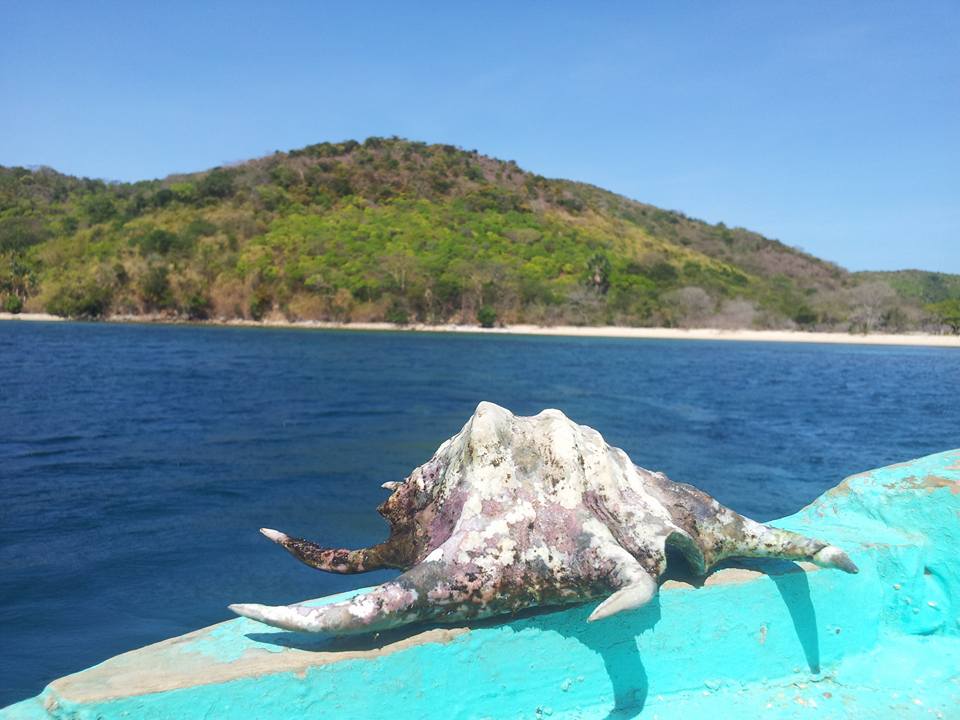
Each had coral reefs right off its shores and were almost guaranteed to be completely deserted. Besides, don’t these pictures (from a humble camera phone) make you want to go there right now? Call Maileen and Benji for an adventure on the Brinze Kylene!
Linapacan is well worth your time – wow! What do you think about Palawan?
“…a series of swims, naps, novels, games, walks, talks and snorkels with turtles…”
We could end it there, but hopefully some elaboration will convince you that Gili Meno is really worth the effort.
The Gili Islands
When people talk about ‘The Gilis’ they are generally referring to the three tiny Gili islands off Lombok’s northwestern shores (between Bali and Lombok). Gili Trawangan, Gili Meno and Gili Air have become a tourist hub for those searching for a slightly different experience than what mainstream Bali has to offer.
Gili Trawangan (furtherest from Lombok) is the main destination for those party-seeking young backpackers looking to get lost in the endless sounds of deep bass reverberating off the gentle waves. Being the gentle travellers that we are, looking to enjoy natural beauty and soak up God’s amazing creation, Gili Trawangan was the only one of these three that we did not spend time exploring.
Two night on Gili Air, a mini-version of Trawangan (closest to Lombok), was definitely still relaxing and the snorkelling was lovely off the north shore. The Matahari Bungalows did not have a sea view, but were still beautifully finished and well worth 300,000 IRP (including breakfast). Turtles, eels, a ray and a living cowrie were just some of the spots snorkelling off the northern beach (near the Gili Air Wall).
Please note: The management photo on TripAdvisor does not reflect the Matahari bungalows (it shows the beachfront Gili Air Hotel pool with umbrellas which is on the northeastern side of the island).
There are also countless other Gili islands all around Lombok, some inhabited by local Sasak tribes and others not. We did not have enough time to explore these other Gilis or find ways to get there, but it certainly would be off the beaten track from regular tourists.
Meno is awesome
Gili Meno is the middle island, the quietest and the smallest of the three Gili islands. It is difficult to describe how much we loved Gili Meno – so much so that we decided to spend a full ten days here right off the bat. Tranquil island life surrounded by natural beauty and the most stunning coral reef almost right around the island, easily within reach from the beach on every side.
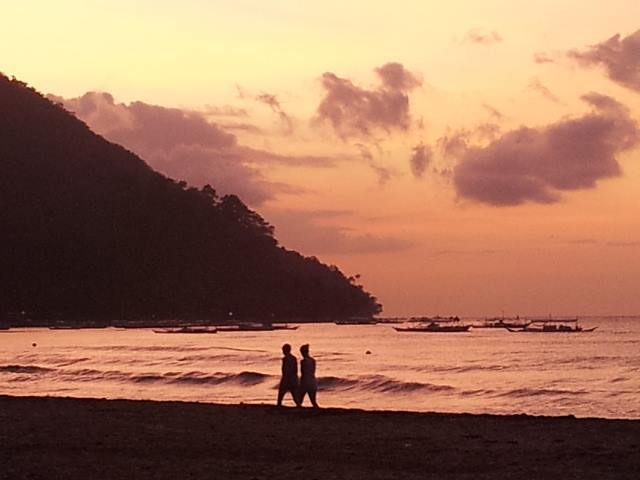
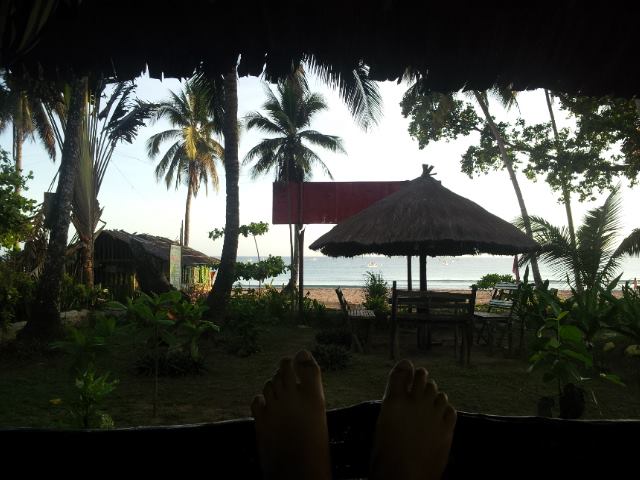
Focussed on preserving its natural assets, Gili Meno boasts a shallow lake (a mangrove conservation area teeming with birds, monitor lizards, Fiddler crabs and golden orb spiders), a turtle sanctuary, a tiny port and a handful of laid back locals and their horse carts. The few lodges, resorts, bungalows and homestays dotted around the island are far enough from each other to give some privacy, but close enough to take a quick walk to find meals. The beach is at most a 10-minute walk away, in any direction.
As on the other islands, and mainland Lombok, the mosque leads prayers five times a day (if there’s electricity); and most times on Gili Meno it’s the island’s children that take turns at the microphone to practice their chants. The islanders are friendly, hospitable, hard-working and always ready for a chat about life in Indonesia. Enterprising and proud of their island, the people are invested in protecting the environment and using tourism in a responsible way (always great to see). It was also interesting to hear mention of an aquaponics documentary that was filmed at the Gili fish farm (somewhere out in the ocean) that the locals go to about once a month on rotation.
Life on Gili Meno is also slightly cheaper for tourists than the other two islands. We were spending about 175,000 IRP per day (for two of us) including accomodation (with breakfast), one other meal and activities (which were free, because we snorkelled right off the beach).
Adem Ayem Homestay
We had an awesome stay at Adem Ayem Homestay (the neighbouring plot to Nura Homestay) in the middle of the island. For only 150,000 IRP a night (low season) there is a wonderful air-conditioned room with en-suite bathroom, free WiFi and porch (and this includes a delicious breakfast from Mama Nura, too).
Nura Homestay is right next to the Mosque, so you’re up at sunrise, however, being a quiet island, we were in bed early too so our days in the sunshine were longer and fuller to enjoy.
Restaurants and Resorts
Gili Meno has quite a large range of restaurants for such a small place and we ate like kings. Indonesian fare is common but there are also a few other types of cuisines on offer. For both cost and authenticity, we stayed with Indonesian dishes and enjoyed curries, nasi goreng, mie ayam and other tasty food – read about Indonesian cuisine here. Our favourite restaurants for the week were Pojok No.5 Star, Two Brother’s, Warung Gratis and Warung Be Family, none of which are on TripAdvisor (these are mostly in the middle of the island as the beach restaurants cost slightly more). On average, we paid about 25,000 IRP per meal per person.
Secret Spot
Each day we went out to explore the island and find a perfect spot for the day. Armed with some of the Travelinds Top 10: Beach Travel Items we found a few fantastic places to plonk down and delve into our books, naps and snorkelling hours each day. Life on the island was a series of swims, naps, novels, games, walks, talks and snorkels with turtles – as it should be. Fantastic!
The one spot is a bit of a secret, but we’ll happily share it so you too can enjoy the peace and quiet of Gili Meno under a shady spot, at the perfect entry point for the stunning coral reef, where we saw turtles every single day! Head along the beach towards the Mahamaya Boutique Resort from Diana Cafe.
Just before Mahamaya, you’ll see a huge bush on the beach with a shady spot inside it. Tucked away from the sun and the tide line here, it is possible to spend hours and hours reading, sleeping, relaxing and swimming – and hang up your snorkels and sarongs on one of the tree branches when you’re done.
You’re welcome!
Secret Spot view of Gili Trawangan. This reef (30 metres out) is where we swam with turtles everyday.
Getting to the Gili Islands
The Gili Islands are relatively easy to reach from Bali or Lombok, but you will need to set aside some extra time if you are not taking the fast boats. The options are:
Fly to Bali. Take a shuttle with fast boat (a shuttle to Padang Bai and then a fast boat) to the Gili Island of your choice. Book this at any travel agent or online. We paid around 300,000 IRP for this service from Gili Air to the Bali airport.
Fly to Bali. Take a public ferry from Padang Bai (to Lombok – about 5 hours). Take a van/bus to Bangsal Harbour (2 hours). Take a ferry to Gili Islands (half an hour).
Fly to Lombok (from Bali – we paid 150,000 IRP with Lion Air). Take taxi/bus to Bangsal Harbour. Take a ferry to Gili Islands.
We used Option 3 since we spent a few days on Lombok before heading to the Gili Islands.
Have you been to the Gili Islands? What was your favourite thing about the islands?
Greetings from Lombok – the lesser known neighbour to the east of Bali, Indonesia. It is best known for its variety of white sandy beaches and the tremendously imposing Mount Rinjani – Indonesia’s second highest volcano! After ten days in Bali, we spent five days exploring southern Lombok before heading north to the Gili islands.
Fly, fast boat or ferry?
After doing a bit of research, asking around, weighing up our time constraints (or lack thereof) and thinking about the perpetual “comfort versus cost” debate, we finally decided to fly from Bali to Lombok.
There were several reasons: it was the second cheapest option (the ferry is the cheapest), it was the most convenient for where we were going (to Kuta, South Lombok) and we didn’t really think a (minimum) 5-hour public ferry ride from Padang Bai (Bali) was warranted when we already had a lift back to the airport organised (in the opposite direction).
The flight with Lion Air cost 153,000 rupiah each and took 30 minutes. It was so short, the pilot only switched off the seat belt sign for about a minute before announcing that we were descending and had to put it back on again.
We took the fast boat when we returned to Bali airport from the Gili Islands – read more here.
Beach Paradise
The beaches in southern Lombok are awesome – long white stretches of soft sand along varying degrees of turquoise, cobalt and aquamarine oceans. The two main beaches we biked to were Tanjung A’an (10 minutes from Kuta) and Mawun (30 minutes from Kuta).
Tanjung A’an
Tanjung A’an beach was a lovely two-day spot. The beach swings right around to the other side of the stunning blue bay that sparkles in the sunlight; a great reminder that Lombok is really beautiful and almost untouched compared to its touristy neighbour, Bali.
Mawun
The favourite destination of our five day Lombok exploration was Mawun Beach – about a thirty minute drive west of Kuta. Taking the motorbiking up, up, up the steep hills towards amazing views of palm groves and endless white beaches below, we sailed through heat and rain alternately, got soaked to the bone and tried our best to miss the muddy potholes; and then flew down the other side of the hills down into valleys of stone-cutters, red quarry sand and rice paddies. Once we’d almost missed the Mawun turnoff, we hit the beach and knew it had definitely been worth the numb behinds and gravelly roads.
An exquisite bay of blue green water shone all around us, rimmed by a wide sandy beach and framed by palms and shady trees to keep the scorching sun from grilling us too badly. Small fishing boats dotted one side of the bay near the village, only enough to make it picturesque while still having the beach to ourselves.
Mawun Talent
Jacky, an enterprising fourteen-year-old Sasak Indonesian boy, kept us entertained for a while as he tried his best to sell us a fresh, juicy, sweet coconut for 15,000 IRP. His family owns the small restaurant where we parked our bike and ate lunch. He spoke to us for about an hour about life and Indonesia, wiling away the hours of his school holidays and hoping to make some pocket money from us as two of only six tourists on the whole of the beach. Eventually, Jacky tricked us and we relented by playing rock-paper-scissors (his brilliant proposal that we couldn’t refuse was that if we won, we paid 10,000 IRP and if he won, we paid 20,000 IRP, an exorbitant price for a beach coconut in his eyes). We lost. Jacky won. The coconut was delicious.
Homey Homestays
Talim and Fathima of T&T Homestay looked after us for the time spent in Lombok. Pancakes for breakfast, free tea and coffee, friendly conversation and free advice about travelling around Lombok itself. The rustic home stays in Lombok are clean and comfortable; and even as a tourist visiting this close-knit community one can observe and participate in the daily life of the hospitable Sasak people of Lombok.
The family showed us how they chop down the palm trees (by hand) to make way for the extensions on their home. They eat the top of the palm tree (a thin white bark in the centre that tastes sweet) and rescue any baby birds they find up there, too (whether this is to eat or to raise was not specified…)
Rescued baby birds from the top of a palm tree.
Roy Homestay, a slightly bigger place with air-conditioned rooms available, was good for the night that T&T Homestay was full and we would have stayed longer if there was time. Both home stays served a delicious pancake for breakfast and assisted us with booking vans, motorbikes or taxis where needed. There were also laundry services available at a reasonable price per kilogram.
Moto Power
A forlorn Dutch couple staying nextdoor told us their tale of woe with much forboding about hiring motorbikes in Lombok (we had read all the stories about it, just like they had). They hired a bike (without paperwork, as everyone does), drove it around on a wonderful roadtrip, went to a couple nice beaches and restaurants and then decided to stop for a 20-minute smoke on the beach in the evening. They parked, smoked, came back and it was gone.
After a huge blow up with the owner, little support from the police (because legally, they can only really file a case and give statements), pressure from several men in the community (who would not let them leave Lombok!) and phone calls home to helpless lawyers and family, they eventually had to fork out 12 million rupiah to the demanding owner (who they maintain could have had it stolen for just this reason). Poor Dutchies.
We commiserated and then the next morning we hired a bike because that really is the only way to see Lombok if you want to do it on your own time and budget. We followed strict guidelines and parked in the official parking lots (getting a ticket and paying 5,000-10,000 rupiah for a day), restaurants and where there were people around to watch and help. No incidents for us Saffers.
Bangsal Harbour (to the Gilis)
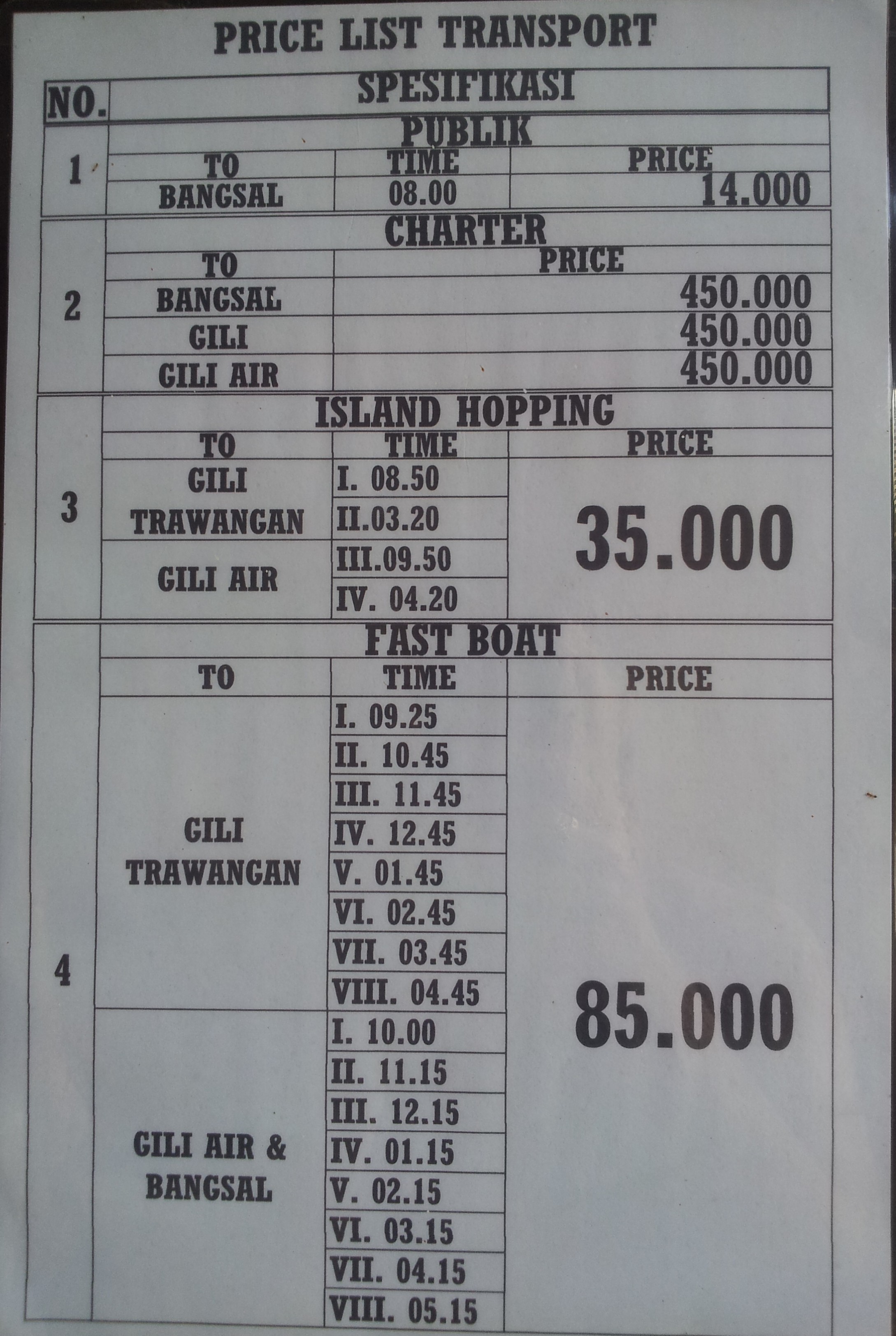
The van from Kuta dropped us at Bunga Bunga Cafe (five minutes walk down the road from Bangsal Harbour). Talim suggested that we get tickets here for our fast boat from the “Gilis” to Bali (and getting from Bangsal Harbour over to Gili Meno). Since we trusted Talim, we decided to go with the offer and even though Bunga overcharged a little (not much!), the boat from Gili Air to Bali was the best of the lot in terms of comfort and facilities (Marina Srikanda).
Basic costs of this trip:
100,000 IRP for a shared private van (4 of us shared for 400,000 IRP total) from Kuta to Bangsal.
325,000 IRP for a trip from Bangsal to Gili Meno and then Gili Air to Bali (ticket from Bunga Cafe).
This should have been about 275,000 for the fast boat and 25,000 for the ferry to Gili Meno if we’d done it through a cheaper agent.
35,000 IRP for the standard ‘island hopping’ trip from Gili Meno to Gili Air (ticket from harbour office on Gili Meno).
Gili Meno boat schedule at the harbour office
Tips from other travellers
Mount Rinjani
The Mt. Rinjani hike, up Indonesia’s second-highest volcano, is a popular activity for energetic tourists. The three day hike promises extreme weather, tough ascents and fantastic views. The travellers we spoke to who had done this hike ensured us that it required fitness and endurance (and waterproof, warm hiking jackets) but that it was well worth the effort! This volcano is part of the Mount Rinjani National Park.
Warung Turtle
If you are visiting Tanjung A’an beach, it is a good idea to park your bike with either the official parking under the tree (paying the guys there and receiving a ticket), or we spent time mostly hanging out at Warung Turtle (because there was shade, beach chairs, food and beverages and friendly locals). Note: You drive to Warung Turtle through the small dirt road that runs behind the beach entrance. At high tide, the water often covers parts of this road near the river bed so watch out for big bumps and pools!
For the last ten days, Travelinds has been living the high life with our folks (higher than normal, anyway) and staying in a charming Balinese villa in Gianyar. The colourful buzz of life in Bali is a great cultural experience and we have loved the time exploring this part of the world together.
Thriller Villas
Situated beside the eastern black sand beaches, our villa complex stands in stark contrast to the rice paddies and fisherman huts around it. The imposing Mount Agung is visible on a clear day, soaring above the clouds to the east; and the stars shine brightly our here during the warm (rather hot!) nights.
In Bali, luxury villas are now all the rage for travellers seeking comfort and privacy. These cosy, stylish holiday homes abound, especially in the busier tourist areas.
Usually situated within a complex of similar units, the villas have high walls, private pools, beautifully finished interiors and crisp white linen.
A villa stay also usually includes a cooked breakfast (brought to you at your requested time and place) by the friendly staff in the mornings. As an honoured guest one is treated to the famous Balinese hospitality with utmost respect. The beautiful home seemed to clean itself everyday, in a silence and serenity, as we lounged in the pool.
It’s a pricey way to travel, but it sure was luxurious. If you are looking for a quiet and isolated vacation to unwind, we stayed at Villa Kori Maharani.
Tours and Taxis
Since we chose a location as far out of the madness of the main tourist area as possible, we needed to take a taxi to get anywhere (other than the beach). There were three taxi days and one tour day during the week, enough to keep us busy and wanting more.
Day 1: Taxi to Amed (Snorkelling and Beach)
After reading up on a few places where we could snorkel right off the beach, we hired a taxi for the day (at 400,000 IRP) to Amed. A minimum two-and-a-half hour drive from Gianyar, there are three main beaches at Amed to swim and snorkel, but we only had time to try one of them as the drive had taken longer than anticipated. The scenic drive winds through juxtaposed greens, blues and black as the jungles and rice paddies rise between sparkling ocean and volcanic rock faces.
Jemeluk was all we’d hoped for, enough to keep us there for two hours, and the coral was colourful, too. After a scrumptious (and cheap) lunch at Warung Made, the drive home took us back through the hills. A bustling crowd delayed the trip with cows, motorbikes, cars and people as we passed at least two festivals along the way – the men in their turbans and traditional linens, the woman in lacey outfits with colourful skirts and jewelry.
TIP: Look out for the East Bali Cashews and buy some to support this great local initiative.
Day 2: Taxi to Ubud, Mount Batur and Tegalalang (Countryside)
Another day we wanted to follow a tourist route without being packed like sheep in a bus or van, so we hired a day taxi again and set our own route.
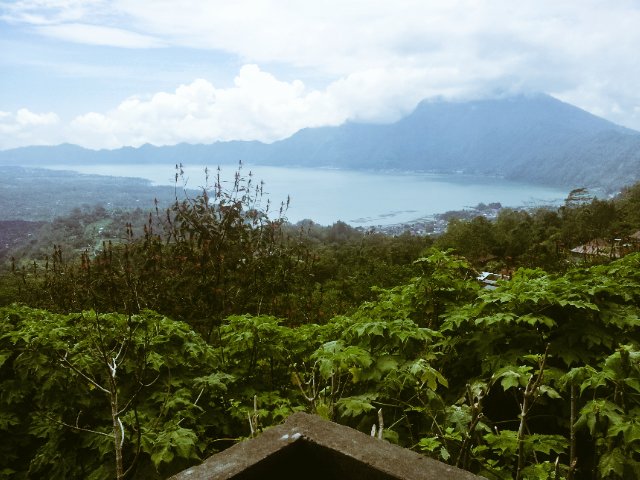
First on the list was Mount Batur, the impressive (active) volcano that boasts a beautiful crater lake on one side and black lava slides down the other.
The viewpoint for this volcano gives a wonderful panorama of contrasts and the cloud cover lifted enough for us to capture a few shots for the memory bank.
From the volcano, we headed down to Ubud through Tegalalang, famous for its tiered rice paddies and quaint cafe lunch spots.
Also in the area is the popular Luwak coffee plantations (literally civet dung coffee – yes, dung!) that produces some of the most expensive (and sought-after) coffee in the world. Somehow, it didn’t appeal to us once we had read up on its origins.
Ubud is full of arts and crafts, cafes, temples, shrines, curio stores, yoga and tourists. A picturesque little village making full use of its appeal and setting, it is a perfect place to gain insight into the cultural and spiritual side of the Balinese people.
Day 3: Snorkel Tour to Nusa Penida
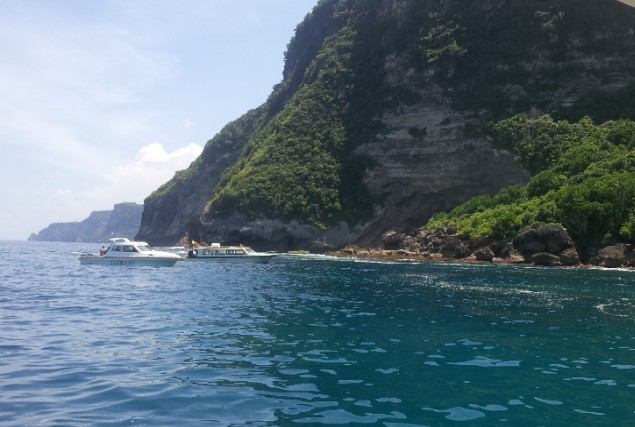
The only official tour we took was to Nusa Penida. All4Diving did a fantastic job keeping us safe and happy, and of course, providing the highlight of our trip as promised – we snorkelled with Manta rays! Amazing! The Nusa Penida tour to Crystal Bay and Manta Point was a truly wonderful experience.
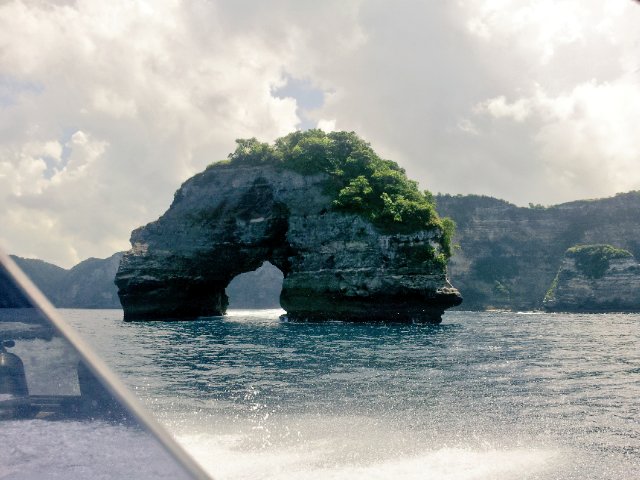
Crystal Bay was beautiful in both coral and creatures with amazing visibility. Manta Point is a cleaning station (where the Mantas come to the surface for fish cleaning) and as snorkellers this was a once-in-a-lifetime sighting.
Swimming just above the 4 to 6 metre wide mantas, watching them glide majestically within touching distance, looking into their wide open mouths all the way down their empty bodies (like whale sharks) as they feed – all of it was unforgettable!
Bucket list item – check.
Day 4: Taxi to Blue Lagoon (Snorkelling)
The last outing was to Blue Lagoon Beach, the well-hidden eastern neighbour to a bustling Padang Bai beach (Bali’s main ferry port).
A fantastic little cove, protected on both sides by forest and cliff, the vibrant coral reef in the small bay was full of life.
Turtles, eels, puffers, large schools of reef fish and trumpet fish are only some of the residents here. Before ten o’clock we had the beach to ourselves and there are two restaurants side-by-side with a range of Indonesian food, desserts and drinks.
It’s possible to walk from Padang Bai to Blue Lagoon – head east along Padang Bai beach road up a steep hill that winds between a few houses and down the other side. At the parking lot head down a flight of steps on to Blue Lagoon beach (don’t forget to take a photograph on the way down to capture the sparkling aquamarine bay through the tops of the palm trees).
Taxi and Airport Transfer
During the week we used Waylan’s Taxi (private) and were impressed with his professional service, clean van and informative, friendly tour guide skills. Give him a call on (+62)85737010230
The airport transfer from Gianyar was around 250,000 IRP (before bargaining it down a bit).


 The mist in Oribi Gorge, just like in the rainforest. PHOTO BY: HEATHER LIND
 PHOTO BY PIXABAY







 Since we were in Kenya having a bunch of ‘first’ experiences, like seeing the magical
 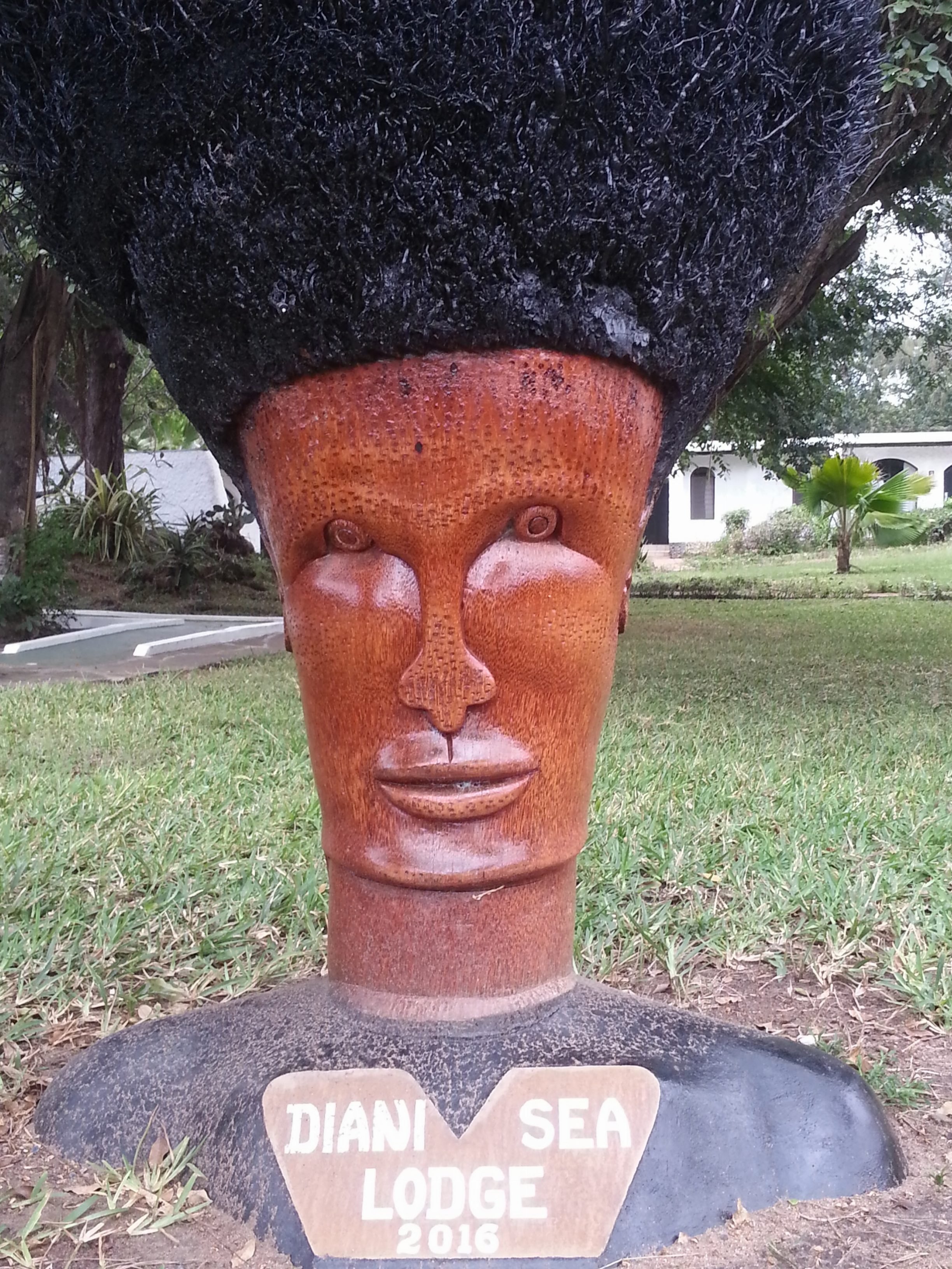 Whitewashed textured walls under the shady reach of enormous trees, where exquisite black Colobus monkeys shake their bushy white manes and call to each other like motorbikes starting up (as Daphne Sheldrick describes in

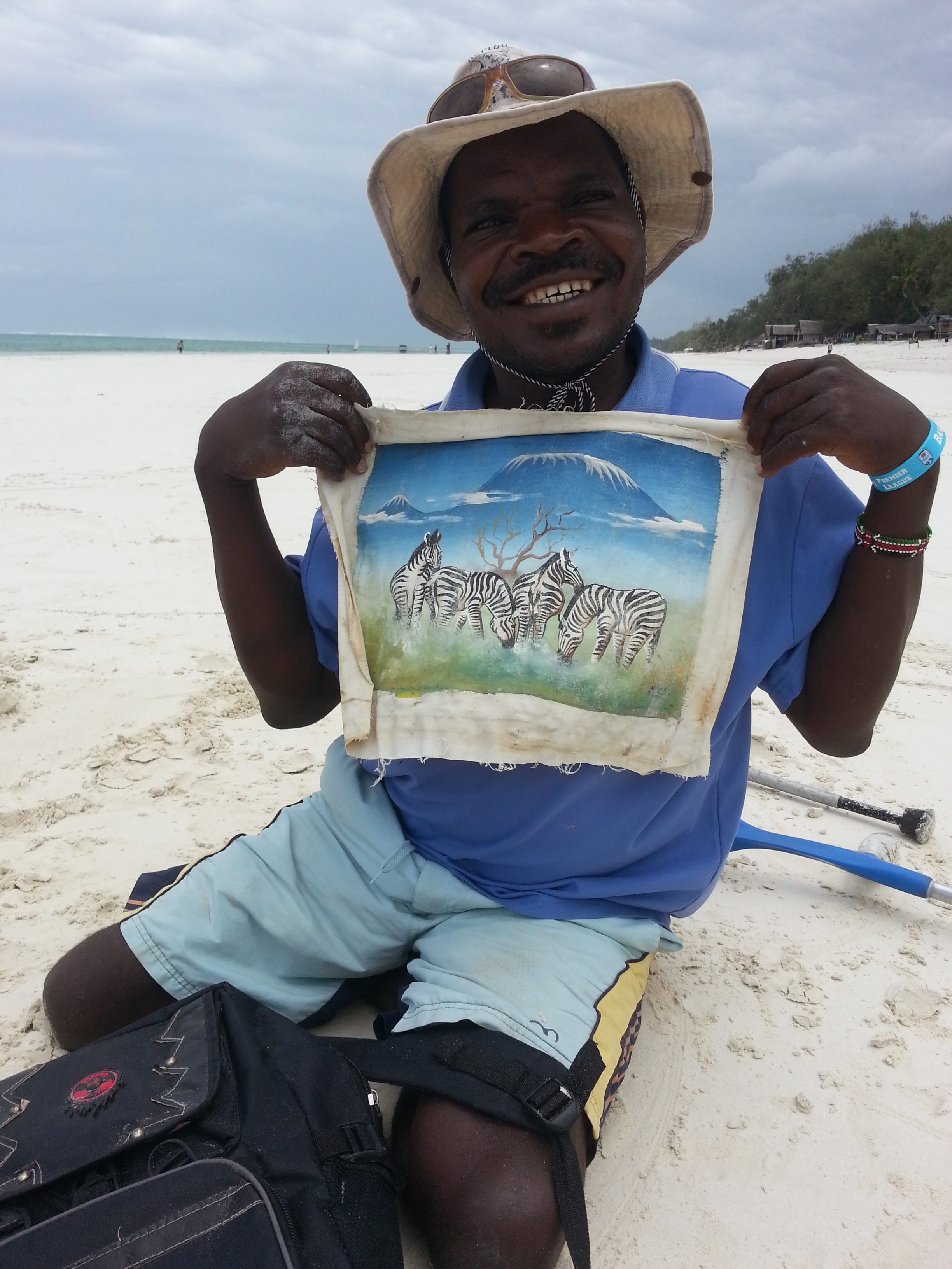 Tuk-tuks and bora-boras (motorbikes) crowd the market places in hopes of a good day.



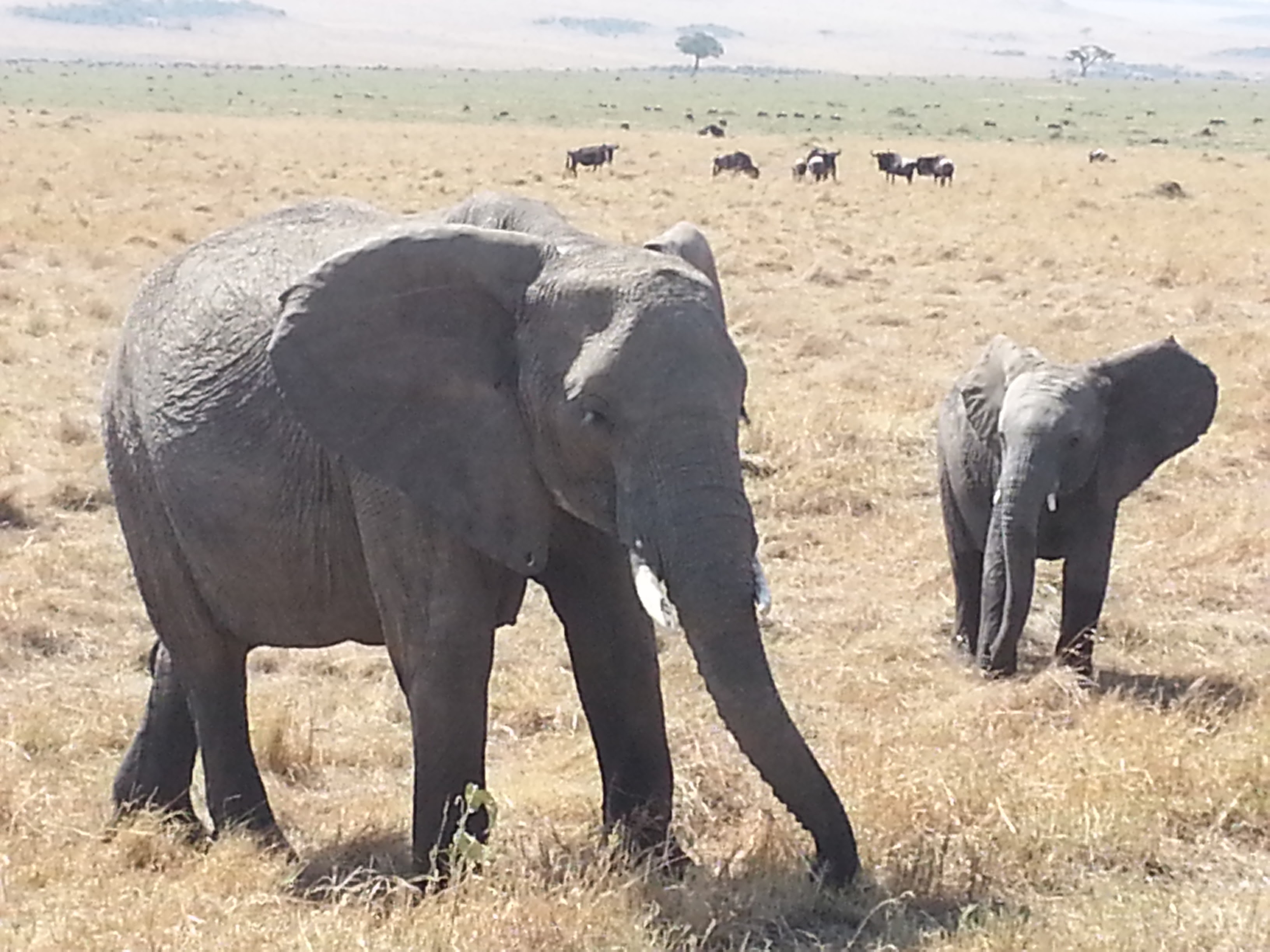
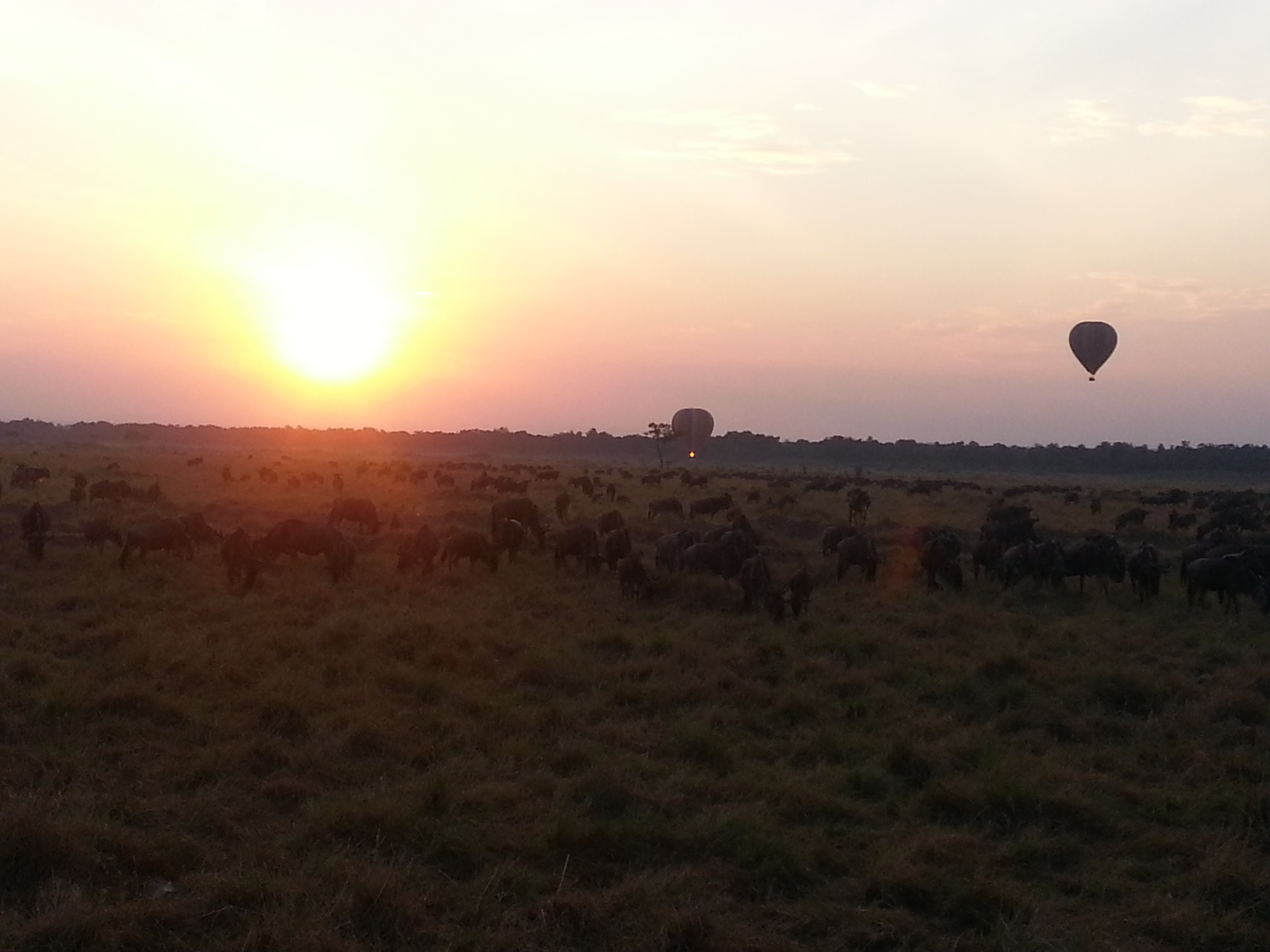
 Masaai Mara – just wow!





 Upon arrival the smiling young airhostess kindly requested that we walk around the plane’s wings, collect our baggage and enjoy our stay in Coron. She looked quite relieved to have finished her duties because we had left an hour late due to delays from the Manila air traffic control tower and she had done a lucky draw of some CebGo souvenirs to keep the mood light and the passengers entertained.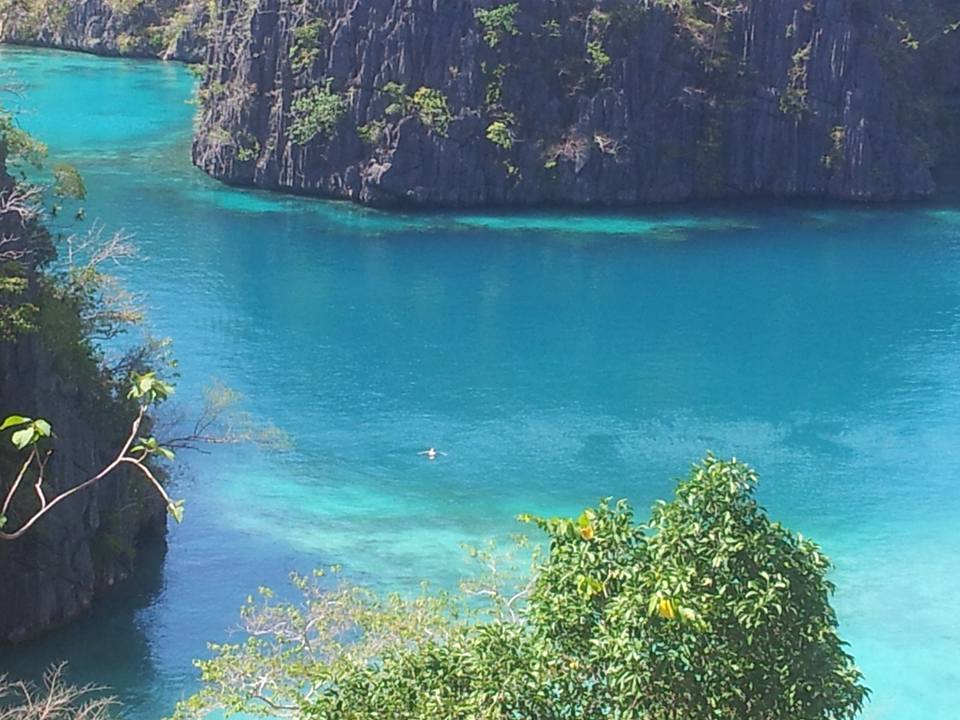
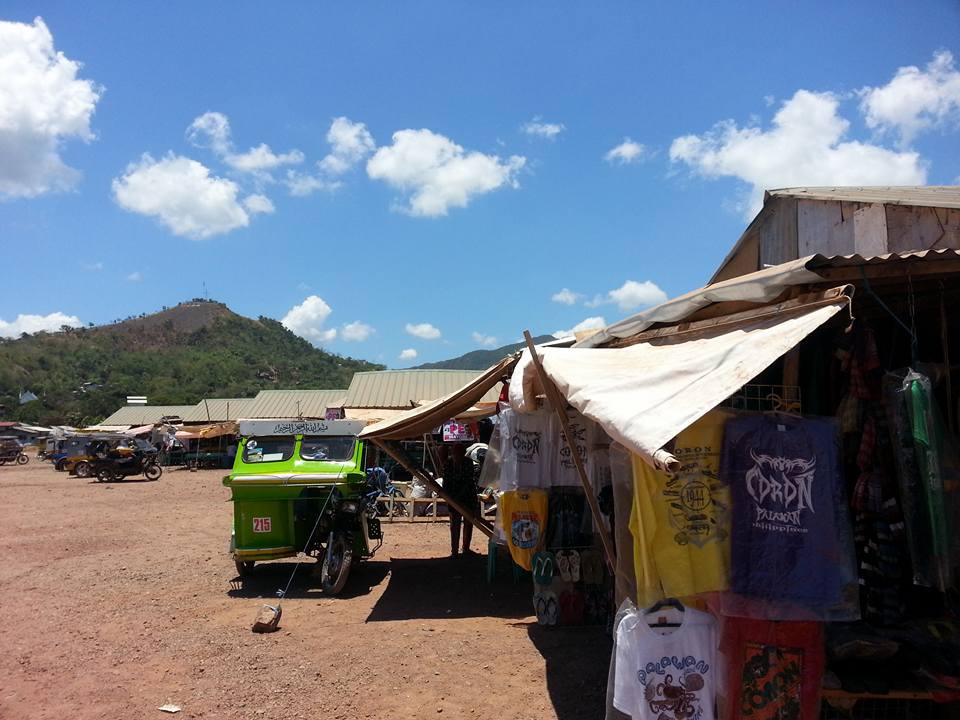
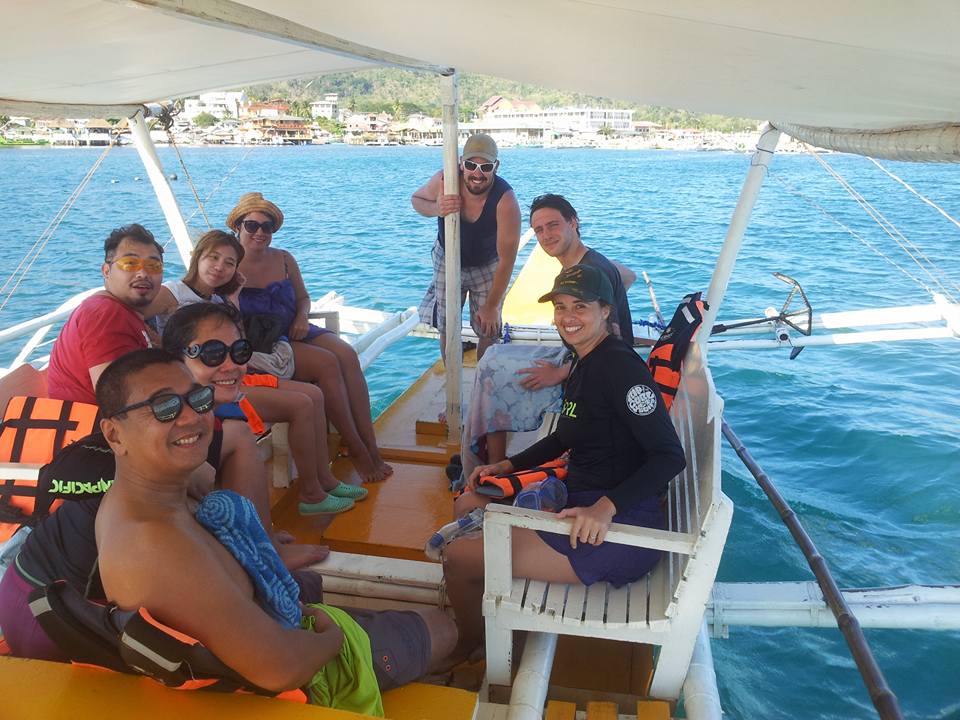
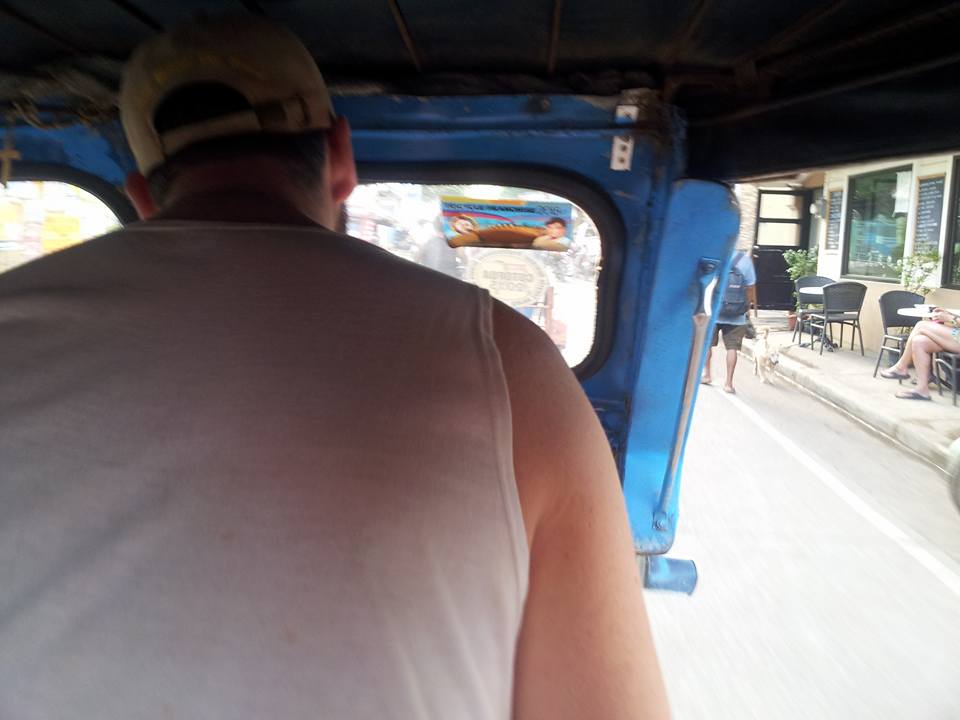 Erwin picked us up and tried to charge us more than double the amount that our hotel mentioned, then dropped us at a ‘delicious local food’ restaurant (after our request for cheap local food), which had prices three times the amount of the real local hangouts. Needless to say, we ditched him the next day.
 From Linapacan, we took an island-hopping tour boat to Sibaltan to spend our last five days exploring Palawan island. Arriving on the mainland after four days on an island-hopping boat was like travelling to a different planet.







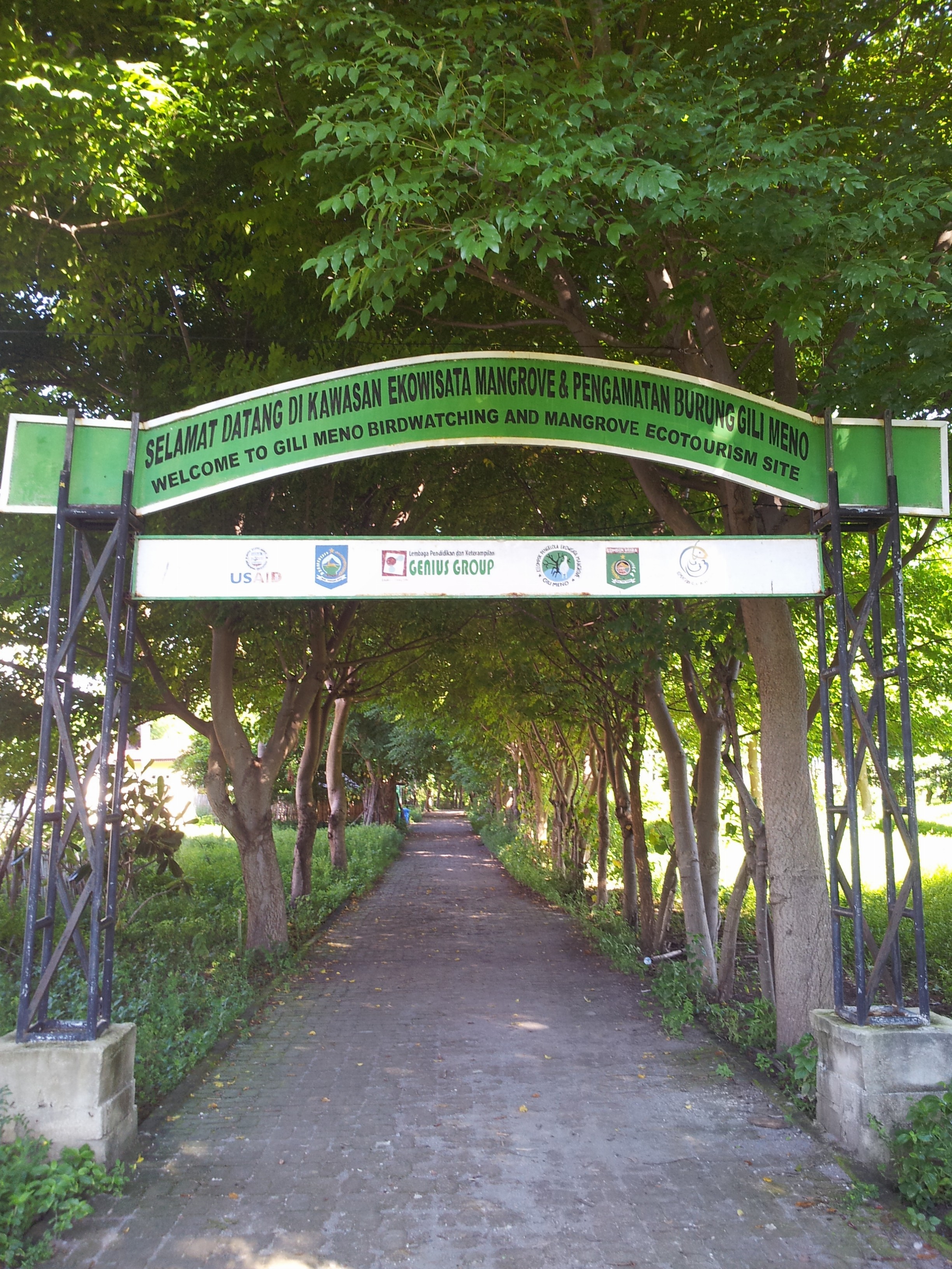 Focussed on preserving its natural assets, Gili Meno boasts a shallow lake (a mangrove conservation area teeming with birds, monitor lizards, Fiddler crabs and golden orb spiders), a turtle sanctuary, a tiny port and a handful of laid back locals and their horse carts. The few lodges, resorts, bungalows and homestays dotted around the island are far enough from each other to give some privacy, but close enough to take a quick walk to find meals. The beach is at most a 10-minute walk away, in any direction.
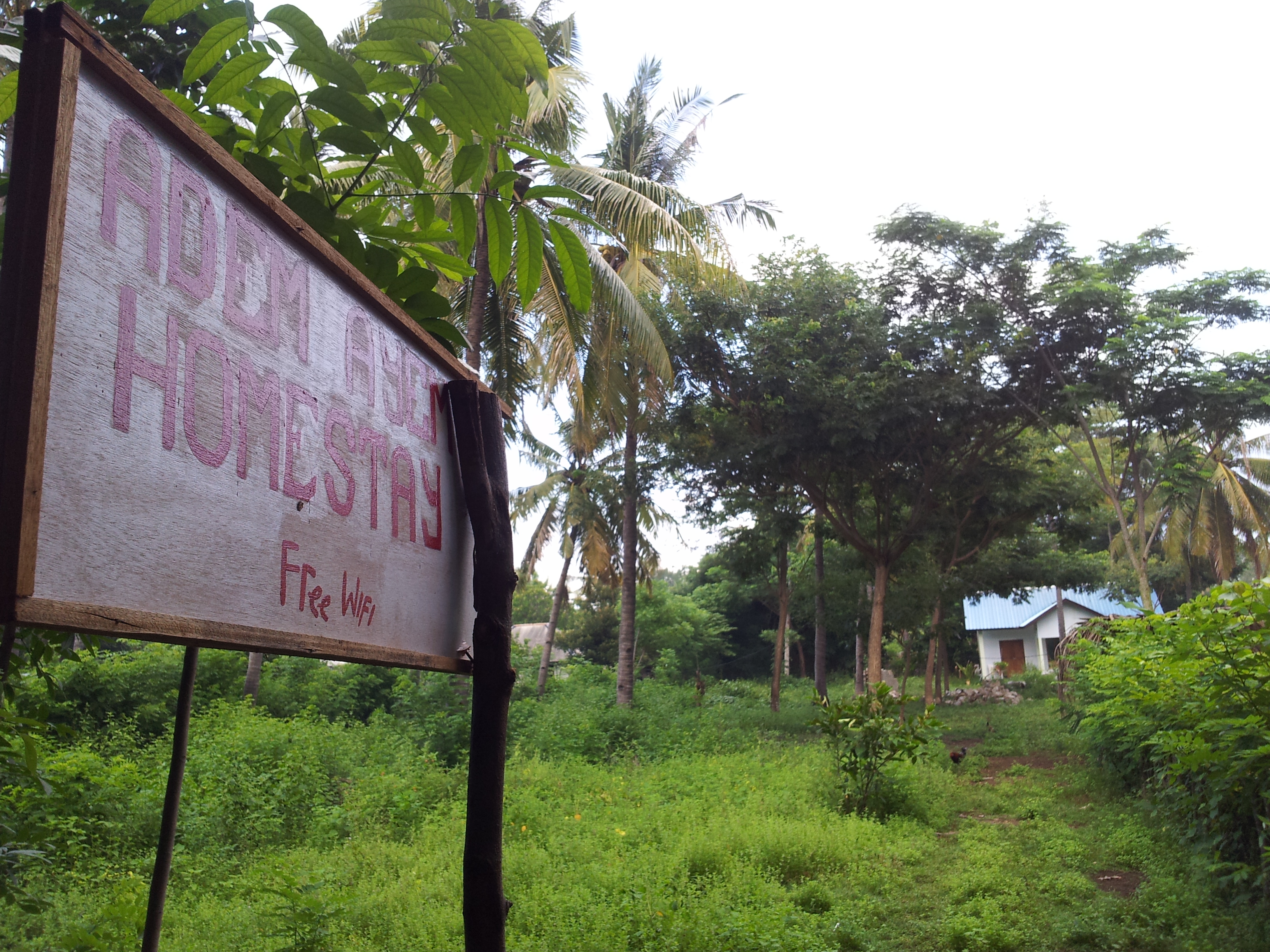 We had an awesome stay at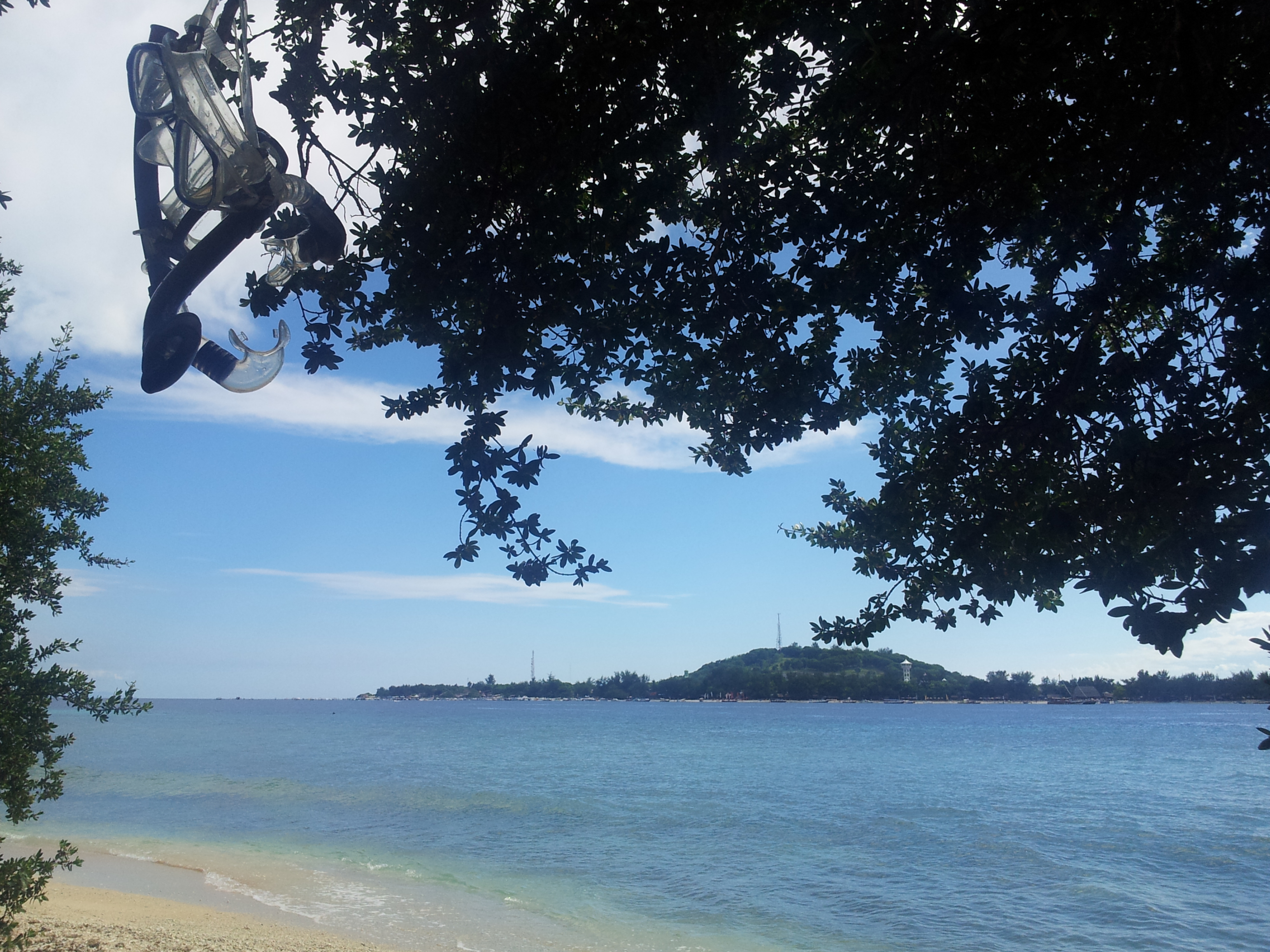


 Talim and Fathima of


 In Bali, luxury villas are now all the rage for travellers seeking comfort and privacy. These cosy, stylish holiday homes abound, especially in the busier tourist areas.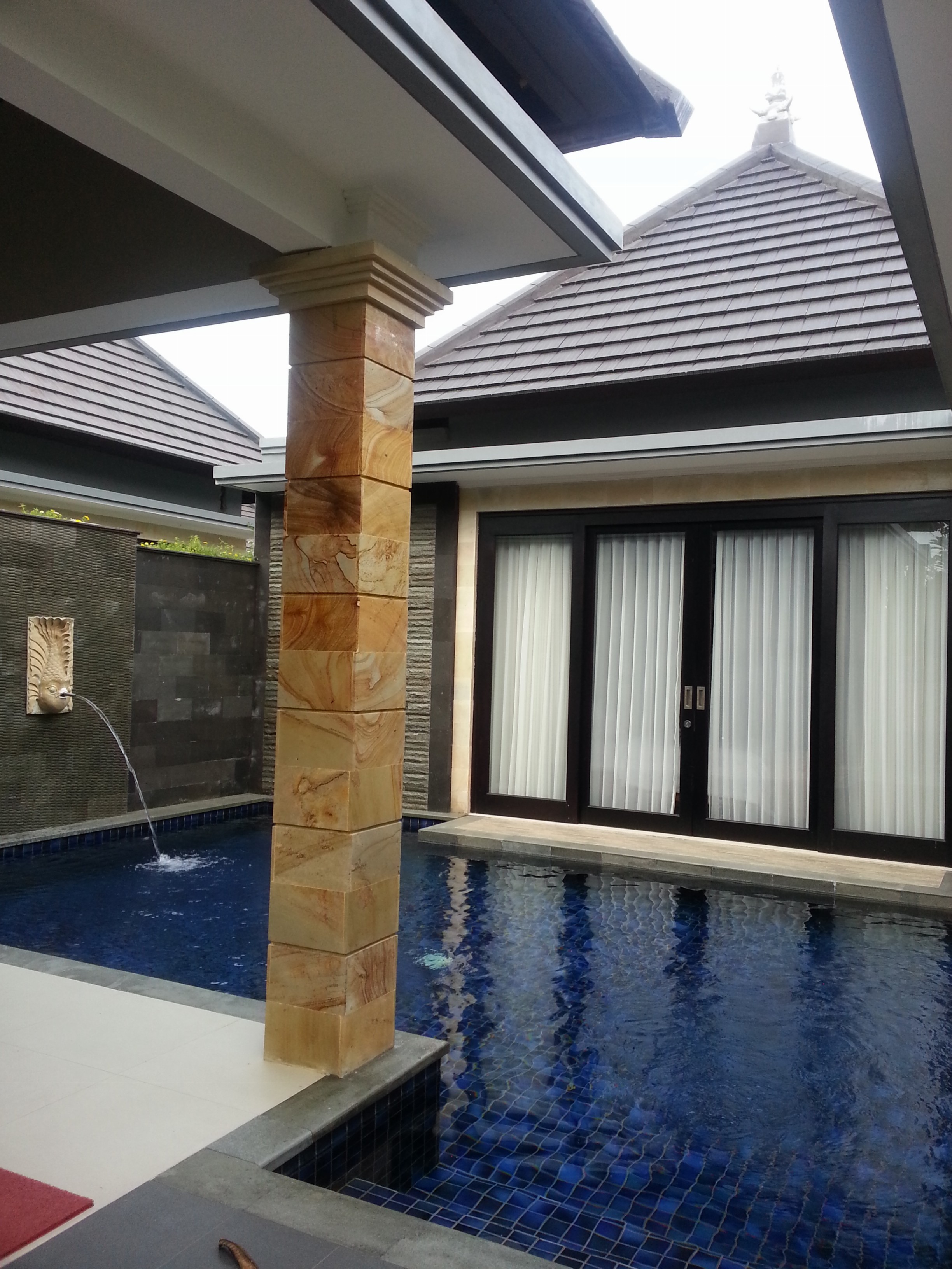

 Crystal Bay was beautiful in both coral and creatures with amazing visibility. Manta Point is a cleaning station (where the Mantas come to the surface for fish cleaning) and as snorkellers this was a once-in-a-lifetime sighting.
 The last outing was to