Tag Archives: animals

Oribi Mom

The “Oribi Mom” Column

Newspaper Column Regularly Featured in the South Coast Herald

Since 2020, this little newspaper column has become a standard feature in the Lind household. It’s an actual newspaper – the kind that rubs off black onto your fingers – publishing our comings and goings here in Oribi Gorge.

Part of the motivation behind it was to give the Lind children something in black and white one day after we get old and don’t remember all the details. The local community here also seems to have enjoyed the offering, which tries to share our story 400 words at a time. A few neighbours and friends have appreciated some of the humour, relatability, family drama, and close encounters with nature. International readers just gasp, wondering why we choose to live in a place where Black Mambas do.

Why Oribi Mom Started

Ambitions to be a journalist in the teen years were short-lived. If you’d asked then whether we’d like to just blog for a local newspaper whenever inspiration hit, it would have seemed inferior to “real” journalism. What a crazy idea.

Fast-forward to about a month before the entire world shut down because of the COVID-19 pandemic, and the need to share our experiences felt overwhelming. At eight months pregnant, South Africa’s hard lockdown had cancelled just about everything. Things got complicated, including the smooth, quick route needed to reach the hospital three hours away.

Instead of calming soundtracks and earphones, we had to remember to pack our eldest child’s birth certificate in the hospital bag — just in case. What if the police stopped us on the highway to ask why we were out of our home when the government had expressly told everyone to stay put. We’d even rehearsed the speech to say in between contractions. “Yes, he’s our son. Yes, we had to bring him with us. No, there’s nobody to look after him at home. No, we couldn’t go to another hospital because the doctor is at the one three hours away (another long story).

We hadn’t found much online about going through a late-stage pregnancy during a global pandemic. Nobody else crazy enough to try it? So, we wrote one. And we’ve never looked back.

Thanks for reading!

Oribi Mom

Oribi Mom: It’s Heartwarming To See Honesty Boxes

“You put your money into the honesty box that’s on the table and then go home with your beautiful plant.”

When you drive up from the nature reserve, there’s a little table of plants in front of a polocrosse field. I often get strawberry plants and other little flowers from there to spruce up my garden. They have labels with a price or just a sign that says R10 or something. And you put your money into the honesty box that’s on the table and then go home with your beautiful plant.

The boys even bought a little strawberry plant the other day for a local Gogo’s birthday. Their dad helped them deliver it to her door, and the next week she had two fresh strawberries in her pot. They also bought me a blackberry bush so that we can grow our own sweet berries to eat. It’s very prickly and I haven’t found a good place for it yet. Didn’t Farmer McGregor have a blackberry hedge that Peter Rabbit hid behind? Maybe I’ll try that.

If I’m Honest, There’s So Much To See In Oribi Gorge

The honesty table even had a geocache by it a while ago! The boys were very excited to spend an afternoon doing that with their cousins and have found all sorts of little treasures in our area here.

Plus, if we drive slowly enough, we can see the ostriches that live at the polocrosse field, a sight that really excites little imaginations. They’re spectacular birds, though it seems odd to call them that.

They’re nothing like mannikins or the lovely sunbird that’s back making her nest on my porch this year again. They can’t soar over the deep gorge and farmlands like the majestic vulture colonies we adore here. And they don’t sit still in the shadows and blend in with the green like the gorgeous Narina trogons, either.

In any case, seeing ostriches in Oribi Gorge shouldn’t come as a surprise. It’s a place that takes your breath away for many reasons, including the beauty of still being able to have an honesty box in the neighbourhood.

Don’t forget your R10 notes next time you come up here. You might get a flower or shrub for your garden to remind you of this beautiful part of the world.

Published here.

Oribi Mom: Hearing the Roar of the Waterfall

Apparently there is some special limestone-evolved skink here that researchers are trying to pin down.

It’s quite a struggle leaving home in the dark. Winter school runs require some otherworldly resolve to crawl out from under the covers. You must will yourself to get the small children dressed, fed, and half-decent for the day.

It’s also ridiculous how much colder we are in Oribi Gorge and Paddock than in town. Oribi Dad often leaves home in the dark with a fleece top and beanie and returns an hour later with a T-shirt and sunglasses. Why bother?

This weather is confusing, too. One minute it’s so dry we’re irrigating the baby macadamia trees and the next there’s giant thunderstorms ripping through our echoing gorge. They strike Eskom poles to leave the whole place off the grid, and not in that idealistic sort of way.

The Waterfall Roars After a Good Storm in Oribi Gorge

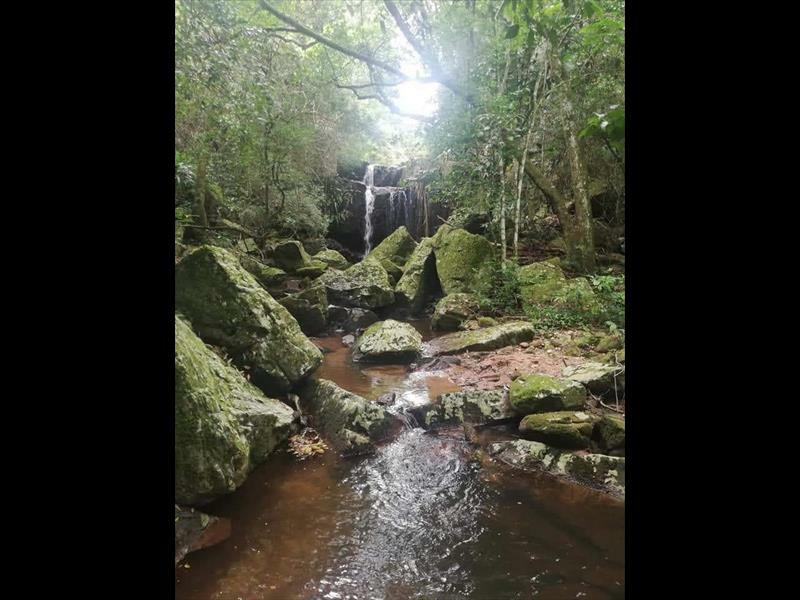
The waterfall below our house really pounds after that rain as the water drains from all the surrounding slopes and gathers in the streambed. It roars, much louder than the cane trucks. It’s louder than the UGU bus putting its accelerator flat on the floor to try and get up our winding gorge road without stalling. The waterfall is even louder than the tractors sometimes, and those whizz right past the house.

You can get to the bottom of the waterfall with some careful balancing and boulder-hopping off the rough trail. And once you do, it’s hard to describe the transformation. The cane, macadamias, and tea tree are far above you. The sounds stop, except for the birds. The bright sunlight doesn’t even make it down there into the moss-covered rocks and twisty skyscraper trees.

Down Into a Magical World Out of Sound and Time

I imagine that’s how Middle Earth’s elven forests must have been in the mind of its maker. It’s like you’ve stepped into a world of fantasy. But you still have to look out for the area’s rather impressive selection of dangerous creatures.

Even grumpy bushbuck aren’t the safest, though seeing them gracefully walking down the narrow bush trails is still spectacular. Apparently there is some special limestone-evolved skink here that researchers are trying to pin down. I’m yet to find it. But there’s still time.

Maybe the dark, cold winter mornings aren’t the most enjoyable part of family life on the farm. But the beauty and diversity of this place makes up for it in a big way. And the aloes, now those are always a great reason to look forward to June on the South Coast, aren’t they?

Published here.

Oribi Mom: Let’s Talk About Invasion

The birds strip my poor little palm trees, and the moles keep pushing up my groundcovers and trees before they can get going. It’s wild.

February 21, 2021 
Let’s talk about invasion. Maybe not the Star Wars (or Occupy Cape Town mansions) type, though.
I mean lantana, for example, the invasive weed that’s ruining every piece of tilled land where something isn’t planted right away. The butterflies love its pink, orange, and yellow buds, and the birds drop the seeds everywhere (which is how it spreads like wildfire).
As a budding gardener who’s just getting into the nitty-gritties, this weed is only one contender for my wrath in Oribi Gorge. Blackjacks and sweethearts (those semi-circle burrs) come in a hot second. The bunnies are trying to help me clear those, but it’s an uphill battle most summers.

It Isn’t Just a Weed Invasion

Between the monkeys, chickens, rabbits, and Southern Boubous, my seedlings and succulents often lose their will to live or multiply. The birds strip my poor little palm trees, and the moles keep pushing up my groundcovers and trees before they can get going. It’s wild this invasion.
What to do when hours and hours of back-breaking work and careful cultivation has come to naught? It’s a relevant question in a global pandemic, not just for those who took up gardening during South Africa’s perpetual lockdowns. As a sleep-deprived working mom of two, my personal choice is often a mini-breakdown with tears.
The exhausted cry of the mom accompanies out-loud roaring at indignant Vervet monkeys as these relentless opportunists scamper back over the fence after decimating my vegetable garden or blooms. My toddler now imitates this pathetic roaring at will. It’s quite awkward when it is directed at passing tractors or an unsuspecting visitor at our coffee table.

It Isn’t Forever Because Seasons Pass

All that sweat, and real blood from stupid lantana thorns, and what is left in the soil? A lonely stalk that looks nothing like a cabbage, butternut, marigold, or echeveria. It’s infuriating. It’s also illuminating.
A certain beloved Gogo down the road has taught me an invaluable lesson about the things under my care: everything needs pruning. When you care for the land, it responds in kind. You need to chop, hack, and discard the dead and dying plants.
Cut the beautiful hedge down to knee-height, and see what happens in the growing season next year. Don’t be stingy about the damage, either. The more you prune, the more beautiful the development. The more you cut down the wayward tendrils, the stronger the bushy blooms are in the sunshine.
Jesus pruned the vine, too. Now, I understand why.
When last did you prune your own expectations, commitments, and bad habits? Lockdown has given many of us these mini-breakdown moments and we’re not yet out of the woods. Go on, test your roots and clear away the excess that has invaded time, money, relationships, and life choices. You may just find life more beautiful.
Also, you may need to get a dog to keep the monkey invasion at bay.
Published here.

Two Days in Nairobi

September 2016

We had two days in Nairobi and wanted a fairly relaxed schedule.  This is what we did:

The Sheldrick Elephants

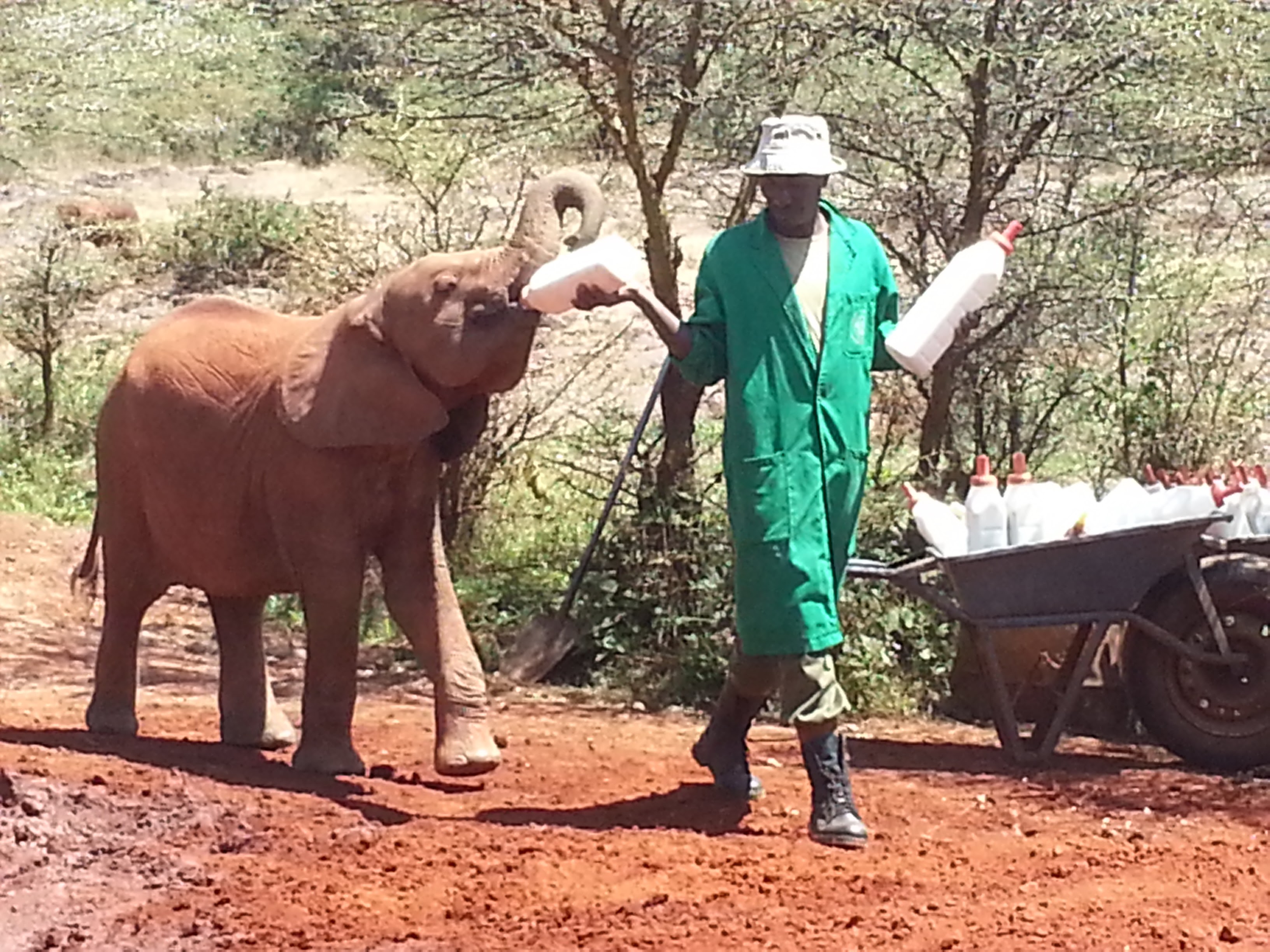
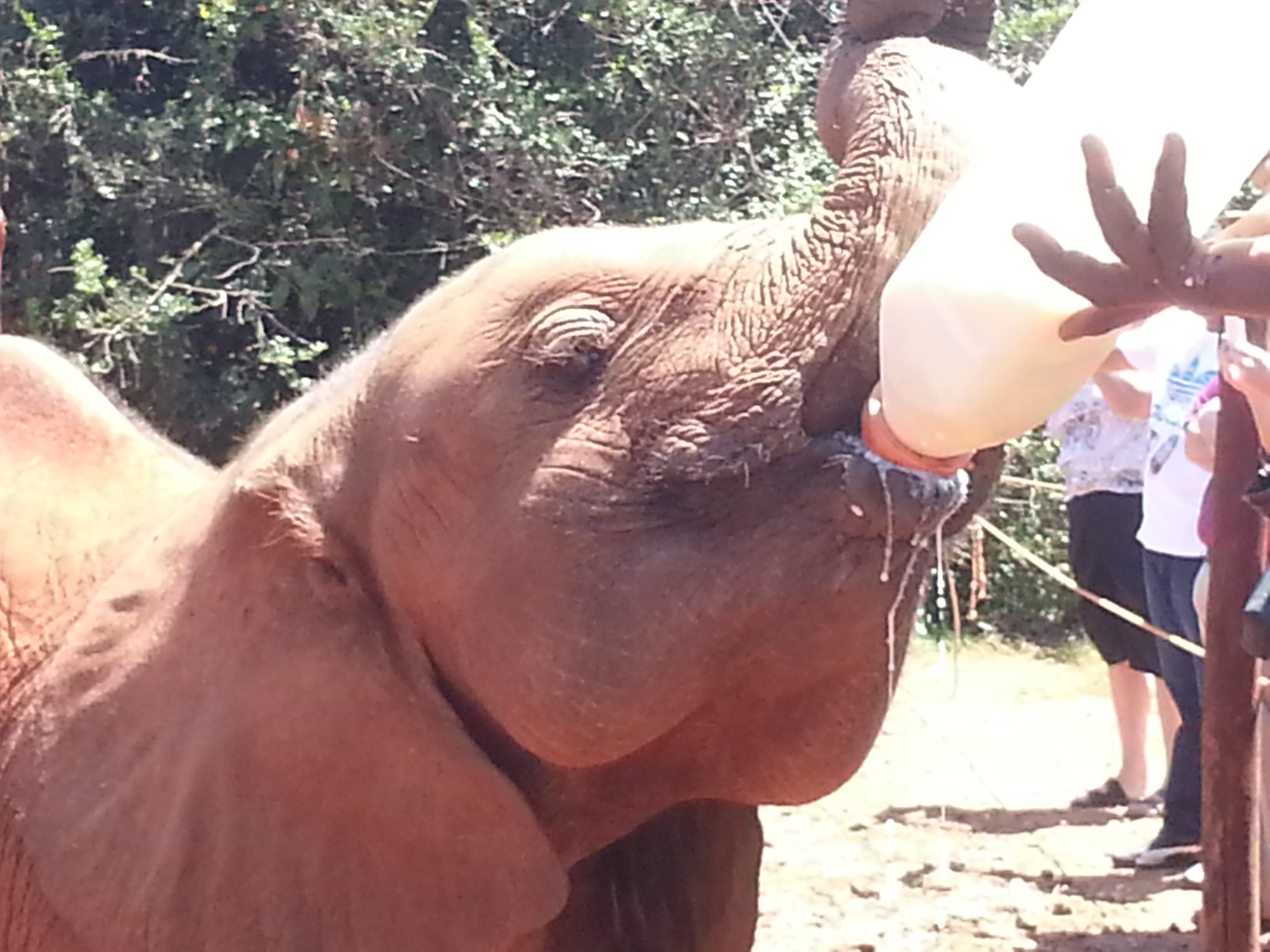
The David Sheldrick Wildlife Trust had us captivated from the first moment. The 11 o’clock feeding was surprisingly endearing, not commercial or money-grabbing, but educational and fascinating. It was wonderful to see the babies and their caretakers interacting. The love that goes into raising these orphans is amazing to behold.

This is a great initiative and needs loads of support to keep on going. I would recommend reading Dame Daphne Sheldrick’s memoirs (An African Love Story) for a deeper history on how this work came to be and the struggle to protect the Kenyan elephants.

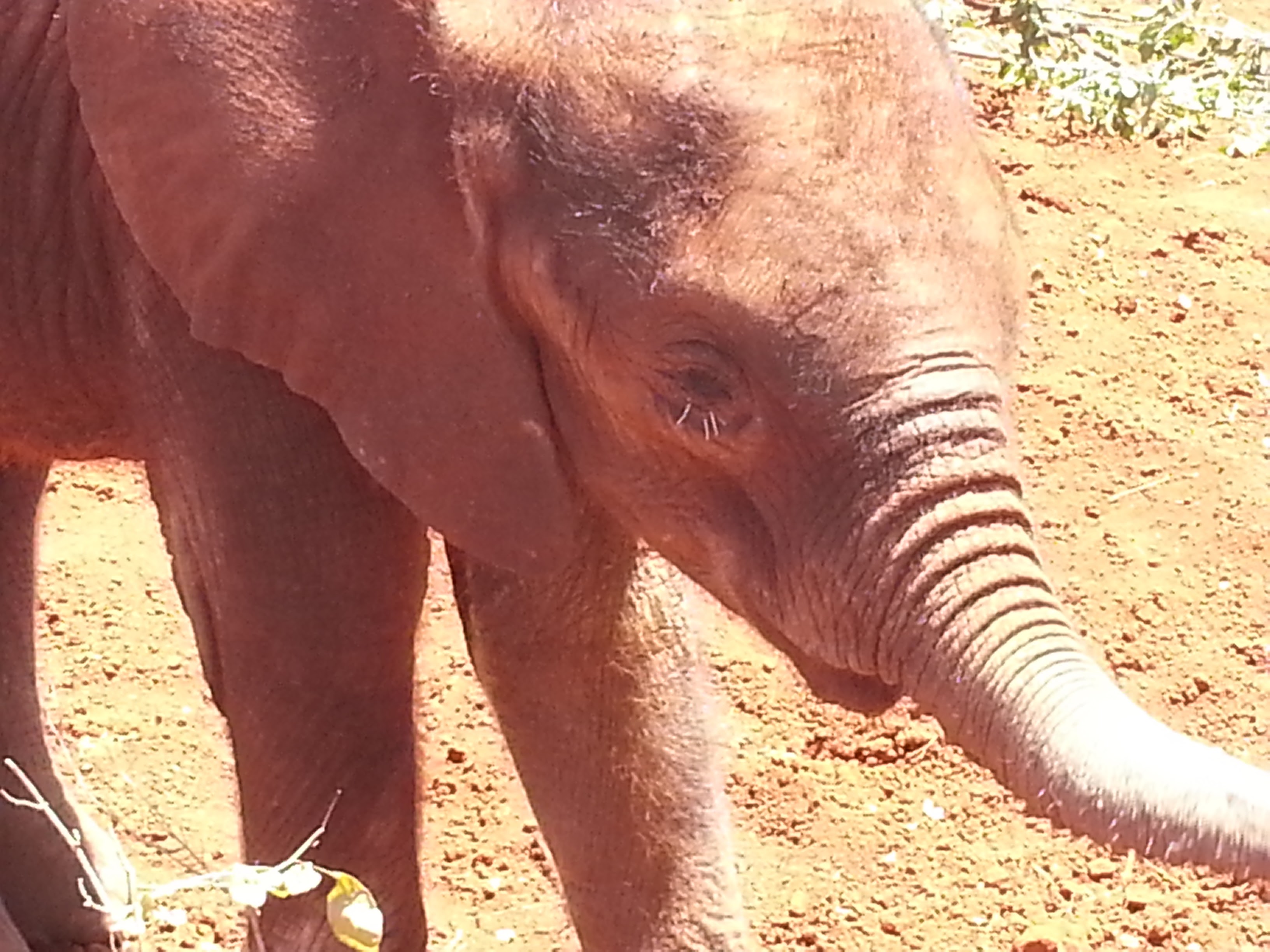
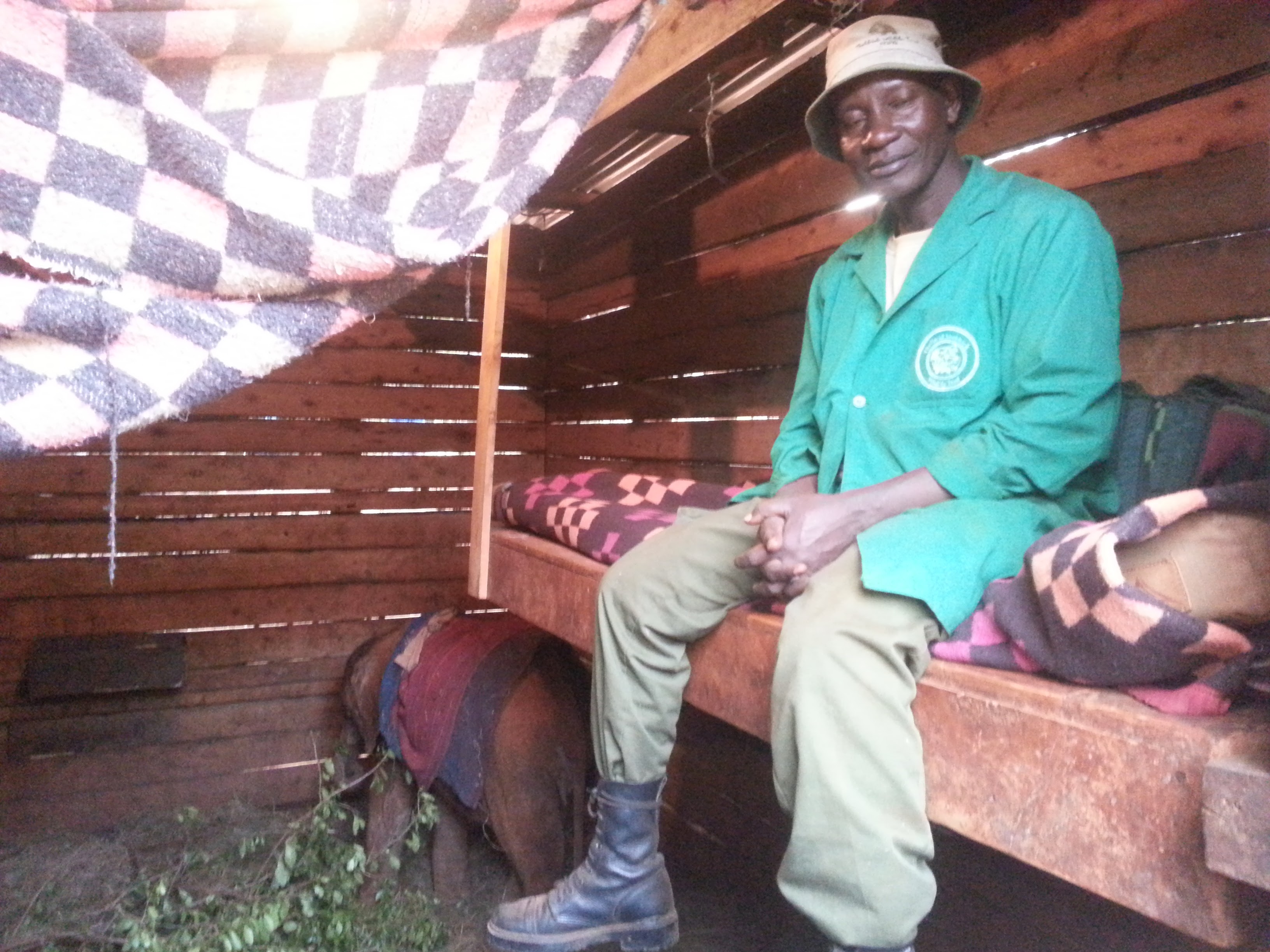
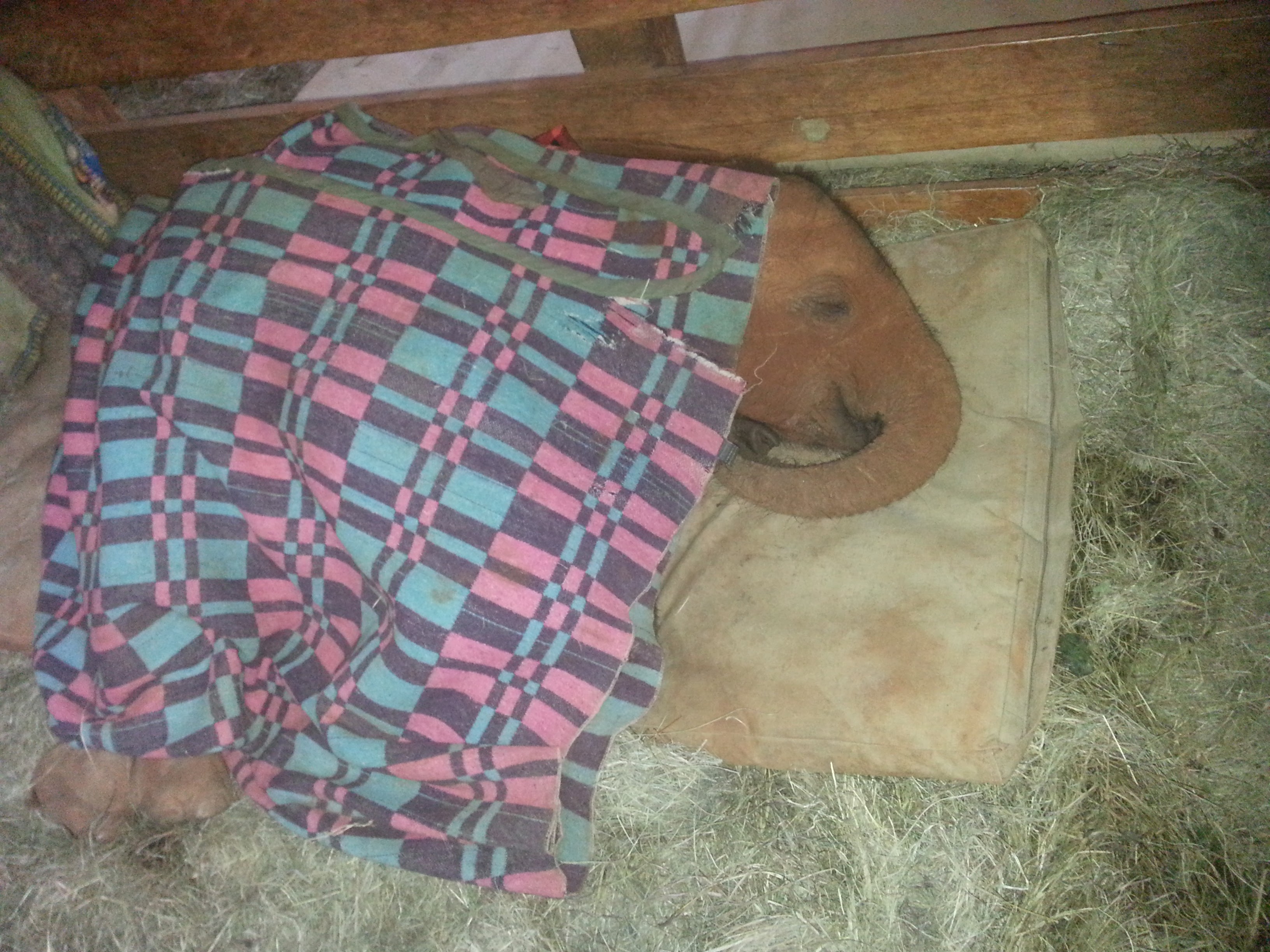
The highlight of our trip was to go back (by appointment) and meet our little adoptee, Ambo (a ten-month old elephant rescued from Amboseli), put him to bed and meet his caretakers. Ambo is just one of many orphans at the Trust and we were happy to know that we have contributed something to his 24 litres of daily milk for the next three years, as well as the countless other costs of running an establishment of this nature.

20160908_110524 20160908_110552 20160908_114823

Keepers like Meshack, who has been here almost 30 years, love their jobs and their orphans.

Thank you to the David Sheldrick Wildlife Trust team for all you do for these gentle giants, for Kenya, for Africa and for our children’s future with elephants and rhinos.

Giraffe Kisses

20160908_131044

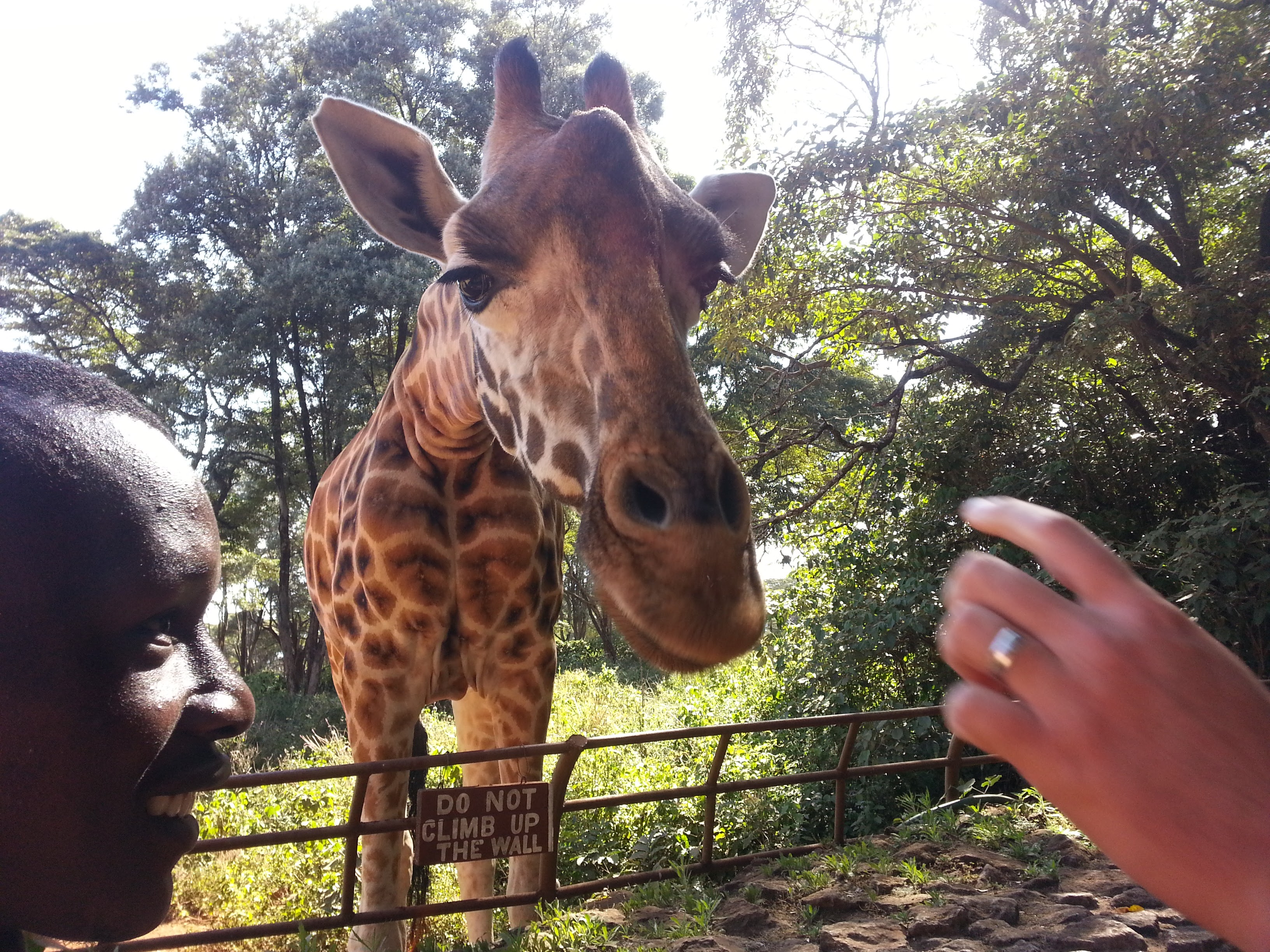
Having watched the Giraffe Tea movie as a child (with the little girl who feeds baby giraffes), I had always wanted to meet these majestic creatures up close and see the famous Giraffe Manor Hotel. Taking a few hours, we headed over to the Giraffe Centre in Karen, Nairobi – The African Fund for Endangered Wildlife.

Cost: As at September 2016, it cost 1000 KSH per non-resident for feeding, viewing and trails for the day.

There were nine giraffe altogether, including two small babies that were too cute for words, and a pregnant mama who was grumpy (and HUNGRY) stealing all the other giraffe’s vantage point for pellets.  There are also warthogs and birds to see from the platform if the giraffe allow you a view around their enormous heads.  Like a horse, it has a long nose, almost the length of your entire upper body, so the Afrikaans word ‘kameelperd’ (camel horse) seemed strangely appropriate up close.

20160908_152843 20160908_125653Kissing the giraffe seemed unthinkable, but we were assured by giggling giraffe centre educators of the ‘antiseptic properties’ of their saliva and the kisses were indeed great fun to photograph (because only one half of Travelinds was brave enough to do it after watching a few people get plastered). A 45cm tongue is rather adept at twirling the pellet right out between your thumb and forefinger and the head butts signal a demand for more!
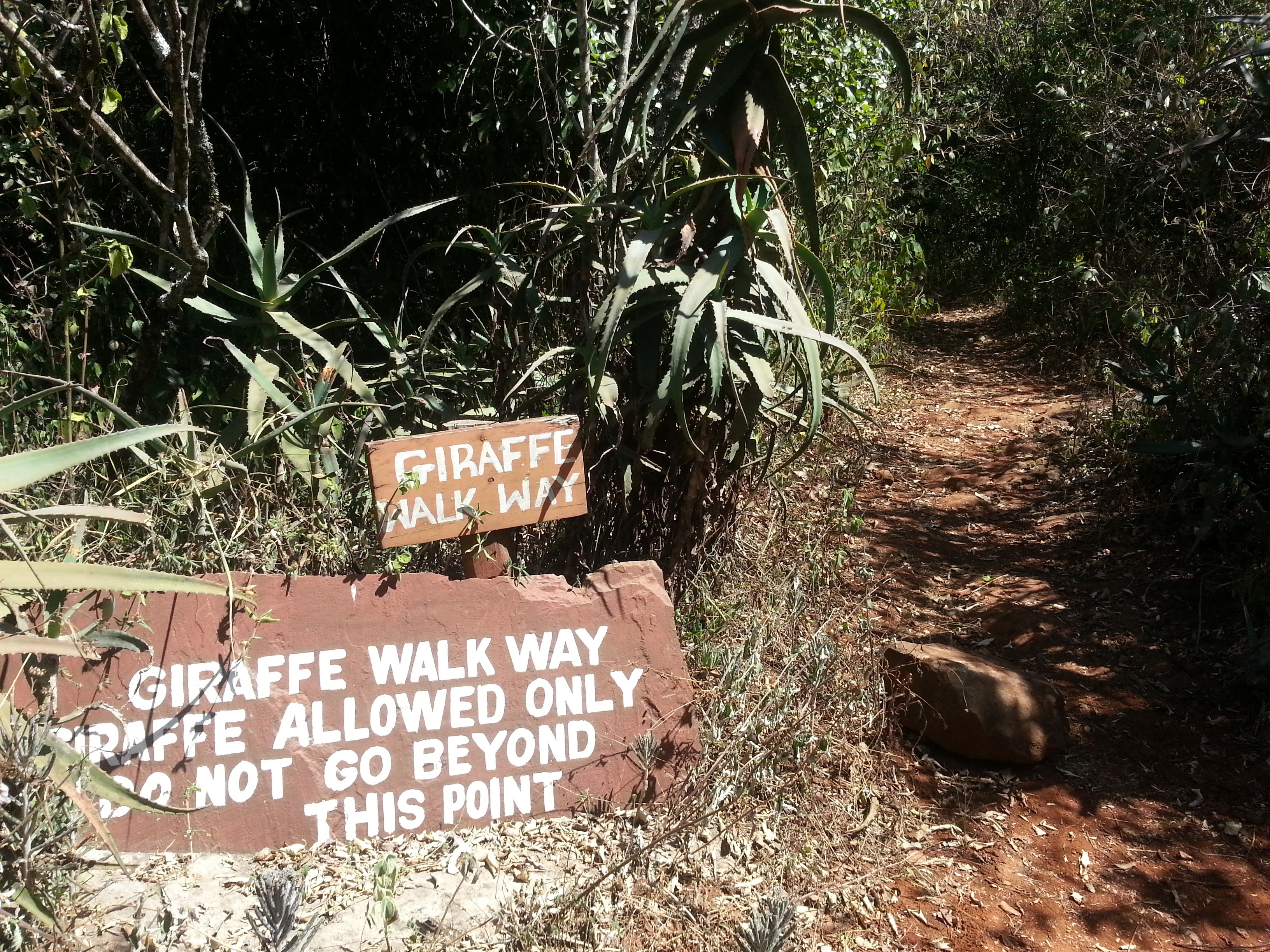
20160908_143051It was a hugely entertaining, and most of all educational visit, where we learnt about the subspecies of giraffe in Africa and how to identify them.  Before this, we were not even aware that we had seen different types of giraffe (Masaai with splotches, Rothschild with white legs and  the Southern Giraffe which we have in South Africa).
Nairobi National Park

This was a fun day out, twelve hours of driving around, picnicking, watching animals and enjoying nature. We arrived at sunrise, paid the exorbitant non-resident fees, and within the first minute of our drive through the gate saw a huge male lion walking in the road, roaring his head off and looking right into our car window. Wow!

We also saw more than a hundred ostriches over the day, all the antelope, black and white rhino, a couple of hundred Maribou storks, 10 secretary birds, a family of crowned cranes, Malachite Kingfisher and a bounty of other small creatures and birds.

Lowlights: Trash covered Kingfisher Picnic Site after the public holiday long weekend party and a brazen Sykes monkey stole our banana (out of the car!) at the one picnic area while we were stretching our legs (this might have been a highlight though).

These are the Kenya Wildlife Services park fees.

20160913_124811 20160913_113142 20160913_075527

At the end of the day, we visited the David Sheldrick Wildlife Trust to meet our adopted elephant and put him to bed. We had to drive out of the Banda Gate (get a special letter to exit) and then go down to the elephant orphanage through the secure area.

Goodnight, Ambo!
Goodnight, Ambo!

20160908_131100 20160908_112059

A wonderful end to a magical Kenyan trip!


Hlatikulu Bush Lodge, iMfolozi-Hluhluwe

JULY 2016

Photo Credits:  Wendy Buchanan (thanks, mom!)

A while ago, Travelinds told you about one of our favourite game reserves in Kwazulu-Natal – iMfolozi-Hluhluwe National Park.  The few days spent at Nselweni Bush Lodge was a great family holiday and we couldn’t wait to go back again!  This time we tried a new hideout – the Hlatikulu Bush Lodge!

13769451_10157119262840291_8995990913587496907_n

Hlatikulu Bush Lodge

This was a good surprise as we had only booked Hlatikulu in a rush to secure accomodation in an already full reserve.  However, as soon as we arrived, after navigating the jolting 4×4 route to get to the lodge, we realised that we had made yet another magnificent discovery!
The bush at your door
The camp is beautifully maintained by Siyabonga and New Year, both of whom have been there for ages and visibly love what they do. Right on the riverbend, with no fence, the animals and birds come and go as they please.  All around the camp are tweets and chirps, grunts and growls, spoor and feathers and evidence of life.
The deal

The camp can accomodate eight people at most, in four lovely huts (each for two people), all of which boast views of either the river or the bush.  The booking includes… (wait for it!)… TWO bush walks with Siyabonga and his gun (2-3hours, one morning, one afternoon) for every night that you stay.  New Year will cook any food that you can bring (and he will insist on setting up AND cleaning up everything in the communal lounge and diningroom himself, too). These two wonderful humans keep the huts immaculately clean and look after you while you simply relax and enjoy the wildlife.

13697057_10157119315235291_4857569789511689644_nNature up close

The resident bushpig, Georgina, can get a little persistent in the evening, but please, do not feed her even if she follows you down the boardwalk or begs.  There are also hippos, crocodiles, lions, elephants, buck and other creatures that roam in and out of the camp at their leisure – look around when you are outside and do remember that you are living in the real African wild now!

We fell asleep each night to lions roaring, hippos grunting, hyenas laughing and melodious nightjars. Early mornings wake up to birds singing and nyalas crunching grass right outside our windows.
A different perspective

The bush walks were also well worth the effort and if you do what Siyabonga tells you, you’ll be in good hands. He’s an experienced game ranger and takes his job, and your safety, seriously.  The animals are wild and unpredictable, especially where humans provoke and disrespect the natural order of things.  It is our responsibility to preserve and care for nature and a bush walk is a great way to remind yourself of your roots.13699980_10157123764390291_2516487894411405346_n

Hlatikulu, we’ll be back!

Read more reviews here.13690805_10157119327665291_1327660552813445550_n

Rhino Card

Use your rhino card to receive discounts on day fees, accomodation and more.  It was worth it for us to buy the card (for a couple) just to cover our day fees during the week here.  Ezemvelo KZN wildlife is also a great cause to support!


iMfolozi-Hluhluwe Game Reserve

30 January 2015


One of our favourite pastimes – and one of the things we miss the most about South Africa – is game viewing.  Not in a zoo, of course, but in a reserve.  The natural habitat of the animals is somewhere you are not guaranteed to see anything at all; but it’s all about the search!  Nothing compares with driving around all day scanning the bushveld, trees, slopes and ravines for animals and then catching a glimpse of the flicking white tail-end of a leopard, or the majestic mane of a ferocious (or lazy) male lion in the shade of a bush.  Reversing away from an approaching elephant or speeding to get away from a protective rhino mother is all the adrenaline you need!

So, this week was spent basking in God’s awesome creation at iMfolozi-Hluhluwe Game Reserve. What a fantastic place to see interesting, dangerous, funny, wild, crazy, big, tiny, rare and fascinating African wildlife in their natural habitat. Four hours from home,  this game reserve is a perfect getaway for long weekends.

Accomodation

We stayed at Nselweni Bush Camp which is down the road from Mpila, where we were supposed to be staying. Thanks to a misunderstanding and a booking problem, the management kindly allowed us to move over to Nselweni – a beautiful bush camp right on the bend of the river. We woke up with the birds and fell asleep with the night sounds of lions, frogs, hyenas and cicadas. It was perfect for a romantic getaway in a private “half tent/half cabin”that looks on to the bush. Conveniently, it was at a central iMfolozi location, about 20 minutes to Mpila.

Nselweni has fully equipped units with a braai place (that’s barbecue for non-Saffers), a gas oven, a fridge, kitchen utensils, an outside table and a semi-covered verandah. The shower window can open right up and the bathroom and bedroom both look out into the bush. We enjoyed the nyala that graze outside your hut during the day and its a colorful bird paradise.

We stayed here three nights in Unit 2 & 3 – both are lovely, private and quiet, especially Unit 2. Units 4 & 5 have half views of the river but only the Conference Centre deck gives a panoramic view of the river; and this is open to anyone who wants to use it. We saw buffalo, kingfishers, crocodile, trumpeter hornbills, impala, vultures and many others right from the deck.

Wildlife

At any wildlife reserve, you need to respect nature and remember that wild animals don’t follow the rules or take heed of the ‘boundaries’ us humans expect.  Watch out for the opportunistic hyenas at night who steal meat right off the braai or pinch anything left out on your verandah while you sleep. It’s best to take a torch and maybe a stick if you’re walking around the camp at night.

Our highlight sightings were a pack of wild dog, lion, puffback, bathing yellow-billed kite, a huge elephant breeding herd with little babies, so many white rhino and a metre-long vine snake on the road.

Night drive

On the last night, we treated ourselves to a night game drive (which leaves from Mpila camp) and we were so impressed with Bheki, our guide, who found us lion (up close and roaring), genet, chameleon, vine snake, crocodile, buffalo, rhino, nightjar, bushbuck.

Ezemvelo Wildlife

Thanks to Ezemvelo KZN wildlife, it was a wonderful stay.  They are doing a great job protecting Kwa-Zulu Natal’s wildlife, especially the precious rhinos!  We never did see that elusive Black Rhino on this trip, but the Whites were magnificent.

Sandakan

01 February 2014

SandakanSandakan is a small city on the east coast of Sabah, Malaysia Borneo. It is a port city and relies heavily on the palm oil trade, as well as other exports like cocoa, tobacco and sago.

Tourists use this city as a gateway to Sabah’s natural beauty with nearby eco-tourism destinations such as the Sepilok reserve, Turtle Islands, Danum Valley and the Kinabatangan River. It does not have much to see in the city itself but offers a couple of nice restaurants and a shopping mall at Harbour Square.  There are also a few historical sites and a museum if you have some time to kill.

It is about 6 hours by bus to Semporna and 2.5 hours to Bilit (known for eco-tourism lodges along the Kinabatangan river).

Read more on Sepilok, Kinabatangan River and Semporna here.