

They’re fighting against crazy odds to survive as their natural habitat gets smaller.
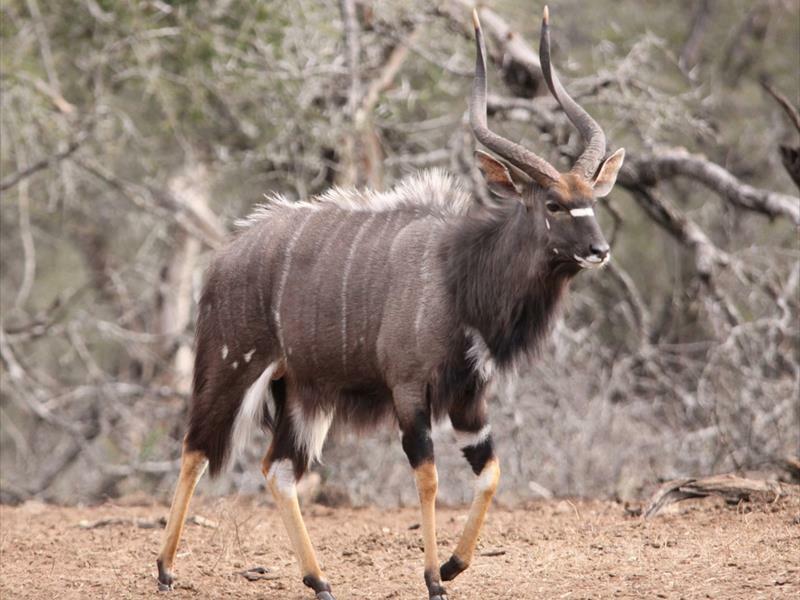 Nyala bull. PHOTO WIKIPEDIA
It’s the third day in a row I’ve seen them. Three shining hazel-coloured coats with white stripes dazzling in the morning sun. They stand there in the macadamia grove, hoping we won’t see them.
Maybe if they stand dead still, we’ll pass by quickly. But they forget that their flopsy, large ears flick away the bugs all the time. And the shape of them stands out very clearly against the backdrop of natural forest that drops off sharply below them.
Somehow, they find their way up through the cliffs and forest and steep gorge slopes. They follow paths the rest of us might not even recognise as throughways, pushing past thick bush and sharp prickles and over loose rocks to get to where they’re going. They’re brazen about chomping baby mac trees, but how can they pass on such succulent treats? They’re planted neatly in rows and cleared of long grass. It’s like a smorgas board as winter dries up the natural vegetation a little in the valley below.
Longtime Residents of Oribi Gorge and Other Wild Places
Nyalas are, by far, our most beautiful natural antelope here. The bulls have the most impressive curling horns with bright orange legs sticking out beneath the dark, hairy coats.
The males are called bulls because their impressive size competes with eland and kudu and all these much larger animals. But the dainty females are called ewes, not cows. They’re not big enough to classify in the upper category like their male counterparts. At least, that’s what the game rangers have told me on trips up to Hluhluwe.
Lessons From Antelope? I’ll Take Them
Even if that’s a tall tale, I’m entranced to have these beautiful nyalas right here at home. They’re just a stone’s throw away from me, a human female who needs regular reminders that how others classify me is no concern of mine. It shouldn’t be, anyway.
These ewes-not-cows are still incredibly beautiful. They’re good mommies to the baby nyalas we see every season. And they’re fighting against crazy odds to survive as their natural habitat gets smaller and smaller thanks to development, mines, and yes, farming.
So, they can nibble our mac trees (Sssh, don’t tell the farmers!) if it means I can still watch them. Let them shining in the sunshine in fifty years’ time with the oribis, duikers, warthogs, reedbuck, and everything else.
Published here.