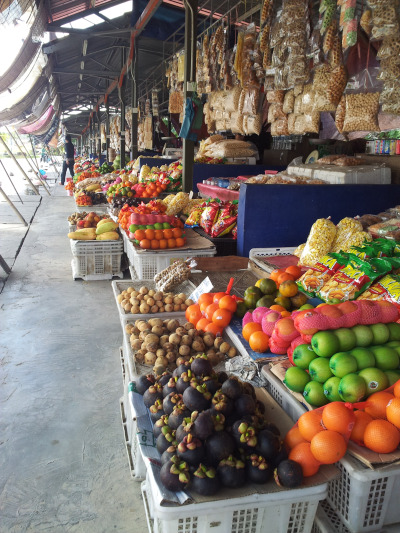

Semporna is a very small city on the south eastern border of Sabah, Malaysia Borneo. It is home to a wide range of cultural groups including Filipinos, Indonesians and Chinese Malaysians. It relies on palm oil and tourism to sustain its economy. It is best known for its association with some of the world’s most beautiful diving and snorkelling islands that lie just off the coastline. Check out Travelinds posts on the gorgeous northern islands off Semporna’s coast – Sibuan, Mabul, Mataking and Timba-Timba.
Upon arriving at this town via express bus, we were surprised to find a dirty, poorly maintained town with litter, water leaks and sorely evident poverty. The overall vibe here was so different to that of other charming cities we had visited in Sabah and our sixth senses seemed to kick in to high alert.
The only reason to visit Semporna is to use the town as a stepping stone across to the vast underwater beauty of its stunning coastline and surrounding islands. Scuba Junkie are the dive operators of choice in Semporna. The islands also boast fantastic white sandy beaches that rival the Tip of Borneo.
We took the Dyana Express Bus (from Sandakan MYR 40, about 6 hours, airconditioned, fairly comfortable). The Dyana express bus terminal is only a ten minute walk down to the waterfront and boat jetty so the town is pretty small. You could also take a taxi or intercity bus from Tawau (where the domestic airport is located), or an express bus from Kota Kinabalu.
We stayed at City Inn (right next to the Dyana bus terminal, ten minutes walk from the jetty) for only MYR60 per night. It was clean, quiet, more reasonably priced than backpackers and comfortable. Trip Advisor reviews seemed a bit harsh for the value for money of this hotel.
Staying in Semporna and doing the dives/snorkel trips from there is highly recommended because it generally works out a lot cheaper than staying on Mabul Island. There are also quite a few restaurant choices on the waterfront (unlike on Mabul Island) so this helps keep the budget in line.
If you are diving at Sipidan, however, you have to stay on Mabul Island or at Kapalai resort (this is usually arranged a little while beforehand though as things get booked up quite quickly).
The advice from a local dive instructor was that it was not really worth the money to stay on Mabul Island (no swimming beach, few restaurants, pricey accomodation) unless you were really into diving at a few of the exclusive spots. For regular snorkellers/divers, like ourselves, it worked out better to stay in Semporna and take trips out to the islands every day.
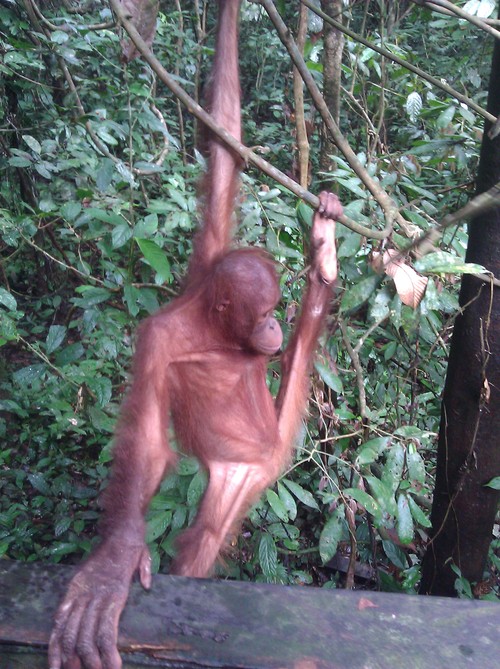
A long time dream of ours has been to see orangutans in the wild. These funny creatures are beautiful, weird and fascinating. The dwindling natural habitats of Borneo and Sumatra (the home of these apes) threaten to erase this species altogether.
In Malay, ‘orang’ means person (man) and ‘utan’ means ‘forest’ so the direct translation might be forest-person but the locals refer to it as ‘Man of the Forest’ when entertaining questions from curious tourists.
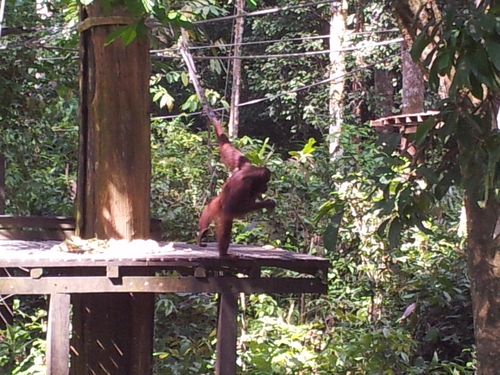
Due to the dire need to protect this special animal from deforestation and clashes with humans over crops and livelihoods, the Sepilok sanctuary was established in 1964. Its main purpose was to care for orphaned orangutans and rehabilitate them back in to the wild. The Kabili-Sepilok Sanctuary is 4,300 hectares of natural jungle and there are said to be almost 75 rehabilitated orangutans in the reserve.
The sanctuary has to feed some of the juvenile orangutans who have not yet learned to forage for themselves and they estimate that only 20% of the total orangutan population in Sepilok actually come to the feeding sites each week.
 Bird trail
Within the sanctuary there walking trails. From the Orangutan Sanctuary you can do the “Bird Trail” – a 2.2 kilometer (total) walk through the jungle to a bird viewing tower that overlooks the canopy. It is not an easy walk so be sure to take proper walking shoes and water with you. It can be muddy when raining and there are lots of roots and trees to clamber over along the way. We didn’t know it, but the trail actually closes at 2 p.m. so make sure you are back through the gate near the orangutan feeding section before 2 p.m.
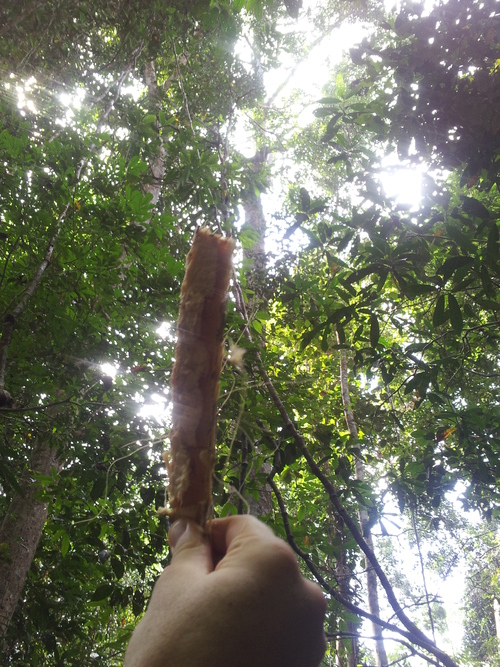
After walking for more than an hour, not seeing anything besides a troop of short-tailed macaques, we were almost smacked on the head by a half eaten pod. More pods and sticks came down in the next few minutes and no matter how hard we strained our eyes, we could not see the culprit who was trying to murder us.
Eventually, we spotted a small orangutan at the very top of the jungle canopy and we walked away with a half-eaten pod as a souvenir (and to prove to other people that the Bird trail was not a complete waste of time).
This is a reserve in which you can find orangutans, short-tailed and long-tailed macaques, squirrels (including giant flying squirrel), snakes, deer, a staggering variety of endemic birds (including the rare Great Argus) and other reptiles.
MYR 30 each for a one day pass. (Sun Bear Sanctuary is also MYR 30 each, Rainforest Discovery Centre MYR 15 each)
From Sandakan, Take the ‘14 Sepilok’ bus directly to Sepilok Orangutan Sanctuary. It leaves from the mini-bus terminal near the beachfront traffic circle (5 minutes walk from Harbor Square Mall). Bus trip takes about 50 minutes, RM5 (negotiable) and it leaves at 9.00am and 14.00pm from Sandakan to get you there just in time for the 10.00 am and 15.00 pm feedings.

Orangutan sanctuary 10.00 feeding, Sun Bear sanctuary 12.00 – 13.00, Rainforest discovery Centre 13.00 – 14.00, Orangutan sanctuary 15.00 feeding. Bus back to Sandakan at 16.00
*Recommended*
You can read more about Sepilok Reserve, Orangutan Rehabilitation Centre and Rainforest Discovery Centre here.
We hadn’t managed to get the Rainforest Discovery Centre (RDC) on our previous trip to Sepilok, as the orangutans had monopolised our time and attention on the first day at the Rehabilitation Sanctuary. So on Valentine’s Day, our last day in Sandakan, we returned to Sepilok area and spent the day at the RDC. Our intention was to enjoy the bird-watching opportunities that we hadn’t really done to yet.
With ominous weather looming, we brought along rain ponchos and also a few snacks to see us through lunch time should we be distracted by the array of colourful birds that we hoped to see.
We started the day with a stroll along the canopy walkway, punctuated with long rest periods at the various seated viewing sites along the way. At the broadbill tower, we stopped and admired some of the bird-life (although not the elusive broadbill itself) and had a couple of snacks while we looked over at the dam and its surrounding tree tops.
All of a sudden, H noticed a bright orange blur on the far side of the dam and the orange blur continued to jump down from tree to tree, from the highest point of the canopy to the lower level forest. Excited, but without a pair of binoculars to confirm, we headed off in the direction of the orange blur’s final destination in hopes of seeing a monkey or some other creature.
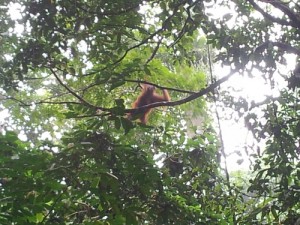 Turns out, it was a small orangutan! A real, live, wild orangutan in the forest where we had only expected to be seeing birds and bugs. We strained our necks and happily watched him for at least an hour, eating and playing on one of the lower trees.
As happens regularly, there was suddenly a downpour and while we were grabbing our ponchos, the orangutan was quickly constructing a nest of leaves and sticks to shelter himself from the ensuing rain. It was amazing to watch him build a nest and search for bigger leaves and longer sticks when the smaller ones didn’t cover him sufficiently. We were forced to seek shelter as the rain got harder and harder and we hid out in a small hut until the worst of the storm had passed.
We also saw some amazing birdlife and a Great Red flying squirrel as we were walking later that day.
From Sandankan, Number 14 Bus (Sepilok), ask to get out at Rainforest Discovery Centre (it is 2km before the Orangutan reserve and about 1km from the main junction roundabout). take the same route as for Sepilok Orangutan Rehabilitation Centre (Sepilok reserve covers this whole area).
Entrance Fee: MYR 15 per person
For suggested itineraries for Sepilok, click here.
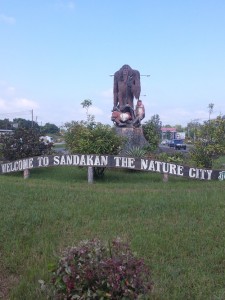 Sandakan is a small city on the east coast of Sabah, Malaysia Borneo. It is a port city and relies heavily on the palm oil trade, as well as other exports like cocoa, tobacco and sago.
Tourists use this city as a gateway to Sabah’s natural beauty with nearby eco-tourism destinations such as the Sepilok reserve, Turtle Islands, Danum Valley and the Kinabatangan River. It does not have much to see in the city itself but offers a couple of nice restaurants and a shopping mall at Harbour Square. There are also a few historical sites and a museum if you have some time to kill.
It is about 6 hours by bus to Semporna and 2.5 hours to Bilit (known for eco-tourism lodges along the Kinabatangan river).
Read more on Sepilok, Kinabatangan River and Semporna here.
Borneo Sandakan Backpackers was a pleasant surprise. It’s a clean, friendly, comfortable backpackers in the heart of Sandakan, with an attached tour company that has some of the most efficient staff I have ever met.
A head’s up from a friend (read their blog of six months touring in South East Asia) told us to use this backpackers as our stop off point in Sandakan and also arrange our Kinabatangan river tour through them. We followed their advice and were not disappointed, not even once.
Good points at the backpackers were the clean rooms and bathrooms, airconditioning in the private room, 24 hour desk service, delicious breakfasts (egg, toast, jam, coffee, oats) and friendly, efficient staff. It is also in the Harbour Square location in Sandakan, which is close to the mall, the bus terminal, the minibus terminal, restaurants and the markets. The staff (especially Jonathan) are especially helpful and friendly when it comes to giving free advice on travelling in and around Sandakan. There are maps, posters, bus schedules and tourism brochures available at the backpackers to help you plan the best trip for you.
A Bad point was the dripping shower overflow (kept us awake a little), but that was all.
TIP: Be careful about backpackers with similar names like Sandakan backpackers, Borneo backpackers etc – especially if you are booking online. This is Borneo Sandakan Backpackers and Borneo Sandakan Tours. It is a red and white logo as on the website. Read TripAdvisor Reviews for more information.
 After a friend travelled to Borneo a few months ago, she told us about these ‘jungle river tours’ that are available in Sabah.
The tours travel along the Kinabatangan River where the rainforest creatures still live in the wild. I must admit that this was the main thing that drew me to Sabah itself, as my passion for wildlife exceeds much else in my life. My hope was to find orangutans, proboscis monkeys, pygmy elephants, rhinoceros hornbills and a clouded leopard – and I’d say that having seen 4 of these 5 wasn’t a bad track record for only five nights in the jungle.
 Kinabatangan means ‘china, long river or tree’ and again, it is uncertain where this name originated, but it sure is a very long and rather wide river. It twists and turns back on itself in several places, creating ox-bow lakes; and the river boasts an impressive total length of about 560 kilometres. The area is teeming with wildlife but there are also many parts in Upper-Kinabatangan that have been badly affected by encroaching palm oil plantations. There are conservation efforts to protect the remaining wildlife but clashes between man and nature are often unavoidable.
Lodges are based mainly in the Sukau town area, but Bilit village also has a few which are on the quieter end of things. We ended up enjoying the first tour so much, that we came back to Bilit Adventure Lodge for a second time, after a week in Semporna. During our tours (in mid-February 2014, still technically ‘monsoon season’ for this area) we managed to get thoroughly soaked at least twice on each tour but the rewards were so much greater than a few hours of driving rain. Read a few Kinabatangan River TripAdvisor reviews for more information.
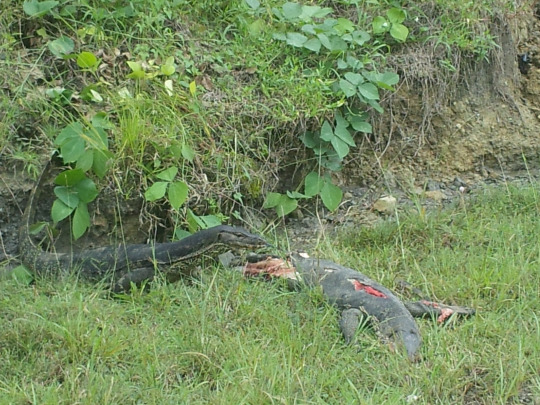
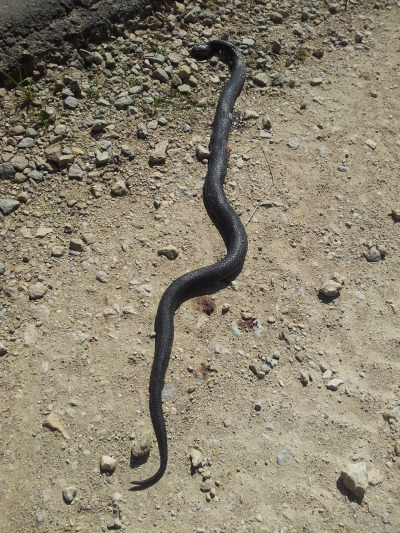
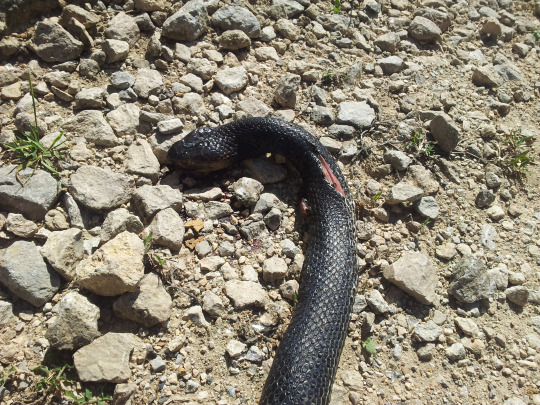
Our wildlife sightings over the five days were: mouse deer (at our lodge!), proboscis monkey, silver leaf monkey, orangutan, long-tailed macaque, short-tailed macaque, crocodile, monitor lizzards, kettle fish, pygmy elephants, python, yellow ring snake, black squirrel, mudfish (no gills!), red velvet dragonflies, one dead black cobra (huge!) and leeches.
 With a vast array of beautiful birds in this area, some of our special bird sightings (those we actually knew the names of anyway) were: stork-billed kingfisher, rhinoceros hornbill (so impressive!), oriental pied hornbill, wrinkled hornbill, black hornbill, bushy-crested hornbill, blue-eared kingfisher, red coucal, lily hens, black and red broadbill (stunning!), blue-throated bee eaters, lesser fish eagle, serpent eagle, ashy tailorbird, egrets, herons and so many other feathered friends!
Sadly, we didn’t see: Sumatran Rhinoceros (not seen by our guide in 16 years on the job), clouded leopard, slow loris, tarsiers, sunbear, mongoose and read leaf monkeys.
Overall, it was a fantastic trip and we really appreciated that this could be a once in a lifetime experience. We hope that one day our children may also be given the chance to see these amazing creatures in their natural habitat, provided environmental conservation efforts can keep them protected that long in to the future. It would be such a shame to lose yet another part of God’s wonderful creation to man’s destruction.
Read more about our adventures in the jungle here.


