Tag Archives: wildlife

Hlatikulu Bush Lodge, iMfolozi-Hluhluwe

JULY 2016

Photo Credits:  Wendy Buchanan (thanks, mom!)

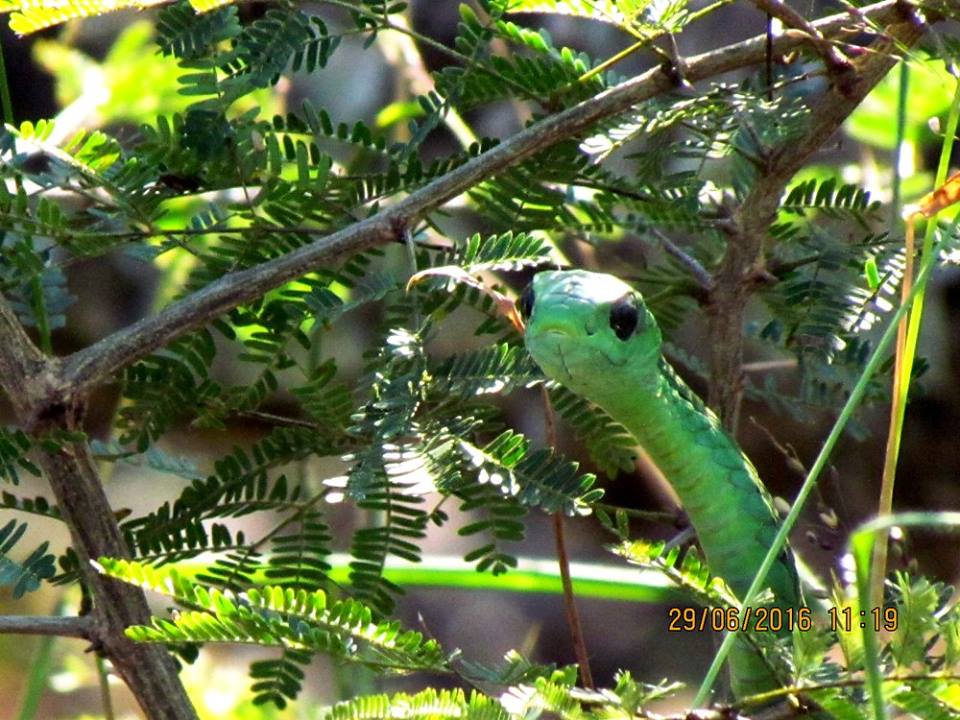
A while ago, Travelinds told you about one of our favourite game reserves in Kwazulu-Natal – iMfolozi-Hluhluwe National Park.  The few days spent at Nselweni Bush Lodge was a great family holiday and we couldn’t wait to go back again!  This time we tried a new hideout – the Hlatikulu Bush Lodge!

13769451_10157119262840291_8995990913587496907_n

Hlatikulu Bush Lodge

This was a good surprise as we had only booked Hlatikulu in a rush to secure accomodation in an already full reserve.  However, as soon as we arrived, after navigating the jolting 4×4 route to get to the lodge, we realised that we had made yet another magnificent discovery!
The bush at your door
The camp is beautifully maintained by Siyabonga and New Year, both of whom have been there for ages and visibly love what they do. Right on the riverbend, with no fence, the animals and birds come and go as they please.  All around the camp are tweets and chirps, grunts and growls, spoor and feathers and evidence of life.
The deal

The camp can accomodate eight people at most, in four lovely huts (each for two people), all of which boast views of either the river or the bush.  The booking includes… (wait for it!)… TWO bush walks with Siyabonga and his gun (2-3hours, one morning, one afternoon) for every night that you stay.  New Year will cook any food that you can bring (and he will insist on setting up AND cleaning up everything in the communal lounge and diningroom himself, too). These two wonderful humans keep the huts immaculately clean and look after you while you simply relax and enjoy the wildlife.

13697057_10157119315235291_4857569789511689644_nNature up close

The resident bushpig, Georgina, can get a little persistent in the evening, but please, do not feed her even if she follows you down the boardwalk or begs.  There are also hippos, crocodiles, lions, elephants, buck and other creatures that roam in and out of the camp at their leisure – look around when you are outside and do remember that you are living in the real African wild now!

We fell asleep each night to lions roaring, hippos grunting, hyenas laughing and melodious nightjars. Early mornings wake up to birds singing and nyalas crunching grass right outside our windows.
A different perspective

The bush walks were also well worth the effort and if you do what Siyabonga tells you, you’ll be in good hands. He’s an experienced game ranger and takes his job, and your safety, seriously.  The animals are wild and unpredictable, especially where humans provoke and disrespect the natural order of things.  It is our responsibility to preserve and care for nature and a bush walk is a great way to remind yourself of your roots.13699980_10157123764390291_2516487894411405346_n

Hlatikulu, we’ll be back!

Read more reviews here.13690805_10157119327665291_1327660552813445550_n
Rhino Card

Use your rhino card to receive discounts on day fees, accomodation and more.  It was worth it for us to buy the card (for a couple) just to cover our day fees during the week here.  Ezemvelo KZN wildlife is also a great cause to support!
 

Jungle Road

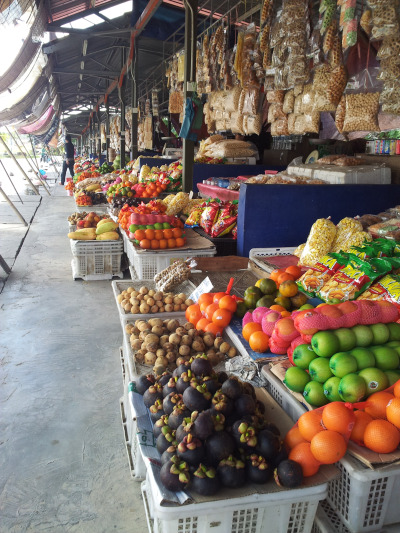
Colourful markets along the main Kinabatangan highway.
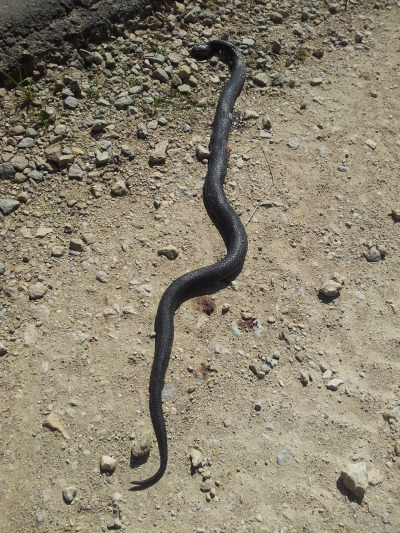
An (unfortunately) dead Forest Cobra - these snakes can grow to terrifying lengths and are fierce predators.
An (unfortunately) dead Forest Cobra – these snakes can grow to terrifying lengths and are fierce predators.
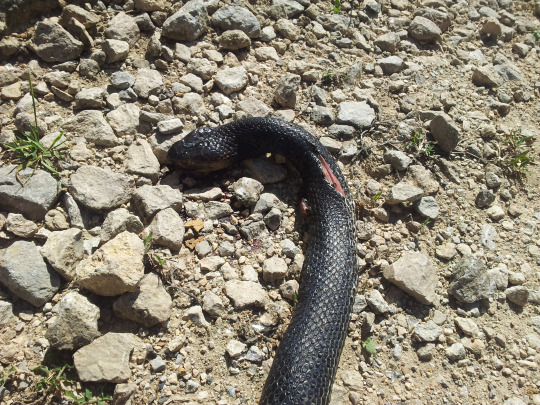
As close as we dared to photograph the dead cobra (what if it was faking?)
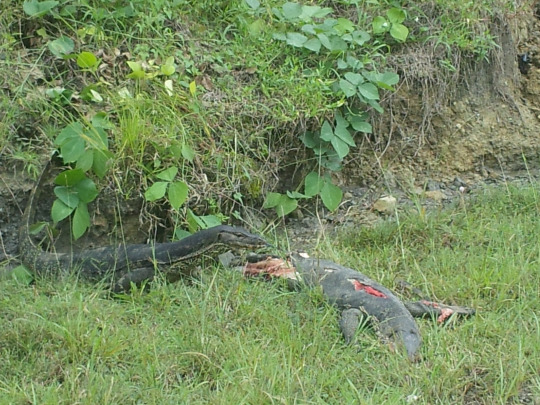
Travelinds' first sight of a monitor lizard eating it's own kind (who had been roadkill just a few hours before).
Travelinds’ first sighting of a monitor lizard eating it’s own kind (who had been roadkill just a few hours before).

iMfolozi-Hluhluwe Game Reserve

30 January 2015


One of our favourite pastimes – and one of the things we miss the most about South Africa – is game viewing.  Not in a zoo, of course, but in a reserve.  The natural habitat of the animals is somewhere you are not guaranteed to see anything at all; but it’s all about the search!  Nothing compares with driving around all day scanning the bushveld, trees, slopes and ravines for animals and then catching a glimpse of the flicking white tail-end of a leopard, or the majestic mane of a ferocious (or lazy) male lion in the shade of a bush.  Reversing away from an approaching elephant or speeding to get away from a protective rhino mother is all the adrenaline you need!

So, this week was spent basking in God’s awesome creation at iMfolozi-Hluhluwe Game Reserve. What a fantastic place to see interesting, dangerous, funny, wild, crazy, big, tiny, rare and fascinating African wildlife in their natural habitat. Four hours from home,  this game reserve is a perfect getaway for long weekends.

Accomodation

We stayed at Nselweni Bush Camp which is down the road from Mpila, where we were supposed to be staying. Thanks to a misunderstanding and a booking problem, the management kindly allowed us to move over to Nselweni – a beautiful bush camp right on the bend of the river. We woke up with the birds and fell asleep with the night sounds of lions, frogs, hyenas and cicadas. It was perfect for a romantic getaway in a private “half tent/half cabin”that looks on to the bush. Conveniently, it was at a central iMfolozi location, about 20 minutes to Mpila.

Nselweni has fully equipped units with a braai place (that’s barbecue for non-Saffers), a gas oven, a fridge, kitchen utensils, an outside table and a semi-covered verandah. The shower window can open right up and the bathroom and bedroom both look out into the bush. We enjoyed the nyala that graze outside your hut during the day and its a colorful bird paradise.

We stayed here three nights in Unit 2 & 3 – both are lovely, private and quiet, especially Unit 2. Units 4 & 5 have half views of the river but only the Conference Centre deck gives a panoramic view of the river; and this is open to anyone who wants to use it. We saw buffalo, kingfishers, crocodile, trumpeter hornbills, impala, vultures and many others right from the deck.

Wildlife

At any wildlife reserve, you need to respect nature and remember that wild animals don’t follow the rules or take heed of the ‘boundaries’ us humans expect.  Watch out for the opportunistic hyenas at night who steal meat right off the braai or pinch anything left out on your verandah while you sleep. It’s best to take a torch and maybe a stick if you’re walking around the camp at night.

Our highlight sightings were a pack of wild dog, lion, puffback, bathing yellow-billed kite, a huge elephant breeding herd with little babies, so many white rhino and a metre-long vine snake on the road.

Night drive

On the last night, we treated ourselves to a night game drive (which leaves from Mpila camp) and we were so impressed with Bheki, our guide, who found us lion (up close and roaring), genet, chameleon, vine snake, crocodile, buffalo, rhino, nightjar, bushbuck.

Ezemvelo Wildlife

Thanks to Ezemvelo KZN wildlife, it was a wonderful stay.  They are doing a great job protecting Kwa-Zulu Natal’s wildlife, especially the precious rhinos!  We never did see that elusive Black Rhino on this trip, but the Whites were magnificent.

Tsitsikamma, Storms River Mouth – I <3 South Africa

Destination: Tsitsikamma

Eastern Cape, South Africa

Description

Tsitsikamma National Park is one of the most beautiful holiday destinations in South Africa and it is situated on the world-famous Garden Route.  TsitsikammaIts rolling green hills, sheer cliffs, wild oceans, fascinating wildlife and rugged beauty are simply breath-taking; Mother Nature at her finest.Tsitsikamma


Tourist Must-sees

In the National Park itself, there are camping facilities, chalets, hiking trails, picnic spots, a bird-watchers paradise, plenty of wildlife and the rugged sandy beaches that belong to the earth, not to tourists.Tsitsikamma view

There are also amazing sight-seeing opportunities in the nearby areas of Storms River Mouth and the village, Nature’s Valley, Plettenberg Bay and The Crags.

The Big Tree, The Otter Trail, Robberg Nature Reserve and Birds of Eden are some of my favourite spots in this area.


Attractions range from the highest bungee-jump in the world at Bloukrans to the five-day beach hike on the Otter Trail, this place offers adventure-seekers a multitude of thrilling endeavours.


There are also a number of acclaimed restaurants nearby.

I especially recommend De Oude Martha in Storms River Village (a short drive from the Tsitsikamma Reserve). There are also other interesting places like Canopy Tours, Monkeyland and the Elephant Sanctuary to make for a great day out with the whole family.


Tsitsikamma is also a perfect setting in which to relax and enjoy the sunsets, or do some serious whale-watching and stroll along the green pathways alongside the dark blue coastline.

My favourite place

My favourite place here is at the Tsitsikamma National Park at the Storms River Mouth Rest Camp. There are cute wooden cabins here, perfect for a romantic getaway, where in fact we enjoyed a very romantic spring break in October 2011.

Otter TrailMemory Bank:

We walked a little way along the Otter Trail to reach the famous waterfall pool, seeing antelope, cormorants, whales, dolphins, seagulls, baboons and kingfishers along the way. Then followed a lunchtime picnic followed by a cool swim in the tannin-coloured waters below the waterfall before heading back along the trail. A little way before the camp, we found a secret rock pool below the path where we enjoyed a dip in the refreshing waters; dodging the bunch of sea urchins on one end of the pool.  Such an amazing day!

Fun facts:

  • Whale-watching Season: June to November
  • Climate:                                 Temperate Coastal Climate – The wettest months are May and October, and the driest are June and July.

Helpful Resources:

Booking website: Tsitsikamma National Park (SANPARKS)

Recommended Tour Agent: Imvelaphi Safaris (her name is Jeannette and she is a vibrant, knowledgeable and professional entrepreneur who will provide you with an awesome tour package).

Check out more posts about South Africa here >> *I <3 South Africa*


Sepilok Orang Utan Sanctuary

03 February 2014


Orang Utan – ‘Man of the Forest’

orangutan
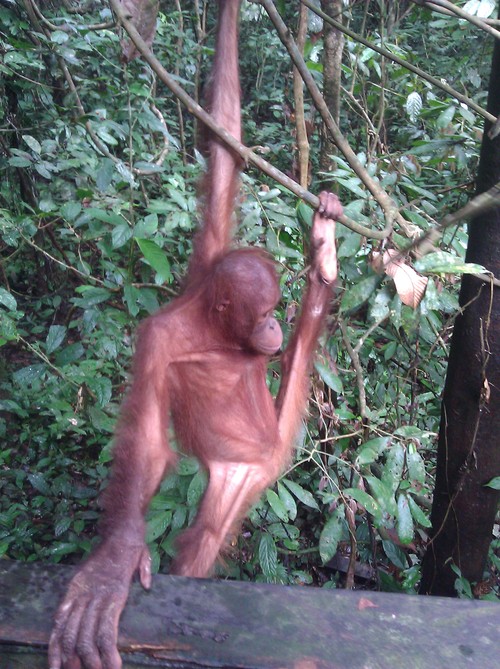
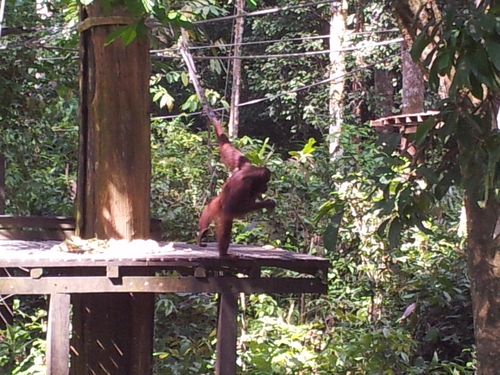
Picture of young orangutan thanks to fellow travellers Olena and Yvginiy who kindly provided a close-up for us.

A long time dream of ours has been to see orangutans in the wild. These funny creatures are beautiful, weird and fascinating.  The dwindling natural habitats of Borneo and Sumatra (the home of these apes) threaten to erase this species altogether.

In Malay, ‘orang’ means person (man) and ‘utan’ means ‘forest’ so the direct translation might be forest-person but the locals refer to it as ‘Man of the Forest’ when entertaining questions from curious tourists.

Orangutan facts

  • The Orangutans are the only apes that inhabit Asia.
  • They are highly intelligent and naturally solitary.
  • The Borneo male’s armspan can reach up to 7 feet (2 metres) and male orangutans have distinctive black cheeks and fleshy jowls.
  • They can not swim, unlike so many of the other animals that make their home in the rainforests of Borneo.
  • The mother and baby will stay together for up to seven years until the baby is ready to go it alone in the wild.
  • Females only give birth once every eight years, which is why the numbers of orangutans are decreasing so quickly and also why there is such a need for the Sepilok sanctuary to care for orphaned baby orangutans.
  • They use big leaves as umbrellas against the regular downpours and branches to make sleeping nests.
  • There diet consists of fruit and leaves and they spend 90% of their time in the trees. This is why deforestation is so detrimental to orangutan populations.

Sanctuary

tumblr_inline_n445nd8kyb1rg4d7l
Female orangutan with her baby clinging on tightly. Feeding at Sepilok.

Due to the dire need to protect this special animal from deforestation and clashes with humans over crops and livelihoods, the Sepilok sanctuary was established in 1964.  Its main purpose was to care for orphaned orangutans and rehabilitate them back in to the wild.  The Kabili-Sepilok Sanctuary is 4,300 hectares of natural jungle and there are said to be almost 75 rehabilitated orangutans in the reserve.

Feeding time

The sanctuary has to feed some of the juvenile orangutans who have not yet learned to forage for themselves and they estimate that only 20% of the total orangutan population in Sepilok actually come to the feeding sites each week.

tumblr_inline_n445g9P4kg1rg4d7lBird trail

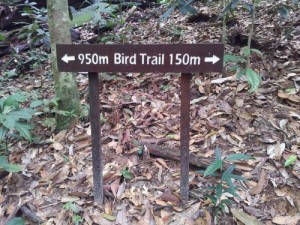
Within the sanctuary there walking trails.  From the Orangutan Sanctuary you can do the “Bird Trail” – a 2.2 kilometer (total) walk through the jungle to a bird viewing tower that overlooks the canopy.  It is not an easy walk so be sure to take proper walking shoes and water with you. It can be muddy when raining and there are lots of roots and trees to clamber over along the way.  We didn’t know it, but the trail actually closes at 2 p.m. so make sure you are back through the gate near the orangutan feeding section before 2 p.m.


Special memory along the bird trail

tumblr_inline_n445vyYES11rg4d7l
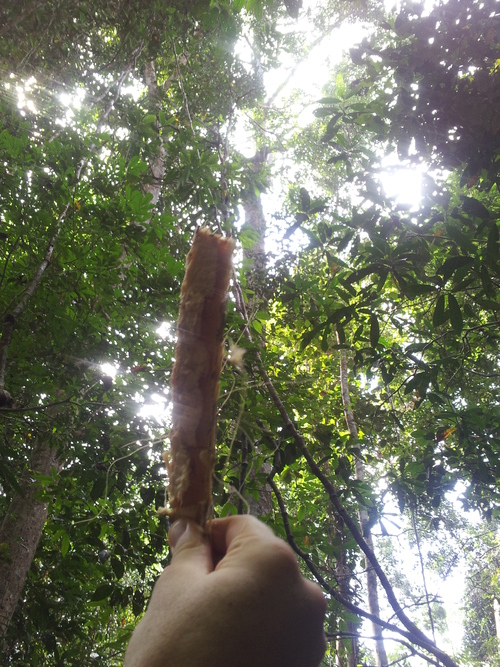
This is one the sticks that the orangutan was throwing down to the canopy floor; the only reason why we spotted him all the way up there in the first place.

After walking for more than an hour, not seeing anything besides a troop of short-tailed macaques, we were almost smacked on the head by a half eaten pod.  More pods and sticks came down in the next few minutes and no matter how hard we strained our eyes, we could not see the culprit who was trying to murder us.

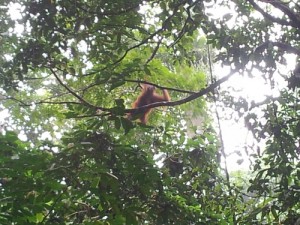
Eventually, we spotted a small orangutan at the very top of the jungle canopy and we walked away with a half-eaten pod as a souvenir (and to prove to other people that the Bird trail was not a complete waste of time).


Wildlife

This is a reserve in which you can find orangutans, short-tailed and long-tailed macaques, squirrels (including giant flying squirrel), snakes, deer, a staggering variety of endemic birds (including the rare Great Argus) and other reptiles.

Admission

MYR 30 each for a one day pass. (Sun Bear Sanctuary is also MYR 30 each, Rainforest Discovery Centre MYR 15 each)

Tips: Visitors are not allowed to take any food or drink into the sanctuary as the animals may try to steal. There are (Free) lockers available at the office where you can leave your bags (small bags/backpacks only).

Bus

From Sandakan, Take the ‘14 Sepilok’ bus directly to Sepilok Orangutan Sanctuary. It leaves from the mini-bus terminal near the beachfront traffic circle (5 minutes walk from Harbor Square Mall). Bus trip takes about 50 minutes, RM5 (negotiable) and it leaves at 9.00am and 14.00pm from Sandakan to get you there just in time for the 10.00 am and 15.00 pm feedings.

Day trip options from SandakanSandakan

Sepilok One Day:

Orangutan sanctuary 10.00 feeding, Sun Bear sanctuary 12.00 – 13.00, Rainforest discovery Centre 13.00 – 14.00, Orangutan sanctuary 15.00 feeding. Bus back to Sandakan at 16.00


*Recommended*

Sepilok Two Days:
  • DAY 1: Orangutan sanctuary 10.00 feeding, Bird Trail and lunch 11.30 – 14.00, Informational video 14.30, Orangutan 15.00, Bus back to Sandakan at 16.00
  • DAY 2: Rainforest Discovery Centre morning,  lunch outside the Orangutan Centre at local stall, Sunbear Sanctuary afternoon. Take the 9.00 a.m. Bus 14 from Sandakan, ask to be dropped at Rainforest Discovery Centre. Take 16.00 bus back to Sandakan from the Sepilok Orangutan Sanctuary. (Note: Rainforest discovery centre is about 1.2km walk from the Sunbear and Orangutan Sanctuaries)

You can read more about Sepilok Reserve, Orangutan Rehabilitation Centre and Rainforest Discovery Centre here.


Rainforest Discovery Centre- Sepilok

02 February 2014

Sandakan to Sepilok

We hadn’t managed to get the Rainforest Discovery Centre (RDC) on our previous trip to Sepilok, as the orangutans had monopolised our time and attention on the first day at the Rehabilitation Sanctuary.  So on Valentine’s Day, our last day in Sandakan, we returned to Sepilok area and spent the day at the RDC.  Our intention was to enjoy the bird-watching opportunities that we hadn’t really done to yet.

With ominous weather looming, we brought along rain ponchos and also a few snacks to see us through lunch time should we be distracted by the array of colourful birds that we hoped to see.

Rainforest Discovery Centre

We started the day with a stroll along the canopy walkway, punctuated with long rest periods at the various seated viewing sites along the way.  At the broadbill tower, we stopped and admired some of the bird-life (although not the elusive broadbill itself) and had a couple of snacks while we looked over at the dam and its surrounding tree tops.

All of a sudden, H noticed a bright orange blur on the far side of the dam and the orange blur continued to jump down from tree to tree, from the highest point of the canopy to the lower level forest.  Excited, but without a pair of binoculars to confirm, we headed off in the direction of the orange blur’s final destination in hopes of seeing a monkey or some other creature.

tumblr_inline_n4472gtU8k1rg4d7lTurns out, it was a small orangutan! A real, live, wild orangutan in the forest where we had only expected to be seeing birds and bugs.  We strained our necks and happily watched him for at least an hour, eating and playing on one of the lower trees.
As happens regularly, there was suddenly a downpour and while we were grabbing our ponchos, the orangutan was quickly constructing a nest of leaves and sticks to shelter himself from the ensuing rain.  It was amazing to watch him build a nest and search for bigger leaves and longer sticks when the smaller ones didn’t cover him sufficiently. We were forced to seek shelter as the rain got harder and harder and we hid out in a small hut until the worst of the storm had passed.

We also saw some amazing birdlife and a Great Red flying squirrel as we were walking later that day.

Getting there

From Sandankan, Number 14 Bus (Sepilok), ask to get out at Rainforest Discovery Centre (it is 2km before the Orangutan reserve and about 1km from the main junction roundabout). take the same route as for Sepilok Orangutan Rehabilitation Centre (Sepilok reserve covers this whole area).

TIP: Take binoculars – you are going to get much more out of the experience that way.

Entrance Fee: MYR 15 per person

For suggested itineraries for Sepilok, click here.

Sandakan

01 February 2014

SandakanSandakan is a small city on the east coast of Sabah, Malaysia Borneo. It is a port city and relies heavily on the palm oil trade, as well as other exports like cocoa, tobacco and sago.
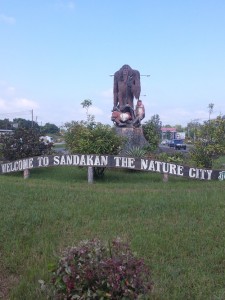
Tourists use this city as a gateway to Sabah’s natural beauty with nearby eco-tourism destinations such as the Sepilok reserve, Turtle Islands, Danum Valley and the Kinabatangan River. It does not have much to see in the city itself but offers a couple of nice restaurants and a shopping mall at Harbour Square.  There are also a few historical sites and a museum if you have some time to kill.

It is about 6 hours by bus to Semporna and 2.5 hours to Bilit (known for eco-tourism lodges along the Kinabatangan river).

Read more on Sepilok, Kinabatangan River and Semporna here.

Jungle Adventures

31 January 2014

The Borneo jungle beckoned to us long before we finally reached it and the experience of finally being there was truly spectacular! The wildlife was incredible and the scenery like something out of a dream – it is almost too beautiful to describe!

Our jungle destination was the Bilit Adventure Lodge, which is nestled quietly alongside the great Kinabatangan River.  We did a two night stay here and then, a week later, returned for another three nights in specifically in search of the elusive pygmy elephants who had managed to evade us on the first two nights.

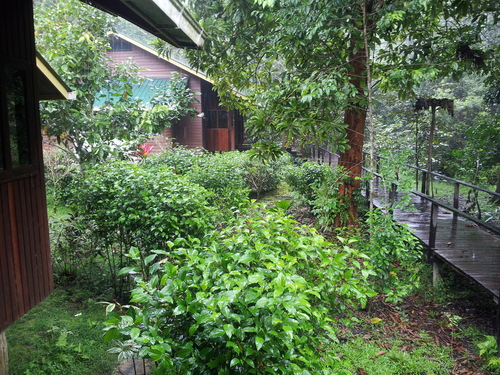
Bilit Adventure Lodge itself is a real slice of heaven in this already dream-like place, with dark wooden cabins and wooden boardwalks blending perfectly in to the surrounding jungle. Monkeys, tortoises, deer and hornbills were regular visitors within the lodge area and the sounds of the jungle gave us both a frog-lined lullaby in the evenings and a refreshing wake up call in the early mornings.

Bilit Adventure Lodge
Cabin at Bili Adventure Lodge tucked into the rainforest.

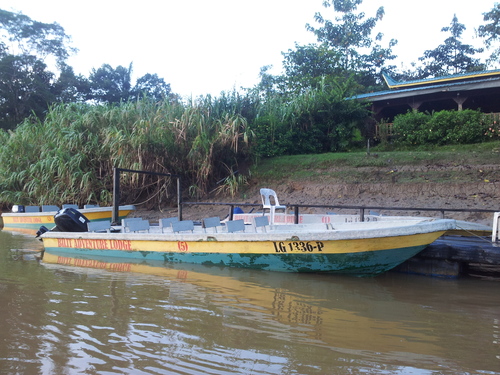
The river cruises are mornings (1 hour) and evenings (2 hours) as this is when the most animals are up and about alongside the river.  Despite being a completely open motorboat (with place for only 8 people), regular rain did not deter us from venturing out in search of the fascinating wildlife of the Kinabatangan jungles.

TIP: We wore clothes that could get wet and that would dry easily.  We left all valuables locked at the lodge and took only cameras (in waterproof bags).  Caps also help to shield eyes from the rain.  No shoes needed in the boat, so leave them at the lodge under the dry cover of the communal dining room.

Kinabatangan
The tour boat where we spent mornings and evenings searching the riverbanks for wildlife and birds.
LAUGH: While preparing for our trip, I came across this hilarious review on TripAdvisor by wiredfrog.  Read this review if you want to have a good laugh; and also to get a sense of what the river cruises can be like if it’s raining heavily.  Please note however, that this was a very over-dramatic rendition of what we actually experienced during our five days (which were still in the Nov-Mar monsoon season) and that the superb wildlife spotting is sure to make up for any discomfort experienced.

The meal times at the lodge were also a real highlight for us, with delicious cuisine inspired by Malay, Indonesian and Western methods.  Tea times were even better, with little cakes, buns or sweet local delicacies that tickled our taste buds and filled the gap for our two hour cruise before dinner.

TIP: Take a pair of (quick dry) long pants and long shirts for evenings to avoid getting attached by mosquitoes.  We didn’t use any repellents (brave or stupid?) but have not picked up any illnesses from the thousands of mosquitoes we donated blood too during our month long stay in Borneo (supremely grateful)!

We did the jungle trek one morning which took us out to one of the ox-bow lakes.  We were relieved to have hired gumboots though as we had mud up to our ankles in so many places. Also, with hungry leeches all around (in trees, plants, mud and grass), we were also so glad to have had long sleeves and long pants (everything tucked in tightly to avoid leech bites) as many of the other tourists got nice fat leech surprises when they checked under their clothes! Lucky for us, the leeches ignored us completely.

Kinabatangan
The trek through the rainforest requires sturdy gumboots for the deep mud.

At the time (February 2014), the dormitory-style rooms were almost fully completed, but lucky for us, we got to stay in the fancy cabins (air conditioning, double beds, en-suite bathrooms, lounge overlooking the jungle, kettle and shower).  It was far more than we were expecting and made for a rather wonderful few days enjoying the jungle in luxury. We stayed in the cabins that have names such as ‘Proboscis Monkey’ and ‘Western tarsier’ – the one with the best view was Cabin number 3 (the front-facing room) as this is where I watched a comical pair of Oriental Pied Hornbills who danced along the water tower every morning after tea.

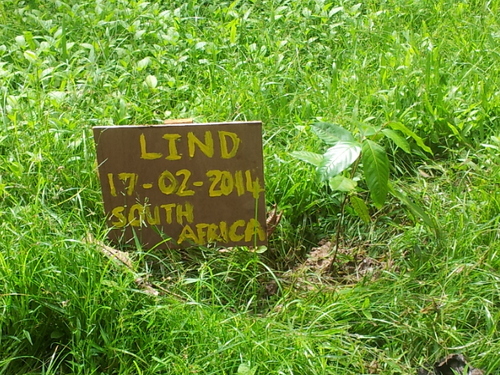
Bilit Adventure Lodge also offered us a chance to plant a tree in their property (at MYR 10) to help replenish the loss of vegetation that is caused each year from flooding.  We proudly contributed a small little tree somewhere next to Cabin number 3 and hope to return one day to see if it survives long enough to do its part for the Kinabatangan jungle.

Plant a tree
Travelinds planted a tree in the rainforest.

Read more about the tour package here.

Bohol’s Tarsiers

25 January 2014

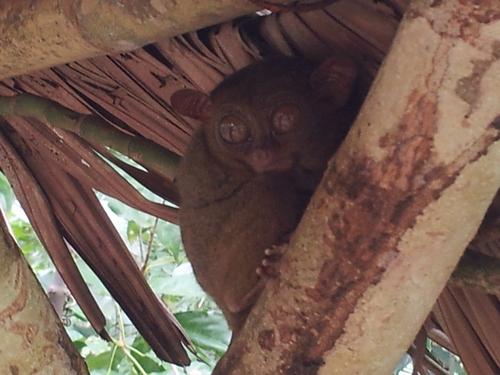
Big round eyes, sticky little toes, ruffled brown fur and strange pointy ears was my first glimpse of the tarsier, a tiny creature that I have been dying to see since starting our travels in South East Asia. Nocturnal by nature, the tarsiers are sleepy during the day and these mostly insectivorous primates spend the daylight hours fast asleep.  At night, it is a completely different story with jumping, shrieking and feasting on whatever they can find.

The Philippine Tarsiers, like their cousins the Western Tarsiers, are the cutest, tiniest, weirdest-looking animals ever!  Tarsiers are only found in South East Asia and are critically endangered.

Bohol island in the Philippines is home to some of the only Philippine tarsiers left in the world and there are conservation efforts happening on the island to increase the dwindling numbers of this lovely little creature.  Many of those animals kept at the conservation centres have been rescued from illegal trade and can never survive again in the wild.  Others have been successfully bred through carefully guarded breeding programmes and then successfully released into their natural habitat.

Travelinds was forced to visit the Carmen Tarsier Sanctuary (in Loboc) instead of the Corella sanctuary which I’d read so much about, because the road had been severely damaged by the October 2013 earthquake and made it impossible to get to Corella from where we were staying in Panglao, Alona Beach.  It was great to finally meet these amazing little monkeys, but I felt guilty once again that captivity is no place for wild creatures.  Even though I so badly wanted to see one of these animals, I would still have preferred to see one at a far distance knowing it was free and wild!

Loboc Tarsiers

East London – I <3 South Africa

Destination: East London,

Eastern Cape, South Africa

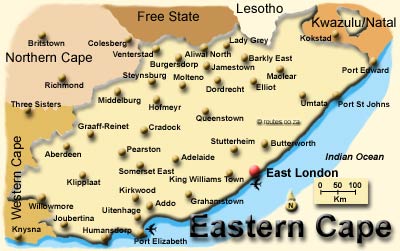
routes.co.za
Source: www.routes.co.za

Description:

East London is a lovely coastal city in the wilder parts of the Eastern Cape Province in South Africa.  It has a small harbour, really beautiful beaches, sought-after schools and maintains a relaxed small-town vibe.  It even has two shopping malls – Vincent Park and Hemingways Mall.

My favourite place:

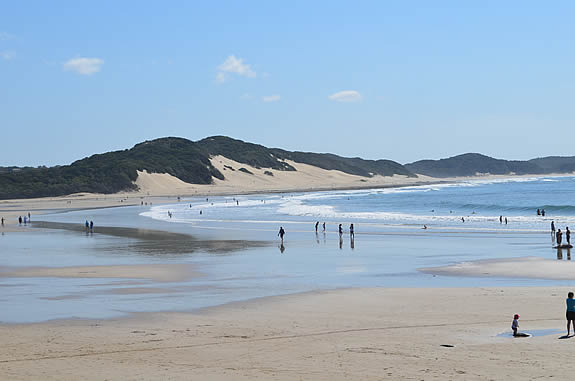
This has to be a toss up between two classic Slummies landmarks – the rugged expanse of the sandy Nahoon Beach and a famous drive in cafe called The Windmill, with THE best milkshakes (in the world?), ice-creams and toasted sandwiches.

Tourist Spots:

Best Beaches: Nahoon beach, Gonubie Beach, Cintsa

Best Restaurants: Two Dogs (Beacon Bay), Le Petit (Nahoon), Cafe Neo (beachfront), Fish River Sun (highway), Lavender Blue (Beacon Bay), The Heavenly Pancake House (Gonubie).

Tourist Spots: There are also so many private game reserves on the coastal road from East London to Port Elizabeth and the famous Nanaga Farm Stall where you can find a plethora of curios, as well as fresh and delicious South African snacks like biltong, nuts, chocolate treats and dried fruit.

Accommodation: We’d also like to recommend a stay at the Seaforth Guest House, a quaint bed and breakfast right near the beach in Gonubie – they also offer an on-site beauty salon. Bonus!

Day Trips:

From East London, a day trip to the following destinations is a breeze: Hogsback, Cintsa beaches, Port Alfred, Bathurst, Grahamstown and Trennery’s Hotel.

Don’t forget to do the absolutely beautiful drive along the coastline to the north of East London.  Grab a picnic lunch and beach gear and explore the coastline to find the hidden treasures of Glen Gariff, Haga-Haga and Morgan’s Bay too!

Fun facts:

Nicknames: The Slum, Slondon, Slummies

Rugby team: Border Bulldogs

Check out more posts about South Africa here >> *I <3 South Africa*