Tag Archives: birdwatching

Oribi Mom: Dark-backed Weaver Friends Are Everywhere You Know

“They’ve been right there in front of us the whole time, waiting for the sun.”

Have you ever heard the dark-backed weaver sing? That’s not a book title. They really have the most melodic singing you can hear for miles. It might be Oribi Dad’s favourite bird sound. Maybe because it took us a good long while to identify what bird it was coming out of when we first moved to the farm.

They’re tricky from far, especially in Echo Valley. You think it’s one tune, but when the bird flits closer, it sounds a bit different. It rises and falls, and then ends in this buzzing sort of noise, like a phone vibrating on a table. You also hardly see them in the thick bushes they sing from or if their backs are turned to you. Yet from the front and in the sun, they’re the brightest yellow – rivalling orioles and African emerald cuckoos. Against the dry winter brush, it’s really quite stunning.

Isn’t that so like some people we know? We meet them, masked in their dark brown coats with faces turned away from us. We hear their names but don’t remember. We wonder what others see in them at all. Then, one day, we hear their song and it makes us pay attention. Where is that coming from? We want to know more.

Sometimes, it takes us a while to figure out how this brown-coated interesting figure can produce such a clear and beautiful sound in the first place. Did we hear wrong? No, we think, as we hear that melody ring out a few more times. There’s something there worth discovering.

One day, we might even hear that voice and catch the owner turning to face us, just as the sun hits from over the gorge cliffs to the east. The sparkling yellow seems to light up the whole valley as the song rings loud and captivating from that tiny black beak. What a sight! What a talented package this is. How could we have missed that mesmerising beauty for so long?

It feels like that’s how friends are made sometimes. We see each other, really see each other. And we hear a song we can’t ignore any longer. Then, once we’ve seen and heard it, we suddenly start to see that person’s influence and worth everywhere we look. How could we possibly have missed it before? They’ve been right there in front of us the whole time, waiting for the sun.

Published here.

Oribi Mom: Must Love Birds and the Adventure of the ‘Chase’

I’ve also loved flitting about the South Coast birding community on Facebook bird groups.

I’ve always loved nature, but since our move to Oribi Gorge, my blood is emerald green, just like ‘Hello Georgie’.

I may actually be obsessed with the feathered friends that fill this beautiful country.

An overseas friend asked if I was a twitcher, and after a quick Google search, I solemnly declared myself a true bird lover instead.

I’m not a tick-off-the-list ‘twitcher’ who loses interest after they’ve seen every one of South Africa’s 850 recorded species once (725 resident species).

No, I sit on my porch for morning coffee and daily appreciate the wine-red firefinches, melodious black-headed orioles, opportunistic Black Sparrowhawk (which hunts our free range chickens), and the soaring vultures high above our Umzimkulu cliffs.

I’ve also loved flitting about the South Coast birding community on Facebook.

Hugo Voigts in Paddock is phenomenally dedicated – he once sat for over four hours in camouflage to capture elusive flufftail chicks (and this wasn’t his only comparable effort).

Lia Steen in Shelly Beach has the most magnificent finds right in her garden. She must have a brilliant camera to capture that much detail, too. I’ve learned a lot about birding habits from her fascinating posts.

The luckiest South Coast birder must be Stan Culley, somewhere near Port Edward maybe? ‘Culley’s Dam’ boasts fantastic bird visitors daily, including the cutest baby white-starred robin I’m yet to find in my patch of paradise.

Why birding? I think it’s the chase.

Some days you see a new one that you have never, ever noticed before. You read about it (maybe you’ll get a Roberts bird app for your birthday like I did) and learn the sound. The next few weeks, you realise that it is a screech or a song that you hear constantly. It wasn’t a new bird in your garden at all, just a hidden gem.

Once you see it, you can’t un-see it and then you start to appreciate the immense beauty of this country.

Birdwatching Is Good for the Soul

Next time coronavirus has you down, sit at your window or put your binoculars next to you on the porch.

Take a breath, laugh at the bobbing wagtails and the fluttering sunbirds and open your eyes.

You might see that martial eagle gliding above the clouds or you might notice the white-browed scrub robin around your fallen leaves for the very first time.

Wonder is the beginning, and from there, joy.

Published here.

Rainforest Discovery Centre- Sepilok

02 February 2014

Sandakan to Sepilok

We hadn’t managed to get the Rainforest Discovery Centre (RDC) on our previous trip to Sepilok, as the orangutans had monopolised our time and attention on the first day at the Rehabilitation Sanctuary.  So on Valentine’s Day, our last day in Sandakan, we returned to Sepilok area and spent the day at the RDC.  Our intention was to enjoy the bird-watching opportunities that we hadn’t really done to yet.

With ominous weather looming, we brought along rain ponchos and also a few snacks to see us through lunch time should we be distracted by the array of colourful birds that we hoped to see.

Rainforest Discovery Centre

We started the day with a stroll along the canopy walkway, punctuated with long rest periods at the various seated viewing sites along the way.  At the broadbill tower, we stopped and admired some of the bird-life (although not the elusive broadbill itself) and had a couple of snacks while we looked over at the dam and its surrounding tree tops.

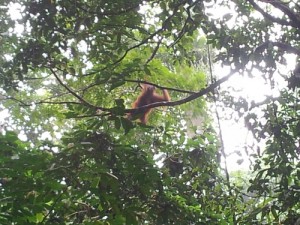
All of a sudden, H noticed a bright orange blur on the far side of the dam and the orange blur continued to jump down from tree to tree, from the highest point of the canopy to the lower level forest.  Excited, but without a pair of binoculars to confirm, we headed off in the direction of the orange blur’s final destination in hopes of seeing a monkey or some other creature.

tumblr_inline_n4472gtU8k1rg4d7lTurns out, it was a small orangutan! A real, live, wild orangutan in the forest where we had only expected to be seeing birds and bugs.  We strained our necks and happily watched him for at least an hour, eating and playing on one of the lower trees.

As happens regularly, there was suddenly a downpour and while we were grabbing our ponchos, the orangutan was quickly constructing a nest of leaves and sticks to shelter himself from the ensuing rain.  It was amazing to watch him build a nest and search for bigger leaves and longer sticks when the smaller ones didn’t cover him sufficiently. We were forced to seek shelter as the rain got harder and harder and we hid out in a small hut until the worst of the storm had passed.

We also saw some amazing birdlife and a Great Red flying squirrel as we were walking later that day.

Getting there

From Sandankan, Number 14 Bus (Sepilok), ask to get out at Rainforest Discovery Centre (it is 2km before the Orangutan reserve and about 1km from the main junction roundabout). take the same route as for Sepilok Orangutan Rehabilitation Centre (Sepilok reserve covers this whole area).

TIP: Take binoculars – you are going to get much more out of the experience that way.

Entrance Fee: MYR 15 per person

For suggested itineraries for Sepilok, click here.