The Kota Kinabalu State Museum complex is a most interesting place to visit if you want to learn more about the intriguing culture and history of Sabah. We spent an entire day here and still didn’t get to see all that the complex has on offer.
The first stop was the Main Museum building and this kept us busy for a very long time! Natural history, Sabah special ‘Then and Now’ display and the ‘Our culture’ sections were the most interesting and it took a lot of time to work through all that valuable information. We also watched a video (about an hour) in the natural history section titled ‘Borneo’ (1937) – an old black and white movie travelogue shot by famous explorers Martin and Osa Johnson.
We found some local Malaysian lunch at the small cafe called Zureen’s cafe (located just outside the heritage village, in the parking lot). This included our favourite ‘Char Keow Teoy’(fried flat noodles with chicken or prawns), ‘Mee Goreng’ (fried yellow noodles) and Horlicks/Nestum (milky sweet drink, served hot or with ice cubes). I think the total lunch came to only MYR 12 for both of us.
After lunch, we finished up at the main building and then headed to the Heritage Village. Here you can see all the different kinds of houses/huts/structures/transport/machinery/equipment used by the different tribes that can be found in Sabah. It was a very interesting experience to see the vast differences in lifestyles, building designs and practical day-to-day instruments employed in these different tribes. There was everything from a Chinese farm house to a Rungus longhouse. The Murut longhouse was my favourite, with its huge porcelain jars, wooden rhinoceros hornbills hanging from the ceiling and a trampoline-like floor that is used for entertaining guests.
There were not enough hours in our day to see everything so unfortunately we had to leave before we had seen the science museum, islamic museum and the ethnobotanical garden. Read more about the Sabah Museum here.
This vibrant city is the largest city in the eastern Malaysian province of Sabah, on Borneo. As in most other parts of Malaysia, Kota Kinabalu is home to a wide variety of cultural groups, including some special people groups specific to Borneo, like the Rungus. This province includes 33 indigenous groups speaking 50 different languages and up to 80 different ethnic dialects. Talk about an administrative nightmare for local government!
The province of Sabah has a wide range of attractions that make it a very alluring spot for tourists from all over the world. Beaches, islands, reefs, mountains, parks, nature reserves, museums, temples, mosques, markets, hot springs and rainforests – and Kota Kinabalu is the doorway to it all!
Named for its proximity to Mount Kinabalu, the city of Kota Kinabalu lies on the north-western coast of Sabah and boasts the largest port and population in Sabah. Kinabalu means ‘Chinese/China’ (kina), ‘Widow’ (balu), which perhaps explains why the mountain itself is held in such awe by the local inhabitants. It soars above the rest of the landscape, often swathed in a thick layer of white clouds and stands a lofty 4,101 metres above sea level.
With so much to see and not enough time to see it in, Sabah offers tourists a jam-packed holiday filled with endless activities and interesting places. You will need to take some time out to help it all sink in!
Read more about the following attractions in Kota Kinabalu (NOTE: these are just a few of them that we managed to see):
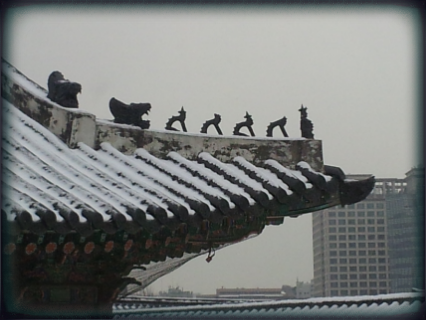
On visiting the Gyeongbok Palace (Gyeongbokgung) in Seoul, I happened to notice some mysterious figurines on the corners of the roof, especially for the larger buildings. Intrigued, I investigated a little further and found that these are traditional Korean figures called Japsang (잡상).
The figures depict the grandeur of the building (more Japsang means the building is of higher importance), as well as the shamanistic beliefs that these figurines work to ward off evil spirits. This notion was apparently derived from the characters of a traditional Chinese story called “Journey To The West”, which follows the adventures of Monk Xanzang, a Bhuddist monk who went to India in search of sacred writings.
There are about ten guardians, which are placed in a specific order on the sloping roof and always arranged in odd numbers.
Some of the most important characters are:
Monk Xanzang, the main character
Sonojeong, The Monkey King
Jeopalgye, the Pig Monster
Saojeong, the Half-Water Demon
Iguryong, Double-mouthed Dragon.
Mahwasang, Horse
Cheonsangap, Pangolin
Another example of just how much the Korean culture has been influenced by the Chinese nation, even though most are loathe to admit it.
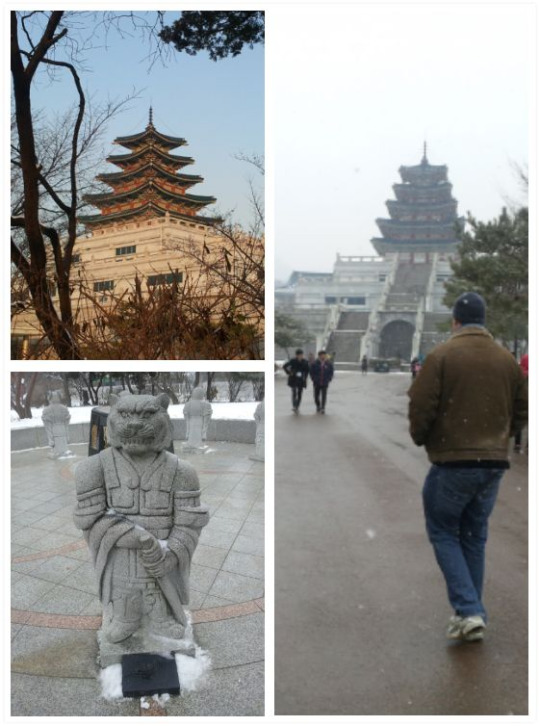
The National Folk Museum of Korea houses quite a few interesting exhibits about life and culture in South Korea. The museum is next to the Gyeongbok Palace in central Seoul and admission is free (remember, it is closed on Tuesdays).
It is quite an eye-catching building with the traditional Korean architecture towering above the pretty park (which, when we went, was also covered in a thick layer of white snow).
We chose to do a guided English tour (at 14.30) with a Korean guide and to watch a (free) traditional music performance that was being hosted at the museum auditorium. It is definitely worth a visit, especially with its convenient proximity to the Gyeongbok palace and Insadong for touristy sightseers.
Our guide at the museum was wonderful and we thoroughly enjoyed her quirky take on the Korean life and culture! Her English name was Hillary and she chatted away to us about the museum where she has been a volunteer English guide since she was a university student. She loves the gig so much that she still continues her volunteering every Saturday, because she now works during the week. Her hope is that this guide work will help her to improve her English even more and also allow her to meet foreigners (waegooks) from all countries of the world.
Outside the museum are the twelve Chinese Zodiac animals with birth years engraved so you can find your own. Not that we are superstitious at all, but it was fun to see the details. I’m a Tiger (ferocious and stubborn) and he’s a Rat (highly intelligent and sneaky) – sounds about right!
Be sure to check out the little street of restaurants across the road from the museum, we found such a cute one in a little alleyway. The lunch cafe is situated inside an old Korean house converted into a little eating spot called ‘Rice’ (밥).
Today we went on a teacher’s outing to Gongju, with some of the Asan Board of Education public school teachers. It really was an interesting look into some of the ‘rural’ traditions and the cultural legacy that still lives on in South Korea.
Hunting for Chestnuts
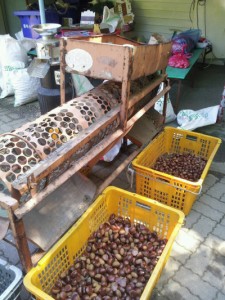
The first task was a thorough chestnut collection, which was actually a lot more fun than it sounded on the itinerary. Chestnuts (밤 ‘bahm’) are traditionally eaten roasted, or peeled and frozen to be eaten raw.
Gongju Roasted Chestnuts
We were shown how to break open the spiky pod and extract the shiny brown chestnuts with tongs. Armed only with tongs and an orange net bag, we were led up the steep pathways and sides of hills to tackle the chestnut plantations.
Aside from minor injuries from chestnut pod spikes, the other exciting event of the morning was finding a small brown snake on the grassy bank (Google later revealed it was a ‘rat snake’ of some sort), which a brave Australian soul rescued from certain death, by flinging it as far into the bush as possible, away from the Korean tour guide.
We headed back with orange bags overflowing with chestnuts and enjoyed some roasted and frozen, raw chestnuts as a reward for our efforts.
Traditional Korean lunch
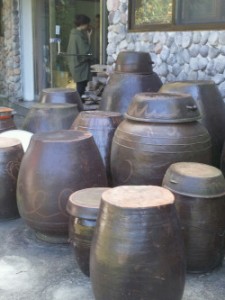
We then headed down the road to a traditional folk museum, restaurant and chestnut dyeing complex. It has been run by the same family for the last 200 years, who still live, farm and dye with chestnuts (no pun intended), in the same farming area in Gongju.
Treated to a traditional Korean lunch, we experienced lotus steamed rice (covered in lotus leaf, with
Gongju Folk Museum
herbs), an array of unique Banchan (side dishes) special to the Gongju region, makgeolli (rice wine) and mushroom water (like ice tea, but made from mushroom juices); all this served in the traditional low Korean tables, sitting on flat cushions on the wooden floor, with legs folded under us.
Since the restaurant and surrounds were all things chestnut, chestnuts appeared as an ingredient in the vast majority of the dishes served. Even the servers clothes and restaurant furnishings were dyed with chestnuts.
Traditional Folk Art Museum
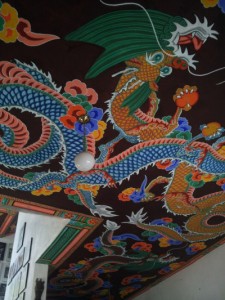
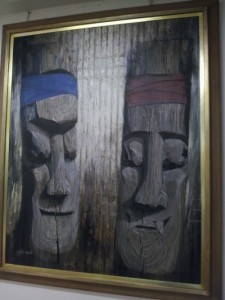
The ‘chestnut’ family has also collected artifacts from the neighbouring farmers over many years, as well as the collection of dramatic art pieces used by the current owner’s father, who was a well-loved traditional Korean puppeteer in his spare time. It includes farm implements, cultural pieces, masks, paintings, shamanistic symbolism, farm life cooking tools and many other interesting things to see and experience.
Gongju Museum
My highlight was seeing an actual South Korean funeral carrier, a colourfully decorated box that traditionally holds the coffin and is carried to the burial mound by about 12 men. These days, it is rare to see one in use as, our host joked that, Koreans are now taller than in the past and so don’t fit in the carrier very well. The carrier at the museum was retired only a couple of years ago.
The next week at school, I was surprised and very privileged to see one of these coffin carriers actually in use, as a funeral procession passed the school and headed down the road; singing, clapping and mourning the loss of a 75-year old lady that had lived in this community.
Chestnut Dye
The last activity of the day was a handkerchief dyeing lesson. We were shown the crushed chestnut husks that are used to make the dye and different ways to tie-dye our handkerchiefs. We dipped it in the hot dye (hands and arms covered in rubber gloves) and took turns to “massage” the dye into the handkerchiefs in the pot. Then out into the cold solution that sets the colour. This process was repeated two or three times; ending with a cold water rinse and then handkerchiefs were hung out dry.
Mine was sadly unremarkable, as it was lost in the dye pot for a while and lost all its strings, but a few of the other teachers managed to produce some seriously impressive dye patterns.
Take a trip
If you are headed to Gongju, you can find more information about the museum and the area at this link. It’s a great day trip for those interested in learning a little more about traditional Korean life.



 Today we went on a teacher’s outing to Gongju, with some of the Asan Board of Education public school teachers. It really was an interesting look into some of the ‘rural’ traditions and the cultural legacy that still lives on in South Korea.