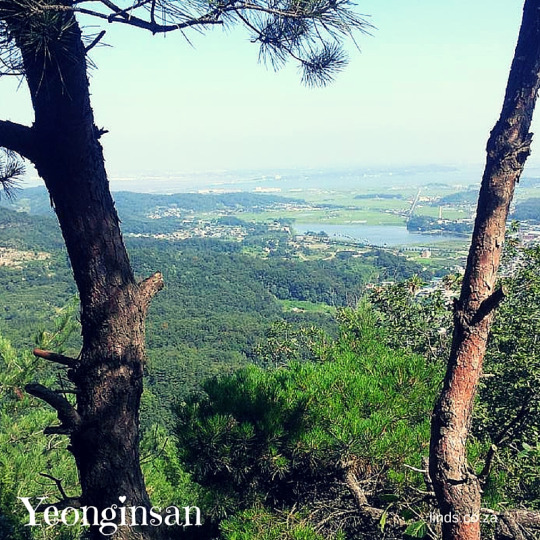
Yeonginsan Natural Forest ( 영인산자연휴양림) is about twenty minutes from Asan. It is a reserve for hiking, picnics, camping and outdoor activities, popular for school outings, families with young children and hikers. It is stunning in spring and autumn and has lush green scenery in the summer. We’d imagine winter would be very pretty in the snow, but hiking in the cold and snow is not our idea of fun!
A ten minute drive from our apartment in Dunpo, it’s an easy morning out if we feel like some exercise with a view. It is a course that lends itself well to all levels of hikers. It is possible to walk to all the major points from the central area and back to the middle again, or from point-to-point in a circuit if you’re a more serious hiker and require more of a challenge.
Cost:
1,000 KRW pp for Asan or Cheonan residents
2,000 KRW for others
Parking:
There are parking lots below the mountain, at the entrance to the reserve (where the swimming pool and chalets are) and further up near the education centre and cable car.
[We usually park (for free) at the bottom entrance to the hiking trail and walk up the 2 km to the central picnic area, passing the ticket booth on the way.]
Bus:
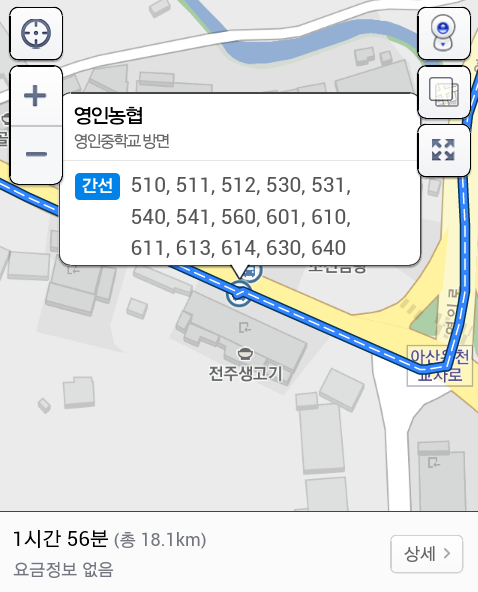
There are two bus stops in Yeongin-myeon, the Middle School stop (영인중학교 1979(아산)) is closest to the hiking trails, but the Nonghyup stop (영인농협 637(아산)) is just a few minutes further.
From both bus stops both, if you carry on walking up the main road towards the mountain, you will come to the beginning of the trail on your right. (It’s opposite the dirt parking lot)
The bus stop in Yeonginsasn.
Next up:
The following weekend, Travelinds ventured out to Bukhansan National Park in Seoul – a more challenging hike than Yeonginsan.
Today we went on a teacher’s outing to Gongju, with some of the Asan Board of Education public school teachers. It really was an interesting look into some of the ‘rural’ traditions and the cultural legacy that still lives on in South Korea.
Hunting for Chestnuts
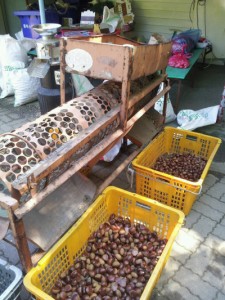
The first task was a thorough chestnut collection, which was actually a lot more fun than it sounded on the itinerary. Chestnuts (밤 ‘bahm’) are traditionally eaten roasted, or peeled and frozen to be eaten raw.
Gongju Roasted Chestnuts
We were shown how to break open the spiky pod and extract the shiny brown chestnuts with tongs. Armed only with tongs and an orange net bag, we were led up the steep pathways and sides of hills to tackle the chestnut plantations.
Aside from minor injuries from chestnut pod spikes, the other exciting event of the morning was finding a small brown snake on the grassy bank (Google later revealed it was a ‘rat snake’ of some sort), which a brave Australian soul rescued from certain death, by flinging it as far into the bush as possible, away from the Korean tour guide.
We headed back with orange bags overflowing with chestnuts and enjoyed some roasted and frozen, raw chestnuts as a reward for our efforts.
Traditional Korean lunch
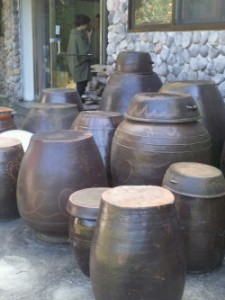
We then headed down the road to a traditional folk museum, restaurant and chestnut dyeing complex. It has been run by the same family for the last 200 years, who still live, farm and dye with chestnuts (no pun intended), in the same farming area in Gongju.
Treated to a traditional Korean lunch, we experienced lotus steamed rice (covered in lotus leaf, with
Gongju Folk Museum
herbs), an array of unique Banchan (side dishes) special to the Gongju region, makgeolli (rice wine) and mushroom water (like ice tea, but made from mushroom juices); all this served in the traditional low Korean tables, sitting on flat cushions on the wooden floor, with legs folded under us.
Since the restaurant and surrounds were all things chestnut, chestnuts appeared as an ingredient in the vast majority of the dishes served. Even the servers clothes and restaurant furnishings were dyed with chestnuts.
Traditional Folk Art Museum
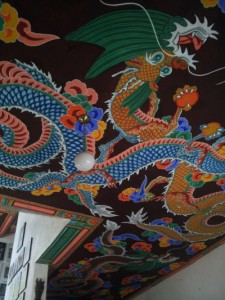
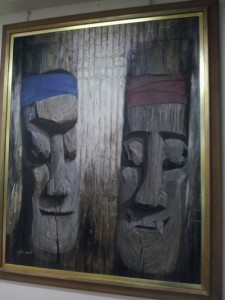
The ‘chestnut’ family has also collected artifacts from the neighbouring farmers over many years, as well as the collection of dramatic art pieces used by the current owner’s father, who was a well-loved traditional Korean puppeteer in his spare time. It includes farm implements, cultural pieces, masks, paintings, shamanistic symbolism, farm life cooking tools and many other interesting things to see and experience.
Gongju Museum
My highlight was seeing an actual South Korean funeral carrier, a colourfully decorated box that traditionally holds the coffin and is carried to the burial mound by about 12 men. These days, it is rare to see one in use as, our host joked that, Koreans are now taller than in the past and so don’t fit in the carrier very well. The carrier at the museum was retired only a couple of years ago.
The next week at school, I was surprised and very privileged to see one of these coffin carriers actually in use, as a funeral procession passed the school and headed down the road; singing, clapping and mourning the loss of a 75-year old lady that had lived in this community.
Chestnut Dye
The last activity of the day was a handkerchief dyeing lesson. We were shown the crushed chestnut husks that are used to make the dye and different ways to tie-dye our handkerchiefs. We dipped it in the hot dye (hands and arms covered in rubber gloves) and took turns to “massage” the dye into the handkerchiefs in the pot. Then out into the cold solution that sets the colour. This process was repeated two or three times; ending with a cold water rinse and then handkerchiefs were hung out dry.
Mine was sadly unremarkable, as it was lost in the dye pot for a while and lost all its strings, but a few of the other teachers managed to produce some seriously impressive dye patterns.
Take a trip
If you are headed to Gongju, you can find more information about the museum and the area at this link. It’s a great day trip for those interested in learning a little more about traditional Korean life.
A little afternoon picnic was on our minds as we headed out today, not too far down the road from our place.
What You’ll Find in Sapgyoho
Sapgyoho is referred to as a ‘beach resort.’ It’s more like a fishing village. There are quite a few fish restaurants, a ferry, some little curio shops, a mini funfair, a park to sit under trees and a wooden walkway. If you are feeling energetic, you can follow this path right across the seawall (a couple of kilometres long). You’ll do so with some bicycles, motorized wheelchairs and even a few walkers.
We didn’t do the sea wall on this particular day, but we ambled around and tried some street food. We also marvelled at the endless supply of live sea creatures in buckets and tanks. You might have to dodge some cut-throat business ladies trying to lure you into their restaurants for lunch, but otherwise, it’s a wonderfully relaxed atmosphere.
Just Have a Picnic and Look Out at the Sea
When we were tired of exploring the little village, we headed to the park. This area overlooks the bay and the seawall. There were quite a few families eating their picnic food, like gimbap (seaweed rice rolls). We settled down to our own picnic on the grass (on our genuine Korean silver picnic mat that looks like one of those shiny windscreen car shades).
It was nice to rest under some shady trees for a while and take in the scene. In fact, the most active thing we managed after that was a simple jellybelly tasting competition — guess the flavour! This is a surprisingly captivating (and delicious) game. It’s also a lot more difficult than it sounds with flavours like toasted marshmallow, crush pineapple and pina colada!
A great spot for future summer picnics to be sure!
All of a sudden it was here — beautiful spring! The season crept up on us out of nowhere, with the white cherry blossoms of Asan heralding the bright occasion for a mere two weeks or so. Then, bursts of red, pink, orange, white, yellow, purple and green appeared everywhere. Breathtaking!
Korean Spring is truly a special (though short) season. It is amazing how life is breathed back into a dead and barren land after the dreary winters here.
With warmer weather and beauty popping up all around us, there’s a promise of brighter days. Travelinds headed to Asan Pinnacle Land for the day to appreciate all the colour.


 Today we went on a teacher’s outing to Gongju, with some of the Asan Board of Education public school teachers. It really was an interesting look into some of the ‘rural’ traditions and the cultural legacy that still lives on in South Korea.