Huddled together off the coast of Kota Kinabalu, the group of five islands, which makes up the Tunku Abdul Rahman Marine Park, serves as a popular tourist zone for those visiting Sabah’s capital city. There are hundreds of boat operators to choose from that offer standard or special tours, as well as diving or snorkelling. It is a wonderful place to go if you need a day at the beach where the only thing to do is enjoy the scenery and breathe in the fresh sea air (once you’ve dodged the busy tourist gatherings).
The five islands – Gaya Island (big), Sulug Island (Sulu people), Manukan Island (fish), Mamutik Island (shell collection) and Sapi Island (mowing buffalo), lie about three kilometers off shore. The Park was founded in 1974 as a national reserve to protect the marine life in the area.
After reading reviews on TripAdvisor, we decided to visit Manukan and Mamutik on one day trip, with snorkelling. The islands were pretty much the same in terms of natural scenery except that Mamutik had amazing shells (as it name suggests) and was a lot quieter without the groups of Chinese tourists that thronged the open spaces on Manukan’s beaches and park areas.
Manukan
Manukan Island was our afternoon destination and we spent a lot of time eating lunch in the shade of the trees, sun-tanning and resting. We saw a lot of monitor lizards here but were feeling too lazy to do the jungle walks where you can explore the rest of the island. There are a few places to eat here but not enough to keep prices competitive. We also saw a couple of people camping here (tents) and barbecuing, which looked like it might be a fun thing to do; especially since most of the tourists go home after 4 pm. This leaves you ample time to enjoy the sunset and then the sunrise too, without the hoards of foreigners blocking the view.
Mamutik
Mamutik Island was our first stop and we spent the morning here snorkelling, sun-tanning, reading and admiring the birdlife around the island. It was a lot of quieter than Manukan and had good snorkelling around the far end of the beach (furthest from where the pier is) which was less damaged and had a quiet part of the beach to enjoy. There are also lockers available for a day at the Borneo Divers offices (on the far side of the beach) if you need to lock up your things, for a small fee.
Getting here:
We found a boatman somewhere along the way to the Jessleton Point (just after the market, but before the main piers) who hustled us into buying a trip from him for MYR 100 (for two people, snorkelling equipment, boat trip return). We then also had to pay a further MYR 10 for a conservation fee when we arrived at the island. Based on some of the other tour packages we’d looked at this didn’t seem like a bad deal.
A few days afterwards, we did see a flyer somewhere for a package deal, including the above, plus KFC lunch and INCLUDING conservation fee, for only MYR 50 per person. So I guess we could have saved about MYR 20 plus lunch costs had we found a deal like this earlier. But it was not too much difference considering our busy schedule.
*Some information was taken from Sabah Parks website.*
An afternoon outing in Kota Kinabalu took us to the Likas Mosque (better known as the ‘Floating mosque’ in KK). Being our first visit to a mosque, we read up a bit on dress code/etiquette required and figured long sleeves, long pants and a headscarf for H would suffice.
Upon arrival, we were directed to the small shop/reception office outside where a kind lady helped us to dress appropriately. There were kaftans, scarfs and head gear available there (for free) so that non-Muslim visitors would be allowed in to the mosque.
Outside the mosque, you are required to remove shoes and a guide then takes you through the mosque giving information about its construction, use and history. We were informed that the mosque was built over 11 years (1989 – 2000), construction cost MYR 40 million and the building can comfortably fit between 9,000 to 12,000 worshipers.
The fifteen-minute tour concludes and visitors can take a couple of pictures inside and outside the mosque, provided no worshipers are disturbed.
At the same reception office, you can pay MYR 5 each and go on the peddle-boats in the water around the mosque. This is great for some fun and for getting a different angle on photos of the mosque. There is no time limit on using the peddle boat as far as we could tell.
Read the reviews on TripAdvisor. Be aware that some travellers have confused the floating mosque (Likas) with the Kota Kinabalu State Mosque, which are two different locations.
Getting here:
Take a (big) bus from in front of the Shangri-la Motel (NOT the same as the fancy hotel complex far out of town). Ask for the Likas bus (it has a purple stripe) and ask the driver to drop you at the Likas Mosque. MYR 1 each.
Favourite memory:
We finished a nice afternoon exploring the mosque and riding the peddle boat and decided to catch a bus to the next stop, the Kota Kinabalu Wetland Centre. We were told that it was an hour’s walk from the mosque, so thought the bus would be best. First, the bus drivers told us ‘no bus, no bus’ (of the three busses standing there), then after some deliberation they decided it would be best to do a bus trip after all. The few tourists and locals were herded on to the one bus and, after a push start, the wonky old bus started going, in the wrong direction from where we needed to go… In fact, it did a full circle and came back past the mosque bus stop before finally continuing on to the route we needed to go. The delay was only about 40 minutes, no big deal.
The Kota Kinabalu State Museum complex is a most interesting place to visit if you want to learn more about the intriguing culture and history of Sabah. We spent an entire day here and still didn’t get to see all that the complex has on offer.
The first stop was the Main Museum building and this kept us busy for a very long time! Natural history, Sabah special ‘Then and Now’ display and the ‘Our culture’ sections were the most interesting and it took a lot of time to work through all that valuable information. We also watched a video (about an hour) in the natural history section titled ‘Borneo’ (1937) – an old black and white movie travelogue shot by famous explorers Martin and Osa Johnson.
We found some local Malaysian lunch at the small cafe called Zureen’s cafe (located just outside the heritage village, in the parking lot). This included our favourite ‘Char Keow Teoy’(fried flat noodles with chicken or prawns), ‘Mee Goreng’ (fried yellow noodles) and Horlicks/Nestum (milky sweet drink, served hot or with ice cubes). I think the total lunch came to only MYR 12 for both of us.
After lunch, we finished up at the main building and then headed to the Heritage Village. Here you can see all the different kinds of houses/huts/structures/transport/machinery/equipment used by the different tribes that can be found in Sabah. It was a very interesting experience to see the vast differences in lifestyles, building designs and practical day-to-day instruments employed in these different tribes. There was everything from a Chinese farm house to a Rungus longhouse. The Murut longhouse was my favourite, with its huge porcelain jars, wooden rhinoceros hornbills hanging from the ceiling and a trampoline-like floor that is used for entertaining guests.
There were not enough hours in our day to see everything so unfortunately we had to leave before we had seen the science museum, islamic museum and the ethnobotanical garden. Read more about the Sabah Museum here.
Wanting to spend a couple days in Kota Kinabalu, we found an amazing place to stay called Marina Courts. It is a complex of high rise apartment buildings with a swimming pool, gym and a prime KK waterfront location.
The particular deal that we found was listed as the Marina Court Vacation Home (Kota Kinabalu). It was a room for rent (not the whole apartment like some of the other options mentioned on TripAdvisor) and it was set up similar to a hostel where the guests shared the living area, kitchen, washing machine and dryer. One of the rooms has an en-suite bathroom, the other three rooms share a common bathroom. You can book it on Agoda.com.
There are showers, air conditioners and basic kitchen facilities.There’s a big swimming pool downstairs for guests to use at their leisure and also a gym.
Marina Courts’ location is perfect for exploring Kota Kinabalu. It is within walking distance of most major tourist points and has a local bus terminal right in front of the complex for catching buses to areas that are further away from the city center.
Walking distances from Marina Court:
25 – 30 minutes: Jessleton point (the ferry and boat jetty), Museum, Signal Hill,
15-20 minutes: Shangri-la Bus terminal, Express bus to Kudat,
5-15 minutes: The Night market, Gaya street Sunday market
Right outside: Wawasan Bus Terminal (intracity busses), Centre Point shopping centre is across the road,
TIP: There is an Arabian restaurant across the road from Marina Courts (on Centre Point side) called ‘Al Andalus’ – visit it! It has delicious, well-priced food, excellent service and an authentic Arabian vibe to it. The extra Arabic Set was enough for two of us and the Baba Ganoush was fantastic! We ate here for at least one meal every day, for eight days.
This vibrant city is the largest city in the eastern Malaysian province of Sabah, on Borneo. As in most other parts of Malaysia, Kota Kinabalu is home to a wide variety of cultural groups, including some special people groups specific to Borneo, like the Rungus. This province includes 33 indigenous groups speaking 50 different languages and up to 80 different ethnic dialects. Talk about an administrative nightmare for local government!
The province of Sabah has a wide range of attractions that make it a very alluring spot for tourists from all over the world. Beaches, islands, reefs, mountains, parks, nature reserves, museums, temples, mosques, markets, hot springs and rainforests – and Kota Kinabalu is the doorway to it all!
Named for its proximity to Mount Kinabalu, the city of Kota Kinabalu lies on the north-western coast of Sabah and boasts the largest port and population in Sabah. Kinabalu means ‘Chinese/China’ (kina), ‘Widow’ (balu), which perhaps explains why the mountain itself is held in such awe by the local inhabitants. It soars above the rest of the landscape, often swathed in a thick layer of white clouds and stands a lofty 4,101 metres above sea level.
With so much to see and not enough time to see it in, Sabah offers tourists a jam-packed holiday filled with endless activities and interesting places. You will need to take some time out to help it all sink in!
Read more about the following attractions in Kota Kinabalu (NOTE: these are just a few of them that we managed to see):
The trip that we discovered mangosteens — the most delicious fruit ever!
January 2013
After receiving news of an extended holiday period for our winter vacation, Travelinds headed to Malaysia for our Christmas and New Year’s break for 14 days. This was only two weeks after we’d returned from our crazy busy South African wedding trip and a week after we’d had to move apartments unexpectedly (within 24 hours). We were ready to relax and unwind.
First stop: Penang
First impression of Penang:Diverse community, skyscrapers juxtaposed with bamboo houses, centered around food, laid back, and puts “African time” to shame.
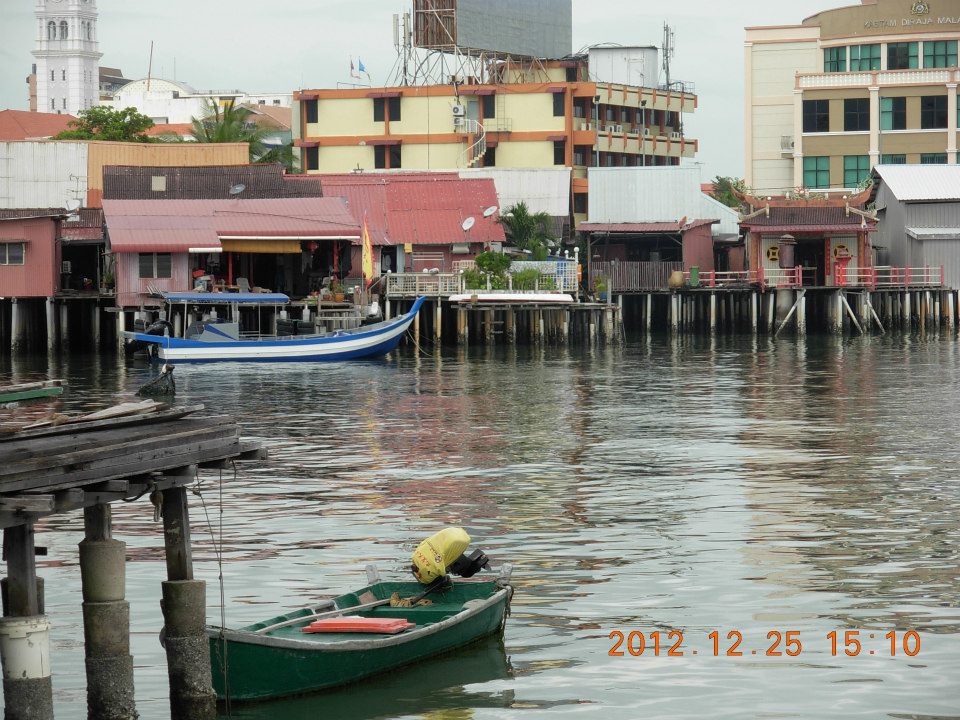
Chew Jetty, Penang
Penang is one of the most popular islands off the coast of Malaysia. It is known for its delicious (and cheap) local food, a rich cultural heritage and great holiday atmosphere for tourists. It has many places to explore, including several UNESCO World Heritage Sites. We visited a few of these, such as Chew Jetty (a Chinese fishing village with houses in narrow alleys built over the sea) and Fort Cornwallis, built by the ‘founder’ of the Penang British colony Captain Francis Light.
The country has a rich history and Malaysians are made up of several people groups, the majority of which are those of Malay, Indian and Chinese descent. This dynamic makes for a rich food culture, not to mChew Jetty, Penangention the very friendly, helpful people in general.
There was such a mixture of religions in Penang that it was hard to say which is the majority without looking at some statistics. There is a fascinating mixture of Muslim, Buddhist, Hindu (Tamil) and Christian places of worship (sometimes right next to each other!). There are little pockets of communities (China town, Indian Town etc.,) where you can see the traditional way of life still continues, even through this modern backdrop of Malaysian development.
Travelinds’ Highlights of Penang
The food!! Amazing Malay and Indian food, especially the “street” food. Noodles, rotis, soups, curries etc., and we ate to our heart’s delight!
The variety!! The beaches were fairly average compared to South Africa. Still, there were so many interesting markets (where bargaining is the favourite pastime), tourist sites (Georgetown and other areas, too) and other things to keep you busy that you can forget about a little bit of litter on the beaches.
The markets!! Our favourite pastime in the evenings was the Batu Ferringhi night market. You can bargain for cheap goods until you drop. Anything from clothing, cologne and curios to massages or food stuffs. And boy are the prices different from each stall to the next!
Memory Maker in Penang, Malaysia
The doctor fish eating our feet
We found a fish spa in one of the massage parlours. We paid the equivalent of around ZAR6.00 for 30 minutes for these tiny fish to nibble at our feet.
It’s great fun. It kind of feels like pins and needles at the time but your feet feel fantastic the next day. The doctor fish especially loved H’s dry heels over R’s softies!
R also loved his long ocean swim out to the small island nearby, despite jellyfish stings along the way. He got to catch his own big shellfish right off the rocks.
Travelling Companions for the Travelinds
In Penang, we met a couple from Shanghai, a couple from Canada and even one man (while we had our fish spa) from Sudan. Also, there were a whole lot of others who we could talk to easily and for extended periods by being our usual friendly selves.
Next stop: Langkawi
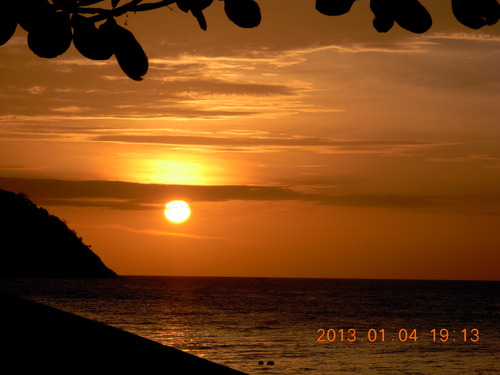
Pentai Tengah bay
First impression of Langkawi: Beach atmosphere, small tourist-centered island, simple living for locals, and beautiful natural sights, including animals and bird life far richer than in Penang.
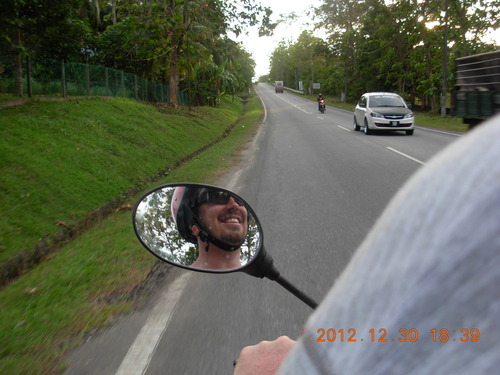
Langkawi is known for its beaches, easy accessibility to and from the southern Thai islands in the Andaman sea and eagles. We managed to do a scooter tour (H’s first time on any sort of motorbike!) in one day. This trip covered just about the whole island of Langkawi (for only about R90).
The long white beaches are absolutely beautiful, with soft sand and an abundance of interesting crabs. There is a great variety of restaurants to cater to the great variety of tourists (Russian, Italian, German, Spanish, American, British, Australian, Polish, Arabic, Chinese… the list goes one).
Travelinds’ Highlights of Langkawi
The nature. Birds, monitor lizards, crabs, monkeys, eagles, trumpeter hornbills, and a large variety of other things could be seen almost on a daily basis. We really enjoyed watching the tiny sand bubbler crabs making extra tiny sand balls all the way around their holes. So interesting! There were thousands of them along the beach that you wouldn’t even notice if you didn’t look closely.
The beaches. All the beaches were beautiful here; busy, but still enjoyable. The ocean was much cleaner than in Penang.
The hotels. We really were privileged to stay at Holiday Villas Resort for our first four nights in Langkawi. This was SUCH an amazing resort to be at – reasonably priced rooms (for a resort). It was an awesome location and the facilities included a beautiful pool, jacuzzi, semi-private beach and sports facilities!
Memory Maker in Langkawi, Malaysia
Scooter time
A day on the scooter together exploring the whole island was bliss. We saw almost all that it has to offer and remains one of our fondest memories.
With soft rain every now and again, the trip also made for a very romantic day together. We saw lots more of island life and of nature this way and could stop where we wanted to explore more.
Travelling Companions
In Langkawi, we met so many people. “Uncle” was one who started his own restaurant or food stall (great local cuisine!). He used to work in a 5-star resort but quit because he wanted to play paintball, his other passion. We enjoyed many chats with Uncle and his crew as we ate at their food stall most nights.
Another interesting couple were some British journalists based permanently in Kazakstan. We chatted to them for most of New Year’s Eve because they were our neighbours at the motel. We also met up again with the Canadians whom we had met in Penang. It was so lovely getting to know them a little more.
Last stop: Koh Lipe, Thailand
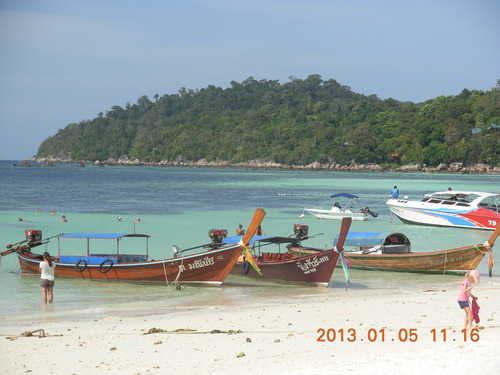
Koh Lipe
Our last two nights on this vacation, we decided to take a speedboat over to Koh Lipe. In Thai, this is literally “Island Lipe” so they all start with “Koh.”
Thailand is another country but only an hour away from Langkawi to the north. Thankfully, R was keeping an eye on the weather forecasts. We chose two sunny days to spend in Koh Lipe when we did the trip there. However, it was pouring with rain on our trip over to Thailand.
The speedboat was not closed off, hence we were all soaking wet! It calmed for the evening, and the next two days were absolutely beautiful weather. That surely made up for the first afternoon’s downpours and very wet luggage.
Koh Lipe is also absolutely beautiful! It is a tiny island (walking distance to go all the way around it) and referred to as “The Maldives of Thailand”. It is known, as is the rest of Thailand, for its beautiful beaches, turquoise-coloured clear water, great snorkelling and diving and cheap but quality massages! We stayed in a small bamboo bungalow (with fans). There were mozzi nets over the bed and a little Asian-style bathroom. The sign on the door said, “Beware of leaving shoes outside on the deck as the dogs love to steal them and bury them!!” Actually, this happened to the German couple staying in the bungalow next door!
Travelinds’ Highlights of Koh Lipe
We only had one full day, so we decided to do a snorkelling trip. It was very reasonably priced and included equipment and lunch for a full day trip. Great decision!
We saw so many beautiful fish and sea creatures in the snorkelling spots and got to see a few little Thai islands along the way. The lunch spot (a deserted white beach) had amazing snorkelling right off the beach. We even saw a scary looking black spider sneaking past us on the beach to go back to the forest.
Travelling Companions
Again, we met up with the Canadians. They had taken our advice and ferried up to Thailand from Langkawi, stopping in at Koh Lipe for a couple of days first. We had a meal or two with them and sunset drinks. We also taught them a few South Africanisms, like “Mozzi”, “Lekker”, “Slops” and “Mielies.”
It was great to make some new friends who are doing what we still dream of doing one day. They have backpacked through Nepal, India and Sri Lanka so far. Now, they’re heading through Malaysia, Thailand, Laos, Cambodia, Vietnam and then Australia.
We also had a lovely chat on the “fast” boat back to Langkawi to Swedish, German and Australian couples, which we enjoyed!
Another Funny Travelinds’ Memory From Koh Lipe, Thailand
On the last evening at about 11pm, we went for a couples massage (one-hour full body). This was something we’d both looked forward to when visiting Thailand! It was amazing, as promised by all the tour guides.
Unexpectedly, the massage was also entertaining. We were bent, prodded, squeezed and stretched —like pretzels — by our tiny masseurs. At one stage, R even had the Thai lady jumping on him with her full body weight. As you can imagine, this was hilarious (and painful for him). It also did the trick to ease the sore muscles!
Final Reflections: Travelinds in Malaysia and Thailand
Tip: Ignore anything that says ‘rapid’, ‘speed’ or ‘fast’ in Malaysia and Thailand – there is nothing rapid about the local transport (or food service). The “rapid” bus that “takes 45 minutes” took us about three hours, and the speed boat of “only 55 minutes” took us 2.5 hours.
Reflecting on this trip reminded us once again, how amazing God’s provision for us has been. He promises to provide for His people. He continues to shower us with most undeserved blessings despite our sinful shortcomings and constant lack of gratitude. We are so very grateful that we have had this opportunity to enjoy a wonderful two-week summer holiday in the middle of the Korean winter with little fuss and a whole lot of fun together!