Tag Archives: Malaysia

Semporna

04 February 2014

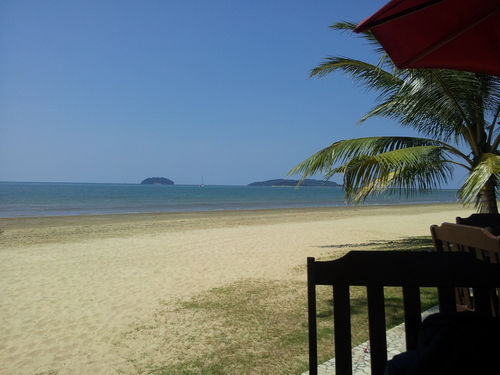
Semporna is a very small city on the south eastern border of Sabah, Malaysia Borneo.  It is home to a wide range of cultural groups including Filipinos, Indonesians and Chinese Malaysians.  It relies on palm oil and tourism to sustain its economy.  It is best known for its association with some of the world’s most beautiful diving and snorkelling islands that lie just off the coastline.  Check out Travelinds posts on the gorgeous northern islands off Semporna’s coast – Sibuan, Mabul, Mataking and Timba-Timba.

First impression:

Upon arriving at this town via express bus, we were surprised to find a dirty, poorly maintained town with litter, water leaks and sorely evident poverty.  The overall vibe here was so different to that of other charming cities we had visited in Sabah and our sixth senses seemed to kick in to high alert.

Tourist attractions:

The only reason to visit Semporna is to use the town as a stepping stone across to the vast underwater beauty of its stunning coastline and surrounding islands.  Scuba Junkie are the dive operators of choice in Semporna.  The islands also boast fantastic white sandy beaches that rival the Tip of Borneo.

Getting here:

We took the Dyana Express Bus (from Sandakan MYR 40, about 6 hours, airconditioned, fairly comfortable).  The Dyana express bus terminal is only a ten minute walk down to the waterfront and boat jetty so the town is pretty small.  You could also take a taxi or intercity bus from Tawau (where the domestic airport is located), or an express bus from Kota Kinabalu.

Accomodation tips:

We stayed at City Inn (right next to the Dyana bus terminal, ten minutes walk from the jetty) for only MYR60 per night. It was clean, quiet, more reasonably priced than backpackers and comfortable. Trip Advisor reviews seemed a bit harsh for the value for money of this hotel.

Staying in Semporna and doing the dives/snorkel trips from there is highly recommended because it generally works out a lot cheaper than staying on Mabul Island.  There are also quite a few restaurant choices on the waterfront (unlike on Mabul Island) so this helps keep the budget in line.

If you are diving at Sipidan, however, you have to stay on Mabul Island or at Kapalai resort (this is usually arranged a little while beforehand though as things get booked up quite quickly).

The advice from a local dive instructor was that it was not really worth the money to stay on Mabul Island (no swimming beach, few restaurants, pricey accomodation) unless you were really into diving at a few of the exclusive spots.  For regular snorkellers/divers, like ourselves, it worked out better to stay in Semporna and take trips out to the islands every day.

Bus booking tip
If you are too tired or lazy to walk up to the Dyana bus terminal and book your tickets, there was a waitress at the Scuba Junkie restaurant who also does bookings for the bus from there.  She phones, books your seats, takes your cash and issues your official ticket. Helpful when it is the end of a long day of sunburn or passed office hours.

Borneo Traveller’s Breakfast

03 February 2014

The standard breakfast in backpackers hostels and lodges in Sabah seemed to be toast and eggs. Or just eggs.  Maybe coffee if you were lucky. So, after a couple of weeks, we felt the need for a little more fibre and found this brilliant alternative in the local Queens supermarket…

***drum roll please******

»»»The Cups ‘Hi-fiber Cereal’ sachets««««

These are like coffee sachets, but with high fibre cereal instead of coffee and sugar. Just add hot water. Or even some raw oats if you happen to get these at your hotel like we did (yes, only raw oats, nothing else?). It is great with hot soy milk too!

These sachets are easy to fit into small spaces for packing, only require a cup of hot water and they taste great! It cost about MYR1 each as at Feb 2014.  Check out other posts about Malaysia from Travelinds.

Note: There are a few different brands of this high fiber cereal but we liked ‘The Cups’ one best for flavour and consistency.

Sepilok Orang Utan Sanctuary

03 February 2014


Orang Utan – ‘Man of the Forest’

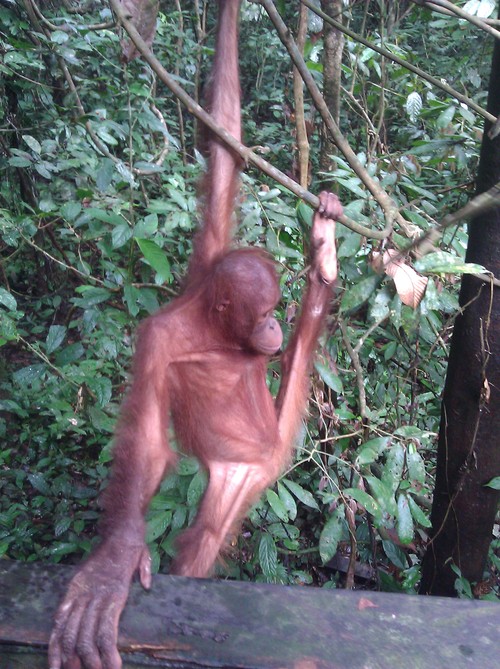
orangutan
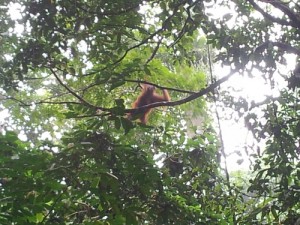
Picture of young orangutan thanks to fellow travellers Olena and Yvginiy who kindly provided a close-up for us.

A long time dream of ours has been to see orangutans in the wild. These funny creatures are beautiful, weird and fascinating.  The dwindling natural habitats of Borneo and Sumatra (the home of these apes) threaten to erase this species altogether.

In Malay, ‘orang’ means person (man) and ‘utan’ means ‘forest’ so the direct translation might be forest-person but the locals refer to it as ‘Man of the Forest’ when entertaining questions from curious tourists.

Orangutan facts

  • The Orangutans are the only apes that inhabit Asia.
  • They are highly intelligent and naturally solitary.
  • The Borneo male’s armspan can reach up to 7 feet (2 metres) and male orangutans have distinctive black cheeks and fleshy jowls.
  • They can not swim, unlike so many of the other animals that make their home in the rainforests of Borneo.
  • The mother and baby will stay together for up to seven years until the baby is ready to go it alone in the wild.
  • Females only give birth once every eight years, which is why the numbers of orangutans are decreasing so quickly and also why there is such a need for the Sepilok sanctuary to care for orphaned baby orangutans.
  • They use big leaves as umbrellas against the regular downpours and branches to make sleeping nests.
  • There diet consists of fruit and leaves and they spend 90% of their time in the trees. This is why deforestation is so detrimental to orangutan populations.

Sanctuary

tumblr_inline_n445nd8kyb1rg4d7l
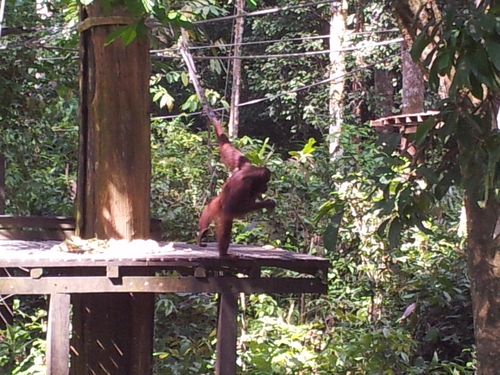
Female orangutan with her baby clinging on tightly. Feeding at Sepilok.

Due to the dire need to protect this special animal from deforestation and clashes with humans over crops and livelihoods, the Sepilok sanctuary was established in 1964.  Its main purpose was to care for orphaned orangutans and rehabilitate them back in to the wild.  The Kabili-Sepilok Sanctuary is 4,300 hectares of natural jungle and there are said to be almost 75 rehabilitated orangutans in the reserve.

Feeding time

The sanctuary has to feed some of the juvenile orangutans who have not yet learned to forage for themselves and they estimate that only 20% of the total orangutan population in Sepilok actually come to the feeding sites each week.

tumblr_inline_n445g9P4kg1rg4d7lBird trail

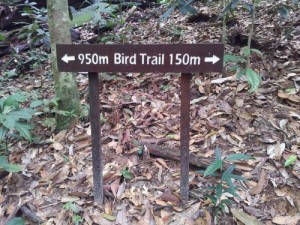
Within the sanctuary there walking trails.  From the Orangutan Sanctuary you can do the “Bird Trail” – a 2.2 kilometer (total) walk through the jungle to a bird viewing tower that overlooks the canopy.  It is not an easy walk so be sure to take proper walking shoes and water with you. It can be muddy when raining and there are lots of roots and trees to clamber over along the way.  We didn’t know it, but the trail actually closes at 2 p.m. so make sure you are back through the gate near the orangutan feeding section before 2 p.m.


Special memory along the bird trail

tumblr_inline_n445vyYES11rg4d7l
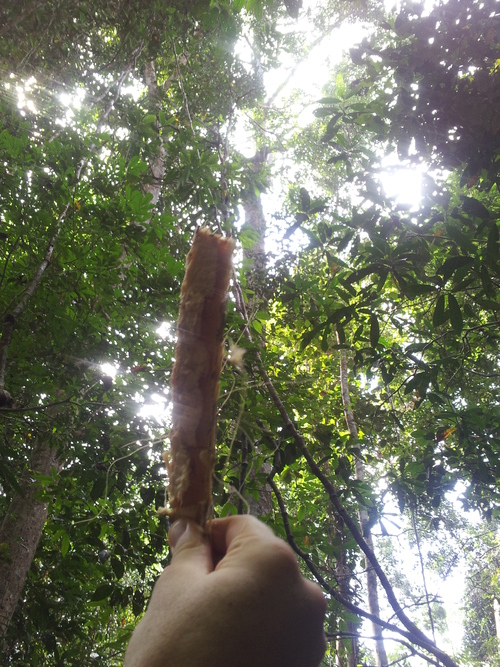
This is one the sticks that the orangutan was throwing down to the canopy floor; the only reason why we spotted him all the way up there in the first place.

After walking for more than an hour, not seeing anything besides a troop of short-tailed macaques, we were almost smacked on the head by a half eaten pod.  More pods and sticks came down in the next few minutes and no matter how hard we strained our eyes, we could not see the culprit who was trying to murder us.

Eventually, we spotted a small orangutan at the very top of the jungle canopy and we walked away with a half-eaten pod as a souvenir (and to prove to other people that the Bird trail was not a complete waste of time).


Wildlife

This is a reserve in which you can find orangutans, short-tailed and long-tailed macaques, squirrels (including giant flying squirrel), snakes, deer, a staggering variety of endemic birds (including the rare Great Argus) and other reptiles.

Admission

MYR 30 each for a one day pass. (Sun Bear Sanctuary is also MYR 30 each, Rainforest Discovery Centre MYR 15 each)

Tips: Visitors are not allowed to take any food or drink into the sanctuary as the animals may try to steal. There are (Free) lockers available at the office where you can leave your bags (small bags/backpacks only).

Bus

From Sandakan, Take the ‘14 Sepilok’ bus directly to Sepilok Orangutan Sanctuary. It leaves from the mini-bus terminal near the beachfront traffic circle (5 minutes walk from Harbor Square Mall). Bus trip takes about 50 minutes, RM5 (negotiable) and it leaves at 9.00am and 14.00pm from Sandakan to get you there just in time for the 10.00 am and 15.00 pm feedings.

Day trip options from SandakanSandakan

Sepilok One Day:

Orangutan sanctuary 10.00 feeding, Sun Bear sanctuary 12.00 – 13.00, Rainforest discovery Centre 13.00 – 14.00, Orangutan sanctuary 15.00 feeding. Bus back to Sandakan at 16.00


*Recommended*

Sepilok Two Days:
  • DAY 1: Orangutan sanctuary 10.00 feeding, Bird Trail and lunch 11.30 – 14.00, Informational video 14.30, Orangutan 15.00, Bus back to Sandakan at 16.00
  • DAY 2: Rainforest Discovery Centre morning,  lunch outside the Orangutan Centre at local stall, Sunbear Sanctuary afternoon. Take the 9.00 a.m. Bus 14 from Sandakan, ask to be dropped at Rainforest Discovery Centre. Take 16.00 bus back to Sandakan from the Sepilok Orangutan Sanctuary. (Note: Rainforest discovery centre is about 1.2km walk from the Sunbear and Orangutan Sanctuaries)

You can read more about Sepilok Reserve, Orangutan Rehabilitation Centre and Rainforest Discovery Centre here.


Rainforest Discovery Centre- Sepilok

02 February 2014

Sandakan to Sepilok

We hadn’t managed to get the Rainforest Discovery Centre (RDC) on our previous trip to Sepilok, as the orangutans had monopolised our time and attention on the first day at the Rehabilitation Sanctuary.  So on Valentine’s Day, our last day in Sandakan, we returned to Sepilok area and spent the day at the RDC.  Our intention was to enjoy the bird-watching opportunities that we hadn’t really done to yet.

With ominous weather looming, we brought along rain ponchos and also a few snacks to see us through lunch time should we be distracted by the array of colourful birds that we hoped to see.

Rainforest Discovery Centre

We started the day with a stroll along the canopy walkway, punctuated with long rest periods at the various seated viewing sites along the way.  At the broadbill tower, we stopped and admired some of the bird-life (although not the elusive broadbill itself) and had a couple of snacks while we looked over at the dam and its surrounding tree tops.

All of a sudden, H noticed a bright orange blur on the far side of the dam and the orange blur continued to jump down from tree to tree, from the highest point of the canopy to the lower level forest.  Excited, but without a pair of binoculars to confirm, we headed off in the direction of the orange blur’s final destination in hopes of seeing a monkey or some other creature.

tumblr_inline_n4472gtU8k1rg4d7lTurns out, it was a small orangutan! A real, live, wild orangutan in the forest where we had only expected to be seeing birds and bugs.  We strained our necks and happily watched him for at least an hour, eating and playing on one of the lower trees.
As happens regularly, there was suddenly a downpour and while we were grabbing our ponchos, the orangutan was quickly constructing a nest of leaves and sticks to shelter himself from the ensuing rain.  It was amazing to watch him build a nest and search for bigger leaves and longer sticks when the smaller ones didn’t cover him sufficiently. We were forced to seek shelter as the rain got harder and harder and we hid out in a small hut until the worst of the storm had passed.

We also saw some amazing birdlife and a Great Red flying squirrel as we were walking later that day.

Getting there

From Sandankan, Number 14 Bus (Sepilok), ask to get out at Rainforest Discovery Centre (it is 2km before the Orangutan reserve and about 1km from the main junction roundabout). take the same route as for Sepilok Orangutan Rehabilitation Centre (Sepilok reserve covers this whole area).

TIP: Take binoculars – you are going to get much more out of the experience that way.

Entrance Fee: MYR 15 per person

For suggested itineraries for Sepilok, click here.

Sandakan

01 February 2014

SandakanSandakan is a small city on the east coast of Sabah, Malaysia Borneo. It is a port city and relies heavily on the palm oil trade, as well as other exports like cocoa, tobacco and sago.

Tourists use this city as a gateway to Sabah’s natural beauty with nearby eco-tourism destinations such as the Sepilok reserve, Turtle Islands, Danum Valley and the Kinabatangan River. It does not have much to see in the city itself but offers a couple of nice restaurants and a shopping mall at Harbour Square.  There are also a few historical sites and a museum if you have some time to kill.

It is about 6 hours by bus to Semporna and 2.5 hours to Bilit (known for eco-tourism lodges along the Kinabatangan river).

Read more on Sepilok, Kinabatangan River and Semporna here.

Borneo Sandakan Backpackers

01 February 2014

Borneo Sandakan Backpackers was a pleasant surprise. It’s a clean, friendly, comfortable backpackers in the heart of Sandakan, with an attached tour company that has some of the most efficient staff I have ever met.

A head’s up from a friend (read their blog of six months touring in South East Asia) told us to use this backpackers as our stop off point in Sandakan and also arrange our Kinabatangan river tour through them.  We followed their advice and were not disappointed, not even once.

Good points at the backpackers were the clean rooms and bathrooms, airconditioning in the private room, 24 hour desk service, delicious breakfasts (egg, toast, jam, coffee, oats) and friendly, efficient staff.  It is also in the Harbour Square location in Sandakan, which is close to the mall, the bus terminal, the minibus terminal, restaurants and the markets. The staff (especially Jonathan) are especially helpful and friendly when it comes to giving free advice on travelling in and around Sandakan.  There are maps, posters, bus schedules and tourism brochures available at the backpackers to help you plan the best trip for you.

A Bad point was the dripping shower overflow (kept us awake a little), but that was all.

TIP: Be careful about backpackers with similar names like Sandakan backpackers, Borneo backpackers etc – especially if you are booking online.  This is Borneo Sandakan Backpackers and Borneo Sandakan Tours.  It is a red and white logo as on the website.  Read TripAdvisor Reviews for more information.

Kinabatangan River Tour

31 January 2014

After a friend travelled to Borneo a few months ago, she told us about these ‘jungle river tours’ that are available in Sabah.
The tours travel along the Kinabatangan River where the rainforest creatures still live in the wild.  I must admit that this was the main thing that drew me to Sabah itself, as my passion for wildlife exceeds much else in my life.  My hope was to find orangutans, proboscis monkeys, pygmy elephants, rhinoceros hornbills and a clouded leopard – and I’d say that having seen 4 of these 5 wasn’t a bad track record for only five nights in the jungle.

Kinabatangan means ‘china, long river or tree’ and again, it is uncertain where this name originated, but it sure is a very long and rather wide river.  It twists and turns back on itself in several places, creating ox-bow lakes; and the river boasts an impressive total length of about 560 kilometres.  The area is teeming with wildlife but there are also many parts in Upper-Kinabatangan that have been badly affected by encroaching palm oil plantations.  There are conservation efforts to protect the remaining wildlife but clashes between man and nature are often unavoidable.

Lodges are based mainly in the Sukau town area, but Bilit village also has a few which are on the quieter end of things. We ended up enjoying the first tour so much, that we came back to Bilit Adventure Lodge for a second time, after a week in Semporna. During our tours (in mid-February 2014, still technically ‘monsoon season’ for this area) we managed to get thoroughly soaked at least twice on each tour but the rewards were so much greater than a few hours of driving rain.  Read a few Kinabatangan River TripAdvisor reviews for more information.

Our wildlife sightings over the five days were: mouse deer (at our lodge!), proboscis monkey, silver leaf monkey, orangutan, long-tailed macaque, short-tailed macaque, crocodile, monitor lizzards, kettle fish, pygmy elephants, python, yellow ring snake, black squirrel, mudfish (no gills!), red velvet dragonflies, one dead black cobra (huge!) and leeches.

With a vast array of beautiful birds in this area, some of our special bird sightings (those we actually knew the names of anyway) were: stork-billed kingfisher, rhinoceros hornbill (so impressive!), oriental pied hornbill, wrinkled hornbill, black hornbill, bushy-crested hornbill, blue-eared kingfisher, red coucal, lily hens, black and red broadbill (stunning!), blue-throated bee eaters, lesser fish eagle, serpent eagle, ashy tailorbird, egrets, herons and so many other feathered friends!

Sadly, we didn’t see: Sumatran Rhinoceros (not seen by our guide in 16 years on the job), clouded leopard, slow loris, tarsiers, sunbear, mongoose and read leaf monkeys.

Overall, it was a fantastic trip and we really appreciated that this could be a once in a lifetime experience.  We hope that one day our children may also be given the chance to see these amazing creatures in their natural habitat, provided environmental conservation efforts can keep them protected that long in to the future.  It would be such a shame to lose yet another part of God’s wonderful creation to man’s destruction.

Read more about our adventures in the jungle here.

Jungle Adventures

31 January 2014

The Borneo jungle beckoned to us long before we finally reached it and the experience of finally being there was truly spectacular! The wildlife was incredible and the scenery like something out of a dream – it is almost too beautiful to describe!

Our jungle destination was the Bilit Adventure Lodge, which is nestled quietly alongside the great Kinabatangan River.  We did a two night stay here and then, a week later, returned for another three nights in specifically in search of the elusive pygmy elephants who had managed to evade us on the first two nights.

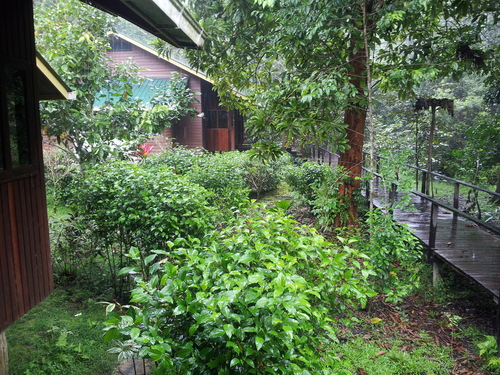
Bilit Adventure Lodge itself is a real slice of heaven in this already dream-like place, with dark wooden cabins and wooden boardwalks blending perfectly in to the surrounding jungle. Monkeys, tortoises, deer and hornbills were regular visitors within the lodge area and the sounds of the jungle gave us both a frog-lined lullaby in the evenings and a refreshing wake up call in the early mornings.

Bilit Adventure Lodge
Cabin at Bili Adventure Lodge tucked into the rainforest.

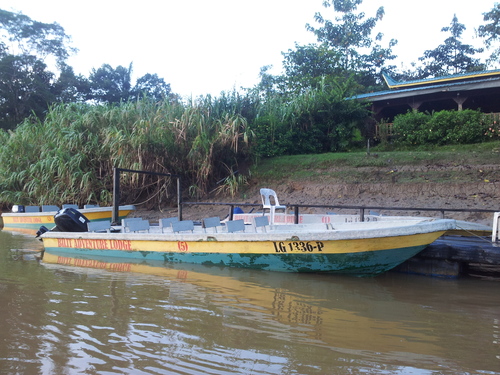
The river cruises are mornings (1 hour) and evenings (2 hours) as this is when the most animals are up and about alongside the river.  Despite being a completely open motorboat (with place for only 8 people), regular rain did not deter us from venturing out in search of the fascinating wildlife of the Kinabatangan jungles.

TIP: We wore clothes that could get wet and that would dry easily.  We left all valuables locked at the lodge and took only cameras (in waterproof bags).  Caps also help to shield eyes from the rain.  No shoes needed in the boat, so leave them at the lodge under the dry cover of the communal dining room.

Kinabatangan
The tour boat where we spent mornings and evenings searching the riverbanks for wildlife and birds.
LAUGH: While preparing for our trip, I came across this hilarious review on TripAdvisor by wiredfrog.  Read this review if you want to have a good laugh; and also to get a sense of what the river cruises can be like if it’s raining heavily.  Please note however, that this was a very over-dramatic rendition of what we actually experienced during our five days (which were still in the Nov-Mar monsoon season) and that the superb wildlife spotting is sure to make up for any discomfort experienced.

The meal times at the lodge were also a real highlight for us, with delicious cuisine inspired by Malay, Indonesian and Western methods.  Tea times were even better, with little cakes, buns or sweet local delicacies that tickled our taste buds and filled the gap for our two hour cruise before dinner.

TIP: Take a pair of (quick dry) long pants and long shirts for evenings to avoid getting attached by mosquitoes.  We didn’t use any repellents (brave or stupid?) but have not picked up any illnesses from the thousands of mosquitoes we donated blood too during our month long stay in Borneo (supremely grateful)!

We did the jungle trek one morning which took us out to one of the ox-bow lakes.  We were relieved to have hired gumboots though as we had mud up to our ankles in so many places. Also, with hungry leeches all around (in trees, plants, mud and grass), we were also so glad to have had long sleeves and long pants (everything tucked in tightly to avoid leech bites) as many of the other tourists got nice fat leech surprises when they checked under their clothes! Lucky for us, the leeches ignored us completely.

Kinabatangan
The trek through the rainforest requires sturdy gumboots for the deep mud.

At the time (February 2014), the dormitory-style rooms were almost fully completed, but lucky for us, we got to stay in the fancy cabins (air conditioning, double beds, en-suite bathrooms, lounge overlooking the jungle, kettle and shower).  It was far more than we were expecting and made for a rather wonderful few days enjoying the jungle in luxury. We stayed in the cabins that have names such as ‘Proboscis Monkey’ and ‘Western tarsier’ – the one with the best view was Cabin number 3 (the front-facing room) as this is where I watched a comical pair of Oriental Pied Hornbills who danced along the water tower every morning after tea.

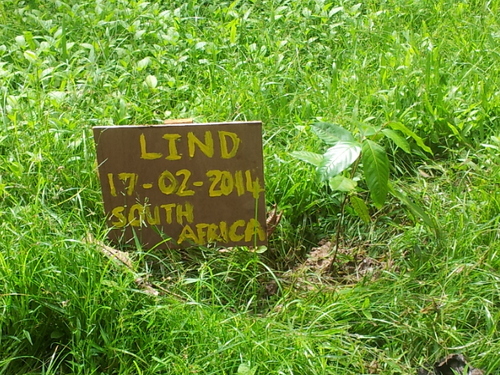
Bilit Adventure Lodge also offered us a chance to plant a tree in their property (at MYR 10) to help replenish the loss of vegetation that is caused each year from flooding.  We proudly contributed a small little tree somewhere next to Cabin number 3 and hope to return one day to see if it survives long enough to do its part for the Kinabatangan jungle.

Plant a tree
Travelinds planted a tree in the rainforest.

Read more about the tour package here.

Tanjung Aru

30 January 2014

Tanjung (Beach) Aru is the long, flat beach between the Kota Kinabalu International airport and the Sutera Harbour.  It looks out on to the four islands off the coast (Manukan, Sapi, Mamutik and Gaya island).

We spent one morning here just sunbathing, reading and swimming; and then left after lunch.  It was a lovely, quiet place, although the sand looked a little dirty (oily) in some patches. The water was surprisingly clear and from the amount of people swimming, didn’t seem to pose any health threats.

There is also a small park with benches and places to picnic. The one or two restaurants on the beachfront seemed reasonably priced and good enough for a lunch on the run.

Getting here:

  • Take (big) Bus Number 16 from Wawasan Bus Terminal.
  • MYR 1.50 each, ask for Tanjung Aru beach.
Note: There is a small bus (minibus) 16 that also goes to this area, but it drops you at Tanjung Aru town, not at the beach. So it is about a twenty-five minute walk to the beach from the town bus stop.

Kota Kinabalu Wetland Centre

29 January 2014

Kota Kinabalu Wetland Centre (KKWC) is a few minutes by bus from the Likas Mosque. You can also easily walk to it from Signal Hill and from Likas Square.

The area consists of low-lying mangrove vegetation, lots of mud, muddy creatures and quite a nice variety of birdlife.  There are board walks, viewing platforms, benches and look out points.  Entrance was MYR 15 per person. The centre closes around 6pm.

We enjoyed an afternoon here on our way back from a visit to Likas Mosque.  It was peaceful, not busy at all and there were educational posters and informational boards all around the walkways.  The only disappointment was the amount of litter everywhere which comes in when the waters rise. See more reviews on TripAdvisor.

Worth a visit for an afternoon stroll and some bird watching.

Getting here:

Take a local (big) bus from the Shangri-la Bus Terminal (in front of the Shangri-la motel, NOT the fancy one out of the city), near KFC.  Ask for the Likas bus (purple colour) and tell the driver you want to get off at Likas Square (about ten minutes walk from here to the wetland, follow the tourism boards). MYR 1 each.

Gaya Street Sunday Market

28 January 2014

As informed by the brochures on Kota Kinabalu, we headed over to the Gaya street Sunday Market relatively early on Sunday morning.  We had heard plenty of positive things about this bustling street market and wanted to check it out.  With it being the weekend of Chinese New Year, there was also a lot of excitement around the area with loads of lantern decorations and dancing dragons gliding through the streets.

True to form, the market did not disappoint with its vast array of goods for sale and the whole of Gaya street was blocked off with several rows of stalls. Some of the things we spotted were: clothing, puppies, plants, juice, gadgets, curios, pots, lasers, baskets, fish, fresh produce, fake jewellry, nailpolish, handbags, turtles, musical instruments, canvas artworks and coconut carvings.

Not being too fond of close contact with hundreds of people, we only lasted about an hour and then headed back to find some brunch. The only purchases for the day were a mango juice and matching caps with ‘Sabah Borneo Malaysia’ embroidered on the front.

Getting there:

Coming from Centre Point side, you cross the main intersection at Centre Point heading away from the ocean.  You then head towards the city hall park area (you’ll see a KFC on your right at some point and a bus terminal on your left) and keep walking until you see the colourful Gaya street market decorations. There is a big hotel and a bird statue just before the entrance to Gaya street.  It is the street where a lot of the lower-end backpackers are located.  The traffic and amount of people should also guide you to the right area.

There’s more information about the Gaya Street market here.