Tag Archives: birds

Oribi Mom: Running Into Summer on the South Coast

“Summer is coming and it feels greener since the pandemic started making its exit.”
November 5, 2022 

I’ve started running again. Okay, let’s call it what it is: a slow jog. A very slow one after three babies and a long year.

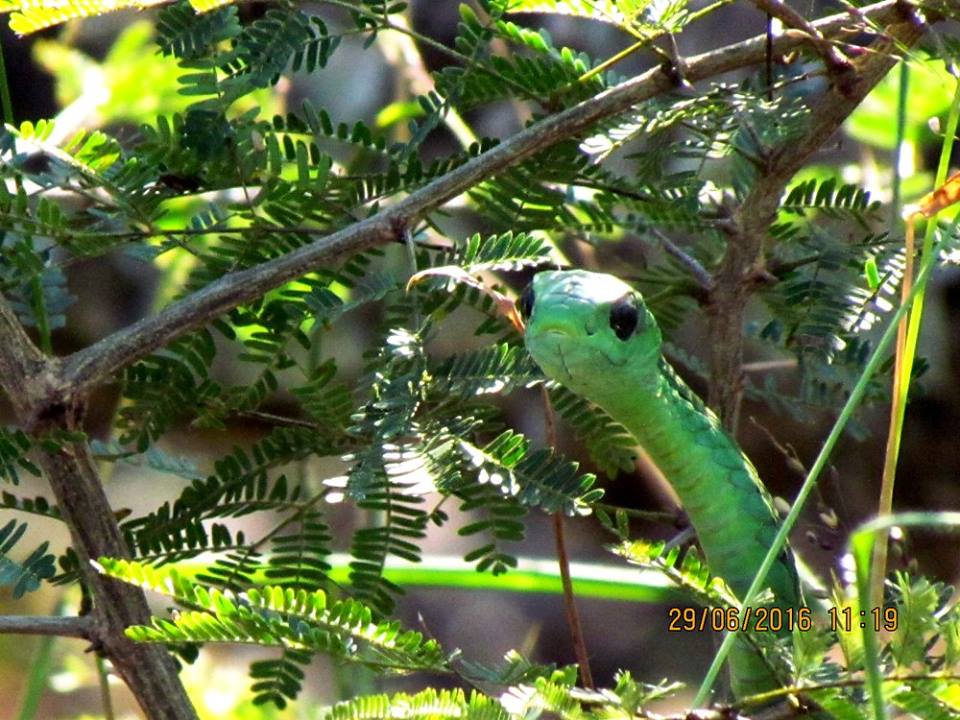
The last time I started jogging was after Baby Number Two. I was bitten by a night adder about a month into my routine and it didn’t go so well after that. But, I’m back again, kicking up dust and looking for bird distractions up the crazy hills.

I’ve tried to catch up to the giant water mongoose that lives by the stream, but it’s too quick. I’ve snuck up to the African Pygmy Kingfisher that lives in the bank, but my cellphone camera is woefully inadequate to get a clear picture. I usually see a bright blur darting out in front of me and know I’ve missed it.

Panting Up the Hills Is Part of Running Again

It’s also a little embarrassing coming into view of one of the occasional workers in the macs. It’s about that moment you realise that you’ve been panting aloud like some old dog all the way up the hill. Did the person just on the side of the ridge wonder why an old gogo was coming up the road in the middle of nowhere?

The crowned hornbills sometimes sit at the tops of the trees and laugh at me while I pant up the steep bits. With an elevation gain of about 150 metres during the jog, the steep bits include the first 2.5km or so. If I can make it past that, I can ease up the heart rate and cruise downhill for most of the way home.

There’s one part of my regular route I’ve named Death Hill. That’s probably slightly dramatic, but it certainly makes you feel like death warmed up when you’re at the bottom of it and want to get to the highest point on the farm. If you can push through, you can turn around and have a full view of the sea in the distance, Gamalakhe next to that, and Oribi Gorge and Paddock the other way.

You can also see some of the Southern Drakensberg on clear days. The view alone is worth a little bit of sweat and embarrassing panting most days.

Jog or Run or Walk, But Get Out and See the World

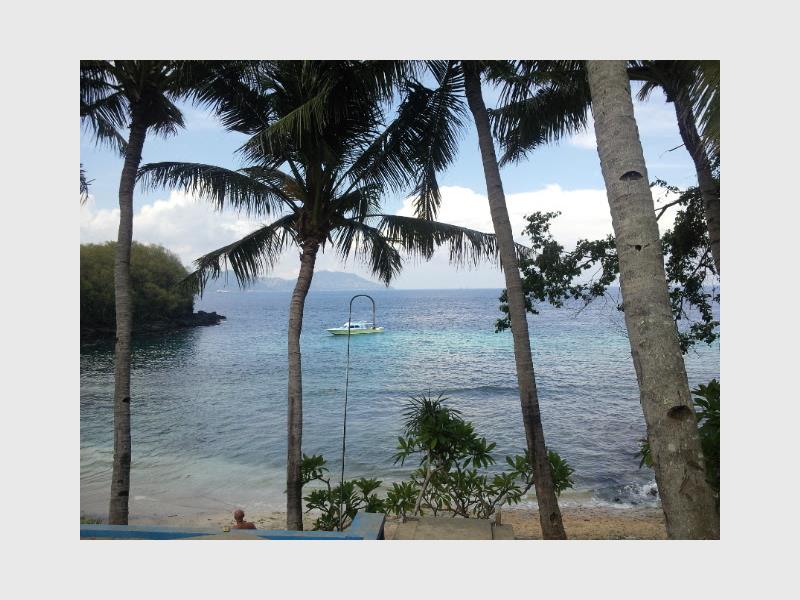
I’ve jogged many places in the world, including around a tiny Indonesian island where we snorkelled with turtles every day. I’ve jogged in the Mara Triangle in Kenya and wondered about lions hidden in the grass. Now, I’m running on my farm on the South Coast and it’s just as beautiful.

Summer is coming and it feels greener since the pandemic started making its exit. Who knows, maybe we won’t even have to cancel the holidays this year.

Published here.

Oribi Mom: Spring Has Arrived in Oribi Gorge

“As the spring approaches, I hope you have good changes coming your way too.”


August 25, 2022The weather has been glorious lately. Cool enough to garden a bit after months of a pregnant belly. Warm enough to go on late afternoon strolls with a baby and two boys on bikes kicking up dust. This spring we will finally have a hectare or two of macadamia saplings in the ground to compete with our growing brood. It is an exciting time interspersed with all the adult responsibilities. It’s also different to how things have looked up until now.

The third week in August was like a switch on the farm. The swallows and yellow-billed kites arrived within a day of each other. The wise are not so quick to declare spring in these parts though. The cold sneaks in every September with wind and rain that’s colder than anything we experience through ‘winter’ on the coastal inland farms.

My garden also gets confused. There are already arums, peaches forming, snake lilies pushing up, and flowers on the coffee tree. There are also captivating paint brush-like flowers and showy blooms starting to pop up everywhere. But my trusty beanie is going to stay ready for the next few weeks. I haven’t swapped out cosy slippers for slops yet. Isn’t it strange that we are so hesitant to change over when the signs are obvious? That’s human nature. We resist the unknown even if positive things may await.

At home now things have changed despite us wanting to hold on to the familiar. Every one of our garden pets has become a meal for a caracal, mongoose, or bird of prey in the last few months. Our lovely bunnies and chickens are all gone but we now have a beautiful new son. Our small farm no longer has the ancient flat crown choked by lantana but we have macadamia trees. We are winning the battle against invasive weeds in those spaces.

Things change like the weather and it seems that waiting out the storms is often worth the sunshine. As the spring approaches, I hope you have good changes coming your way too. We just have to roll with it and wait for the summertime.

Published here.

Oribi Mom: Why Did God Create Birds? SO Many Reasons

“There’s always something to see.”

July 19, 2022
Drongos really are amazing birds. I recently learned that these savvy vocalists are masters of imitation. Their strategy is to ingratiate themselves to the other bird species they like to shadow so that they can steal their food or hunt them while they aren’t looking. They can copy bird calls by the hundreds, and they aren’t the only species that do it. White eyes are exceptionally talented in this discipline.

Distraction 101: Cuckoo vs. Weaver

This spring, I watched a pair of Diedricks cuckoos harassing a flock of weavers. The weavers were trying to build their nests, carefully feeding grass through knots and creating the most intricate shapes. Did you know that you can tell the type of weaver by the shape of its nest?

As the weavers tried to sort out their hierarchy for mating and laying, the sun shimmered off the emerald and white cuckoos with red eyes as they played a game. The one cuckoo called relentlessly and dive-bombed and flitted in and out of the nest area to draw the weavers’ attention. It had them really worked up. The other one waited.

At the opportune moment, it would enter a nest unseen, lay a sneaky egg, and then fly out quickly before the mother returned. Mother weavers raise baby cuckoos, and it is a ridiculous sight. The giant baby cuckoo demands endless food from a mother that is smaller and not at all similar in colour or shape. The cuckoo’s eggs even change colour according to which species they choose to trick into raising their young. It’s truly fascinating.

Want Inspiration? Just Watch the Birds

There is so much to learn from watching nature. Unlike the cuckoo parents who are lazy (or efficient?), the tiny mannikins work tirelessly in a community. They build together and sit on eggs in one big nest. They forage together in twittering bunches that fly here and there, ever vigilant of cunning drongos. My grandmother used to call them frets, and that seems apt as the mannikins jump at their own shadows.

If you want inspiration, a birding day in places like Oribi Gorge is a great choice. But, you may only have to walk a few steps out of your front door to see something awe-inspiring. Haven’t you noticed the extraordinary focus with which swallows build their mud nests in your eaves? Don’t you see the phenomenal agility and stealth of the African harrier hawk? It raids nests in the middle of town, with spindly yellow legs and light grey feathers a sparrow’s nightmare.

Look around. There’s always something to see.

Published here.

Oribi Mom: Must Love Birds and the Adventure of the ‘Chase’

I’ve also loved flitting about the South Coast birding community on Facebook bird groups.

I’ve always loved nature, but since our move to Oribi Gorge, my blood is emerald green, just like ‘Hello Georgie’.

I may actually be obsessed with the feathered friends that fill this beautiful country.

An overseas friend asked if I was a twitcher, and after a quick Google search, I solemnly declared myself a true bird lover instead.

I’m not a tick-off-the-list ‘twitcher’ who loses interest after they’ve seen every one of South Africa’s 850 recorded species once (725 resident species).

No, I sit on my porch for morning coffee and daily appreciate the wine-red firefinches, melodious black-headed orioles, opportunistic Black Sparrowhawk (which hunts our free range chickens), and the soaring vultures high above our Umzimkulu cliffs.

I’ve also loved flitting about the South Coast birding community on Facebook.

Hugo Voigts in Paddock is phenomenally dedicated – he once sat for over four hours in camouflage to capture elusive flufftail chicks (and this wasn’t his only comparable effort).

Lia Steen in Shelly Beach has the most magnificent finds right in her garden. She must have a brilliant camera to capture that much detail, too. I’ve learned a lot about birding habits from her fascinating posts.

The luckiest South Coast birder must be Stan Culley, somewhere near Port Edward maybe? ‘Culley’s Dam’ boasts fantastic bird visitors daily, including the cutest baby white-starred robin I’m yet to find in my patch of paradise.

Why birding? I think it’s the chase.

Some days you see a new one that you have never, ever noticed before. You read about it (maybe you’ll get a Roberts bird app for your birthday like I did) and learn the sound. The next few weeks, you realise that it is a screech or a song that you hear constantly. It wasn’t a new bird in your garden at all, just a hidden gem.

Once you see it, you can’t un-see it and then you start to appreciate the immense beauty of this country.

Birdwatching Is Good for the Soul

Next time coronavirus has you down, sit at your window or put your binoculars next to you on the porch.

Take a breath, laugh at the bobbing wagtails and the fluttering sunbirds and open your eyes.

You might see that martial eagle gliding above the clouds or you might notice the white-browed scrub robin around your fallen leaves for the very first time.

Wonder is the beginning, and from there, joy.

Published here.

Hlatikulu Bush Lodge, iMfolozi-Hluhluwe

JULY 2016

Photo Credits:  Wendy Buchanan (thanks, mom!)

A while ago, Travelinds told you about one of our favourite game reserves in Kwazulu-Natal – iMfolozi-Hluhluwe National Park.  The few days spent at Nselweni Bush Lodge was a great family holiday and we couldn’t wait to go back again!  This time we tried a new hideout – the Hlatikulu Bush Lodge!

13769451_10157119262840291_8995990913587496907_n

Hlatikulu Bush Lodge

This was a good surprise as we had only booked Hlatikulu in a rush to secure accomodation in an already full reserve.  However, as soon as we arrived, after navigating the jolting 4×4 route to get to the lodge, we realised that we had made yet another magnificent discovery!
The bush at your door
The camp is beautifully maintained by Siyabonga and New Year, both of whom have been there for ages and visibly love what they do. Right on the riverbend, with no fence, the animals and birds come and go as they please.  All around the camp are tweets and chirps, grunts and growls, spoor and feathers and evidence of life.
The deal

The camp can accomodate eight people at most, in four lovely huts (each for two people), all of which boast views of either the river or the bush.  The booking includes… (wait for it!)… TWO bush walks with Siyabonga and his gun (2-3hours, one morning, one afternoon) for every night that you stay.  New Year will cook any food that you can bring (and he will insist on setting up AND cleaning up everything in the communal lounge and diningroom himself, too). These two wonderful humans keep the huts immaculately clean and look after you while you simply relax and enjoy the wildlife.

13697057_10157119315235291_4857569789511689644_nNature up close

The resident bushpig, Georgina, can get a little persistent in the evening, but please, do not feed her even if she follows you down the boardwalk or begs.  There are also hippos, crocodiles, lions, elephants, buck and other creatures that roam in and out of the camp at their leisure – look around when you are outside and do remember that you are living in the real African wild now!

We fell asleep each night to lions roaring, hippos grunting, hyenas laughing and melodious nightjars. Early mornings wake up to birds singing and nyalas crunching grass right outside our windows.
A different perspective

The bush walks were also well worth the effort and if you do what Siyabonga tells you, you’ll be in good hands. He’s an experienced game ranger and takes his job, and your safety, seriously.  The animals are wild and unpredictable, especially where humans provoke and disrespect the natural order of things.  It is our responsibility to preserve and care for nature and a bush walk is a great way to remind yourself of your roots.13699980_10157123764390291_2516487894411405346_n

Hlatikulu, we’ll be back!

Read more reviews here.13690805_10157119327665291_1327660552813445550_n

Rhino Card

Use your rhino card to receive discounts on day fees, accomodation and more.  It was worth it for us to buy the card (for a couple) just to cover our day fees during the week here.  Ezemvelo KZN wildlife is also a great cause to support!


Rainforest Discovery Centre- Sepilok

02 February 2014

Sandakan to Sepilok

We hadn’t managed to get the Rainforest Discovery Centre (RDC) on our previous trip to Sepilok, as the orangutans had monopolised our time and attention on the first day at the Rehabilitation Sanctuary.  So on Valentine’s Day, our last day in Sandakan, we returned to Sepilok area and spent the day at the RDC.  Our intention was to enjoy the bird-watching opportunities that we hadn’t really done to yet.

With ominous weather looming, we brought along rain ponchos and also a few snacks to see us through lunch time should we be distracted by the array of colourful birds that we hoped to see.

Rainforest Discovery Centre

We started the day with a stroll along the canopy walkway, punctuated with long rest periods at the various seated viewing sites along the way.  At the broadbill tower, we stopped and admired some of the bird-life (although not the elusive broadbill itself) and had a couple of snacks while we looked over at the dam and its surrounding tree tops.

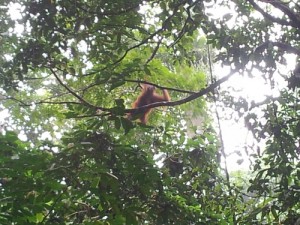
All of a sudden, H noticed a bright orange blur on the far side of the dam and the orange blur continued to jump down from tree to tree, from the highest point of the canopy to the lower level forest.  Excited, but without a pair of binoculars to confirm, we headed off in the direction of the orange blur’s final destination in hopes of seeing a monkey or some other creature.

tumblr_inline_n4472gtU8k1rg4d7lTurns out, it was a small orangutan! A real, live, wild orangutan in the forest where we had only expected to be seeing birds and bugs.  We strained our necks and happily watched him for at least an hour, eating and playing on one of the lower trees.
As happens regularly, there was suddenly a downpour and while we were grabbing our ponchos, the orangutan was quickly constructing a nest of leaves and sticks to shelter himself from the ensuing rain.  It was amazing to watch him build a nest and search for bigger leaves and longer sticks when the smaller ones didn’t cover him sufficiently. We were forced to seek shelter as the rain got harder and harder and we hid out in a small hut until the worst of the storm had passed.

We also saw some amazing birdlife and a Great Red flying squirrel as we were walking later that day.

Getting there

From Sandankan, Number 14 Bus (Sepilok), ask to get out at Rainforest Discovery Centre (it is 2km before the Orangutan reserve and about 1km from the main junction roundabout). take the same route as for Sepilok Orangutan Rehabilitation Centre (Sepilok reserve covers this whole area).

TIP: Take binoculars – you are going to get much more out of the experience that way.

Entrance Fee: MYR 15 per person

For suggested itineraries for Sepilok, click here.

Sandakan

01 February 2014

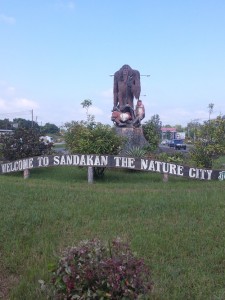
SandakanSandakan is a small city on the east coast of Sabah, Malaysia Borneo. It is a port city and relies heavily on the palm oil trade, as well as other exports like cocoa, tobacco and sago.
Tourists use this city as a gateway to Sabah’s natural beauty with nearby eco-tourism destinations such as the Sepilok reserve, Turtle Islands, Danum Valley and the Kinabatangan River. It does not have much to see in the city itself but offers a couple of nice restaurants and a shopping mall at Harbour Square.  There are also a few historical sites and a museum if you have some time to kill.

It is about 6 hours by bus to Semporna and 2.5 hours to Bilit (known for eco-tourism lodges along the Kinabatangan river).

Read more on Sepilok, Kinabatangan River and Semporna here.

Jungle Adventures

31 January 2014

The Borneo jungle beckoned to us long before we finally reached it and the experience of finally being there was truly spectacular! The wildlife was incredible and the scenery like something out of a dream – it is almost too beautiful to describe!

Our jungle destination was the Bilit Adventure Lodge, which is nestled quietly alongside the great Kinabatangan River.  We did a two night stay here and then, a week later, returned for another three nights in specifically in search of the elusive pygmy elephants who had managed to evade us on the first two nights.

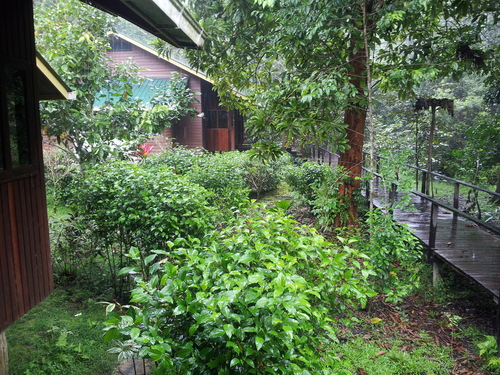
Bilit Adventure Lodge itself is a real slice of heaven in this already dream-like place, with dark wooden cabins and wooden boardwalks blending perfectly in to the surrounding jungle. Monkeys, tortoises, deer and hornbills were regular visitors within the lodge area and the sounds of the jungle gave us both a frog-lined lullaby in the evenings and a refreshing wake up call in the early mornings.

Bilit Adventure Lodge
Cabin at Bili Adventure Lodge tucked into the rainforest.

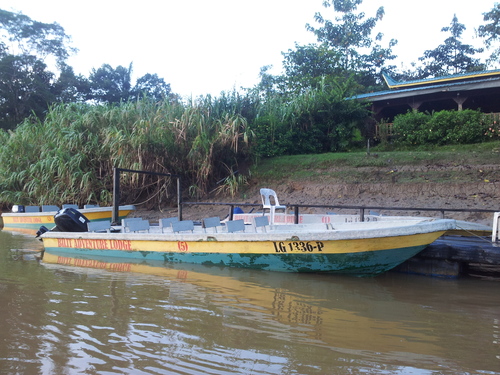
The river cruises are mornings (1 hour) and evenings (2 hours) as this is when the most animals are up and about alongside the river.  Despite being a completely open motorboat (with place for only 8 people), regular rain did not deter us from venturing out in search of the fascinating wildlife of the Kinabatangan jungles.

TIP: We wore clothes that could get wet and that would dry easily.  We left all valuables locked at the lodge and took only cameras (in waterproof bags).  Caps also help to shield eyes from the rain.  No shoes needed in the boat, so leave them at the lodge under the dry cover of the communal dining room.

Kinabatangan
The tour boat where we spent mornings and evenings searching the riverbanks for wildlife and birds.
LAUGH: While preparing for our trip, I came across this hilarious review on TripAdvisor by wiredfrog.  Read this review if you want to have a good laugh; and also to get a sense of what the river cruises can be like if it’s raining heavily.  Please note however, that this was a very over-dramatic rendition of what we actually experienced during our five days (which were still in the Nov-Mar monsoon season) and that the superb wildlife spotting is sure to make up for any discomfort experienced.

The meal times at the lodge were also a real highlight for us, with delicious cuisine inspired by Malay, Indonesian and Western methods.  Tea times were even better, with little cakes, buns or sweet local delicacies that tickled our taste buds and filled the gap for our two hour cruise before dinner.

TIP: Take a pair of (quick dry) long pants and long shirts for evenings to avoid getting attached by mosquitoes.  We didn’t use any repellents (brave or stupid?) but have not picked up any illnesses from the thousands of mosquitoes we donated blood too during our month long stay in Borneo (supremely grateful)!

We did the jungle trek one morning which took us out to one of the ox-bow lakes.  We were relieved to have hired gumboots though as we had mud up to our ankles in so many places. Also, with hungry leeches all around (in trees, plants, mud and grass), we were also so glad to have had long sleeves and long pants (everything tucked in tightly to avoid leech bites) as many of the other tourists got nice fat leech surprises when they checked under their clothes! Lucky for us, the leeches ignored us completely.

Kinabatangan
The trek through the rainforest requires sturdy gumboots for the deep mud.

At the time (February 2014), the dormitory-style rooms were almost fully completed, but lucky for us, we got to stay in the fancy cabins (air conditioning, double beds, en-suite bathrooms, lounge overlooking the jungle, kettle and shower).  It was far more than we were expecting and made for a rather wonderful few days enjoying the jungle in luxury. We stayed in the cabins that have names such as ‘Proboscis Monkey’ and ‘Western tarsier’ – the one with the best view was Cabin number 3 (the front-facing room) as this is where I watched a comical pair of Oriental Pied Hornbills who danced along the water tower every morning after tea.

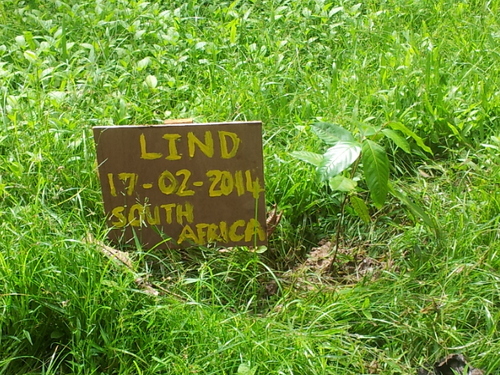
Bilit Adventure Lodge also offered us a chance to plant a tree in their property (at MYR 10) to help replenish the loss of vegetation that is caused each year from flooding.  We proudly contributed a small little tree somewhere next to Cabin number 3 and hope to return one day to see if it survives long enough to do its part for the Kinabatangan jungle.

Plant a tree
Travelinds planted a tree in the rainforest.

Read more about the tour package here.