
One of our favourite pastimes – and one of the things we miss the most about South Africa – is game viewing. Not in a zoo, of course, but in a reserve. The natural habitat of the animals is somewhere you are not guaranteed to see anything at all; but it’s all about the search! Nothing compares with driving around all day scanning the bushveld, trees, slopes and ravines for animals and then catching a glimpse of the flicking white tail-end of a leopard, or the majestic mane of a ferocious (or lazy) male lion in the shade of a bush. Reversing away from an approaching elephant or speeding to get away from a protective rhino mother is all the adrenaline you need!
So, this week was spent basking in God’s awesome creation at iMfolozi-Hluhluwe Game Reserve. What a fantastic place to see interesting, dangerous, funny, wild, crazy, big, tiny, rare and fascinating African wildlife in their natural habitat. Four hours from home, this game reserve is a perfect getaway for long weekends.
We stayed at Nselweni Bush Camp which is down the road from Mpila, where we were supposed to be staying. Thanks to a misunderstanding and a booking problem, the management kindly allowed us to move over to Nselweni – a beautiful bush camp right on the bend of the river. We woke up with the birds and fell asleep with the night sounds of lions, frogs, hyenas and cicadas. It was perfect for a romantic getaway in a private “half tent/half cabin”that looks on to the bush. Conveniently, it was at a central iMfolozi location, about 20 minutes to Mpila.
Nselweni has fully equipped units with a braai place (that’s barbecue for non-Saffers), a gas oven, a fridge, kitchen utensils, an outside table and a semi-covered verandah. The shower window can open right up and the bathroom and bedroom both look out into the bush. We enjoyed the nyala that graze outside your hut during the day and its a colorful bird paradise.
We stayed here three nights in Unit 2 & 3 – both are lovely, private and quiet, especially Unit 2. Units 4 & 5 have half views of the river but only the Conference Centre deck gives a panoramic view of the river; and this is open to anyone who wants to use it. We saw buffalo, kingfishers, crocodile, trumpeter hornbills, impala, vultures and many others right from the deck.
At any wildlife reserve, you need to respect nature and remember that wild animals don’t follow the rules or take heed of the ‘boundaries’ us humans expect. Watch out for the opportunistic hyenas at night who steal meat right off the braai or pinch anything left out on your verandah while you sleep. It’s best to take a torch and maybe a stick if you’re walking around the camp at night.
Our highlight sightings were a pack of wild dog, lion, puffback, bathing yellow-billed kite, a huge elephant breeding herd with little babies, so many white rhino and a metre-long vine snake on the road.
On the last night, we treated ourselves to a night game drive (which leaves from Mpila camp) and we were so impressed with Bheki, our guide, who found us lion (up close and roaring), genet, chameleon, vine snake, crocodile, buffalo, rhino, nightjar, bushbuck.
Thanks to Ezemvelo KZN wildlife, it was a wonderful stay. They are doing a great job protecting Kwa-Zulu Natal’s wildlife, especially the precious rhinos! We never did see that elusive Black Rhino on this trip, but the Whites were magnificent.
South East Asia has given us so many fantastic experiences and an abundance of special memories that we will always cherish. The travelling is not always easy, but it is always worth it; especially when the rewards are life-changing realisations about the world in which we live. Here are our first 10 tips for travelling in South East Asia (Part One):
Well, where to begin? Ho Chi Minh City… this would be a good title of a film that involved elements of slapstick comedy, knee-buckling romance, perpetual hardcore action, subtle and not-so-subtle pornography, plenty of drama and some pointed horror too. All this after only spending two days in this bustling city, previously known as Saigon!
First impressions aside, Ho Chi Minh City has the face of a true Asian metropolitan city, with all the trimmings and a handful of other aspects specific to the Vietnamese culture. There are skyscrapers, traffic jams, thousands of bars, hotels, massage parlours, educational institutions and restaurants, imposing conglomerates and international franchises; and an excited buzz that seems to blend in to part of the background. There are also motorbikes and scooters (apparently referred to as ‘Hondas’) on every highway, road, alleyway and sidewalk.
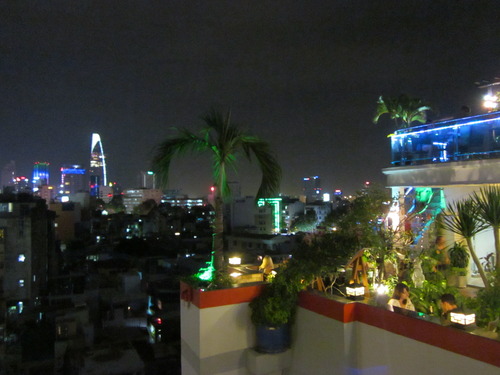
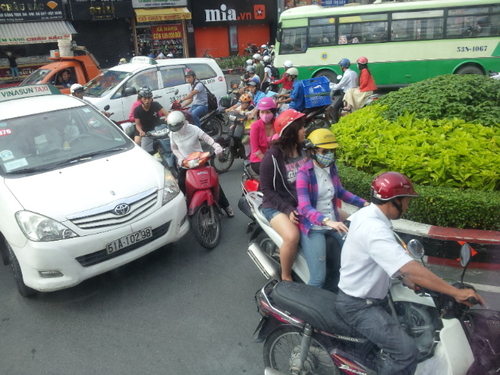 We stayed in the Pham Ngu Lao area (which is where most tourists end up staying and where there is an abundance of hotels, restaurants, bars and entertainment). It’s about 40-60 minutes from the airport, traffic-dependent. Our accommodation at Ngoc Linh Hotel was comfortable and clean, we ate at Mon Hue restaurant (wow, great Central Vietnamese cuisine!), watched some rugby at The Spotted Cow (a little pricey, but great Australian-style menu), explored the market, had a wonderful dinner with a view at Duc Vuong Hotel roof-top restaurant and enjoyed a lovely massage around the corner from our hotel at Mi Mi Massage (cucumber masks and quiet privacy!). We also enjoyed a rather scrumptious brunch at Bookworm’s Coffee, just around the corner from our hotel.
Our group split up on the last day and some explored the city on foot while the rest took a day tour to the Mekong Delta. In the end, both groups insisted that their days were better.
I almost don’t feel qualified enough to write more about the city because what can two days really tell you about any place? You will have to go and experience this city for yourself.
#Namventure – 11 friends go to Vietnam for the journey of a lifetime. Watch this video that Seb made of our travels through Vietnam – from north to south we visited Hanoi, Sa Pa, Halong Bay, Hue, Hoi An and Ho Chi Minh City.
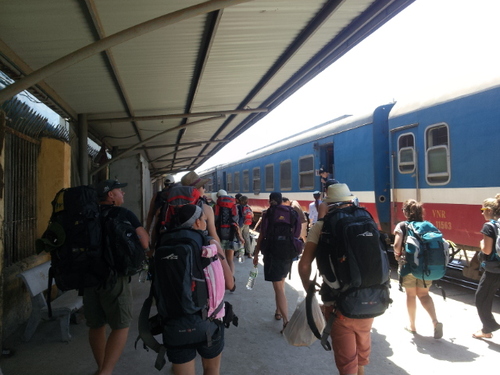
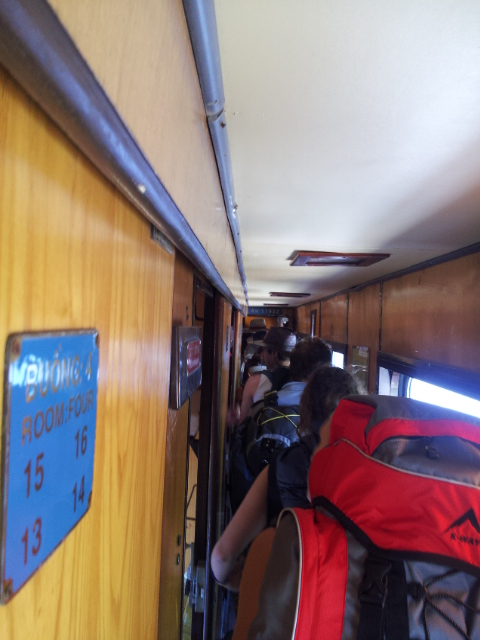 Like the curious travellers we are, Travelinds had read all about the train travel in Vietnam and figured this would be a great way to see the country.
Vietnam is connected by train from Hanoi to Ho Chi Minh city and the total trip between these two big cities spans about 36 hours. There are different types of trains, cabin classes and also differing prices, depending on how you buy tickets.
Our original plan was to do the backpacking thing and hop on-hop off whenever we wanted to stop (which sounded easy enough in theory, but in reality was quite time consuming and, due to the language barrier (and “tourist” tickets vs. “local” tickets), required slightly more advanced planning than just pitching up at the train station in time to catch a train).
We also didn’t have an ‘open’ ticket as we’d envisioned, but had to buy tickets for each specific trip (Hanoi to Hue, etc.).
The idea was to spend as many nights on the train as possible, to save time and money on hotels and not miss out on whole travel days (especially since trips were between eight and sixteen hours).

There seems to be a lot of mixed information about the trains and purchasing tickets and we didn’t have enough time to figure it all out.
We had tried to read up a lot about it before we arrived, but each trip turned out slightly differently from the last and we still don’t actually know if half the stuff we read was true or relevant!
Train travel through Vietnam was an amazing experience, so much fun and definitely worth the extra effort and hours.
Prices for train travel were reasonable, it was comfortable, we felt safe even in the soft seats section and we didn’t get ripped off by any sneaky con men along the way.
I would definitely do this all again!
Only having a short visit to Ho Chi Minh at the end of our trip, we chose to do a full day tour to the Mekong Delta (My Tho to Ben Tre) on our last day in Vietnam. The tour bus was scheduled to pick us up around 8am and we were back at our hotel in Pham Ngu by 5.30pm. The tour company turned out to be TNK travel, the company we had seen advertised a lot, but we didn’t know this until we got on the bus as we had booked through our hotel. It was a good surprise though.
The day consisted of lots of bus travel and boat rides, as you would expect visiting the complex system of rivers and tributaries in the Mekong Delta. The guide, Yen, regaled us with tales of world-renowned rice production, Vietnamese culture, life on the rivers and general facts about Vietnam and its history. He was quite a character and enjoyed some witty banter with the mostly young, backpacking-type crowd on the tour bus, us included (about 25 people in all).

The itinerary for the day consisted of:

All in all, not a bad day (especially for only about R 100.00 / $ 10.00).
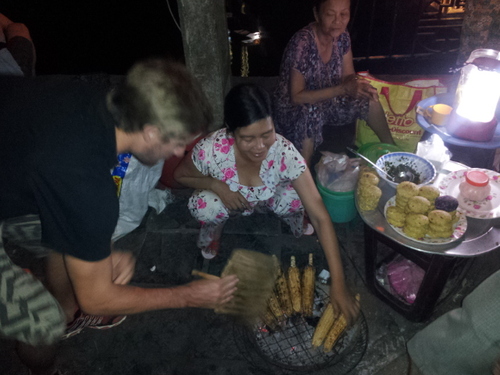
The highlight for me was certainly the coconut candy stop – watching how the workers cook, mould, cut and package the toffee was the most interesting process. Unfortunately, I don’t have a picture of the product because, despite purchasing six packages, most did not even make it back home (too delicious!). It is a soft toffee, wrapped in edible rice paper before being put in a wrapper; with slightly different flavours available like coffee, chocolate, pandan and peanut. Vietnamese Food really is delicious.
 The whole appeal of Vietnam lies not only in the sandy beaches or the vibrant culture, but also in the delicious and varied cuisine.
When I hear ‘Vietnamese food’ I immediately think of beef noodle soup (Pho Bo), spicy sauce and fresh vegetables wrapped in rice paper. This is not far off the mark, but this is only the beginning of the Vietnamese food experience in what can be an invigorating journey of tingling tastes and wonderful aromas.
Fresh and minty, spicy and sour, sweet and tender; the food scene in Vietnam has an abundance of dishes on offer. There are also vastly different menus in North, Central and South of Vietnam; where cultural differences influence both the methods of cooking and the combination of ingredients.
These three sections make for a wide selection and in the bigger cities like Hanoi, one can find restaurants that also offer a combination of Northern, Central and Southern dishes; or a fusion of these tastes.
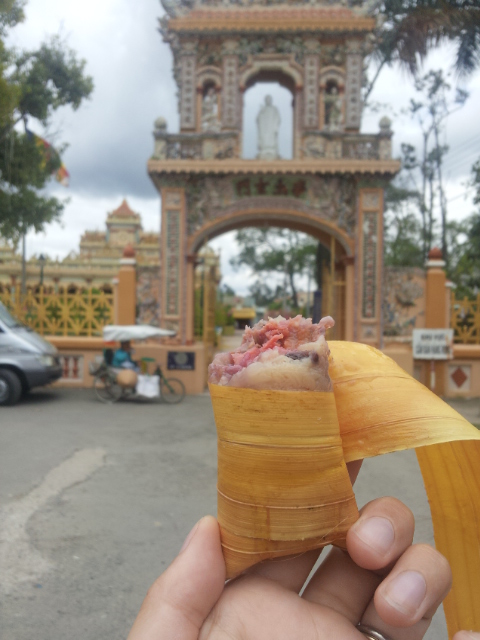 Vietnam is also infamous for its dishes bordering on weird and disgusting (to the unaccustomed palette only, of course) like Balut (19-21day old whole birds still in eggs, including quails), all kinds of animal blood, entire pigs (including ALL parts), snake-scorpion rice wine, dog and snake.
But there is so much choice on offer that you can easily avoid these strange things if it sounds less than appealing.
As you travel through the countryside, whether in the northern mountains or the lush Mekong Delta, the rice paddies are the main agricultural crop on show. It is to be expected then, that rice is featured in every meal and every special occasion from peasants to kings; be it one of the seven rice varieties, rice powder, rice flour, rice noodles, rice wraps, rice candy, rice juice, rice wine, rice porridge or rice cakes.
 According to Wikipedia and VietnamFood.Org, the following food facts are true of Vietnam:
 While on our day tour to the Mekong Delta, we were privileged to watch the preparation, cooking and wrapping of special coconut candy (like soft toffees wrapped in rice paper), which was specific to that region in Ben Tre. It was made very much like fudge (or toffee) by first grinding the coconut (flesh and outer coating) to a fine powder, then boiling the mixture of malt, sugar and coconut powder in a large skillet over the fire.
Once it cools, it is moulded into long strips and cut into uniform blocks. The workers then wrap each block in rice paper and then cover it with the paper wrapper. The coconut candy came in five different flavours; original, coffee, chocolate, peanut and pandan (pandan was my favourite one!).
Well, Vietnam offers such an adventure for the taste buds that its difficult to imagine there could possibly be any more. It gets better, however, because the beer is cheap, widely available and it isn’t half bad either. Our favourite beers for the trip were Lao Cai (from the northern province of Lao Cai, where Sapa is located), Tiger and Viet (from Hoi An). At an average of only 10,000 VND a bottle (about R5.00 or $0.50) it’s that much easier to make it part of your meal.


Hoi An, what a gem!
Travelinds had heard the hype around how ‘wonderful’, ‘amazing’ and ‘beautiful’ Hoi An was, but it was only when we actually arrived here to experience it for ourselves that we believed any of it! It really is a place that finds its way into your heart and no doubt, the memory bank of best holidays ever.
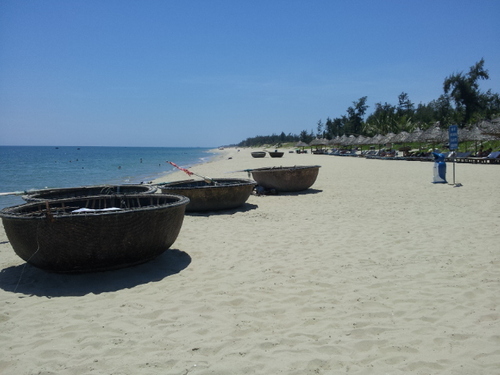
Hoi An was our last stop before Ho Chi Minh City, after two weeks travelling down from northern Vietnam. The week here consisted of delicious food, cheap beer, fantastic shopping, tailor-made clothes, exploring the area on scooters, riding bicycles through the rice paddies, rejuvenating down time and plenty of fun at the beach and in the pool at Sunshine Hotel.
For a change, we were travelling in a group of 11 friends (not just the two of us anymore) and this served to double the fun (and, of course, the stress at times). All of our group thoroughly enjoyed their stay in Hoi An and each said it was the experience of a lifetime!

Places to check out: Sunshine Hotel, TinTin Restaurant, Cua Dai Beach, An Bang Beach, Morning Glory,
TIP: We were told that the tailors tend to line the suits with paper (to save on material etc.) and this later crinkles and ruins the suit. Be aware of this practice and ask the tailor for guarantees, quality and honesty – you still have to place a lot of trust in them though and unless you’re a professional, you may not be able to tell whether these dishonest practices have been used or not.

We had taken the train from Hanoi to Hue and then decided on taking a day tour (16-seater van) from Hue to Hoi An, via Lang Co beach, Hai Van Pass and the Marble Mountain in Danang. There are also 4-5 hour busses (about $5) from Hue to Hoi An. At some point, we were considering doing it on motorbikes (with luggage delivered for us to the hotel in Hoi An), but we chickened out as we didn’t know the way, didn’t speak the language and it was hot (and sometimes raining). Later though, part of our group took the bikes up Hai Van pass from Hoi An (a sunrise ride and they were back at the hotel for a 9am breakfast).
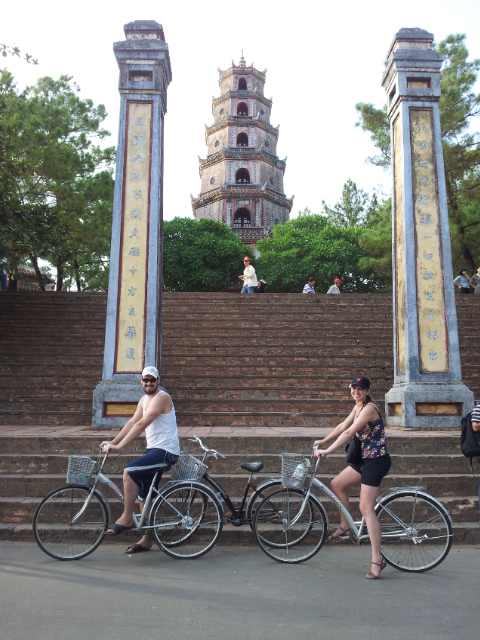
In Hoi An, and Hue, we cycled around on creaky old bicycles (with no helmets) and blended in to the hustle bustle of the traffic without any problems. In Hoi An we also hired scooters to get around, although the Old Town and market were only about 15 minutes cycle from the hotel. There was also a free shuttle to and from the hotel at certain times of the day (except on Sundays).

Hue, the epicenter of ancient Vietnam and previous capital city. Home to the Imperial Fortress, Royal residences, pagodas, tombs, the Perfume River and so much history of war and destruction.
Unfortunately we didn’t have enough time to go and see the ‘garden houses’ and I’m sure this would have been a great place to see Hue’s historical beauty preserved by patriotic, caring citizens.
Hue was definitely one of the most interesting places that we visited in Vietnam. The local cuisine is truly unique and delicious too; I would definitely consider the food as one of the main attractions in this city!
Hue was well worth a trip, especially if you like historical and cultural aspects of travelling.
It is small enough to cycle around (we hired bicycles from our hotel for $2 per day) and there are so many little places to explore, including some local entrepreneurs at street stalls, quaint shops and interesting restaurants.
We stayed at The Canary Hotel ($18, big clean rooms, air-con, nice view higher up, lovely breakfast on the 7th floor overlooking the city).
The staff were really helpful here with planning activities and the rest of our trip to Hoi An.
There is a bus that comes right past the Canary hotel for $5 pp to take you to Hoi An (we made a day trip out of it rather for $12 pp and went on a private van through Lang Co, Hai Van pass, Marble Mountain Danang, to Hoi An).

TIP #1: Ask your hotel about the night market (between the bridges) as this was a highlight for us (it was a Friday night, local market not aimed at tourists, great buys and interesting things to see and do).
TIP #2: The traffic is still a little crazy in parts but you get in to the swing of things and people seemed generally patient with tourists on bicycles and motorbikes. The Thien Mu Pagoda was 3 km out along the Perfume River road and it turned out to be an awesome cycle from the Imperial City to the Pagoda and back to our hotel (about 10 kilometers total). Plus, Hue is relatively flat so cycling on creaking bicycles without gears is not too difficult.
TIP #3: When we visited the Imperial Fortress, we didn’t realise that we couldn’t cycle around inside the paid area (about 105,000 VND per person to enter the purple “forbidden” city), so be prepared for a lot of walking, in the hot sun! Take water, sunscreen and comfortable walking shoes here to make the most of the experience. The Purple city ticket also provides access to the museum just around the corner from the exit. There are places to park your bicycles close by, which the hotel can indicate on the map (only a small fee for a whole day’s parking).
Check out more information on Vietnamese Food, Vietnamese Trains and Hoi An.
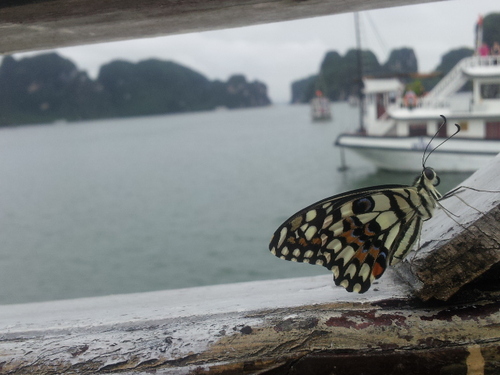
Cruising around Halong Bay has been a long time dream, especially since it features on the list of UNESCO Natural World Heritage sites (as well as a good couple of enormous billboards around Vietnam, claiming it to be in the new top 7 natural wonders of the world).
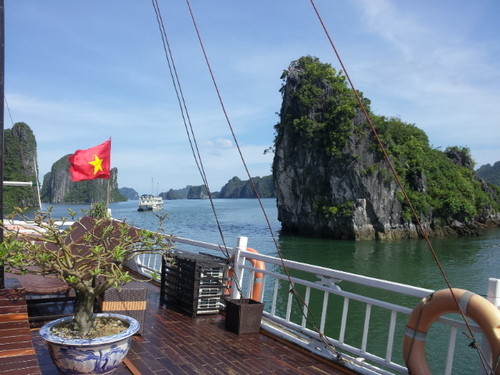
The 1,600+ islands and islets (or ‘around 2,000’ as our guide continually emphasised) makes for an idyllic paradise of smooth green water pierced by the white, orange and black patterns of thousands of limestone cliffs. Dark green vegetation covers the rocky outcrops that, on a sunny day, seem to reach up to the blue sky to touch its wispy white clouds. The overcast days are sombre but beautiful, as the clouds cover the sun to bring out the emerald shimmer in the bay and occasional rain bursts provide welcome respite from the tropical heat.

The tour took us to only a small part of Halong Bay, but it was truly spectacular. The black and white patterned faces of the limestone cliffs look down on the junk boats that meander through the islets, like guardians of some long lost world. Lying on sun loungers and looking out at the bay was a favourite afternoon pastime, as well as a good excuse for a pre-dinner nap after busy days of fun activities and interesting sight-seeing.
The list of favourite memories from this trip includes:

We booked a tour through our hotel in Hanoi (after speaking to a couple more agents just to be sure) and happily ended up on a private cruise (there were 11 friends in our group) with ‘Elizabeth Cruises’, on one of the smaller junks ‘Hai Au’, with a guide named Tony Nguyen. There were 7 rooms on the junk, all with en suite bathrooms. We stayed 3 days, 2 nights (both nights on the boat) and were more than satisfied with our tour itinerary.
It cost us around $190 and included aircon rooms (evenings only), three meals a day, tour guide, kayaks, entrance to Surprising cave and the Pearl Farm, warm (‘hot’) showers, sundeck with sun loungers and the return van transfer (16-seater, aircon) between Hanoi and Halong Bay.
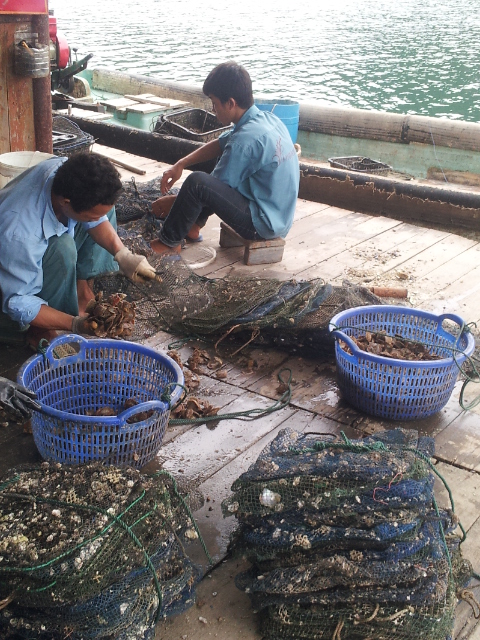
One more thing to mention was the Halong Bay Pearl Farm. It was so interesting seeing the different kinds of oysters used to create a plethora of pearls in all colours and sizes. There were oysters hanging from strings in the water and the assistants showed us how they ‘implant’ the mother-of-pearl grain in to the oysters to start the process. There were pearls that took between 1 and 8 years to fully mature and when you realise the monetary worth of the end product, it was easy to see how much care needs to be taken at getting this process right. The price of the highest valued pearl for sale at this farm hurt my eyes (brain?); it may as well have been worth a million rand.
Talking to a couple of people along the way, we discovered that it is possible to go to Halong Bay on your own if you have a motorbike (and nerves of steel!) or even by catching a van or bus to Hai Phong. From there you can take a ferry across to Cat Ba island (there are resorts and a beautiful beach on the one side of the island). Or you can hire a boat to take you around the bay. We were warned that if we attempted this, however, there are real dangers of encountering illegal boat operators, scams and other less than savoury experiences. We wouldn’t have had enough time to attempt this trip on our own, but it would be an adventure well off the beaten tourist track though!