Tag Archives: SouthKorea

Gongju Teacher’s Outing

5 October 2013

Gongju PersimmonToday we went on a teacher’s outing to Gongju, with some of the Asan Board of Education public school teachers.  It really was an interesting look into some of the ‘rural’ traditions and the cultural legacy that still lives on in South Korea.

Hunting for Chestnuts

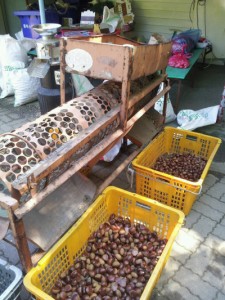
The first task was a thorough chestnut collection, which was actually a lot more fun than it sounded on the itinerary.  Chestnuts (밤 ‘bahm’) are traditionally eaten roasted, or peeled and frozen to be eaten raw.
Gongju Roasted Chestnuts

We were shown how to break open the spiky pod and extract the shiny brown chestnuts with tongs.  Armed only with tongs and an orange net bag, we were led up the steep pathways and sides of hills to tackle the chestnut plantations.


Aside from minor injuries from chestnut pod spikes, the other exciting event of the morning was finding a small brown snake on the grassy bank (Google later revealed it was a ‘rat snake’ of some sort), which a brave Australian soul rescued from certain death, by flinging it as far into the bush as possible, away from the Korean tour guide.

We headed back with orange bags overflowing with chestnuts and enjoyed some roasted and frozen, raw chestnuts as a reward for our efforts.

Traditional Korean lunch

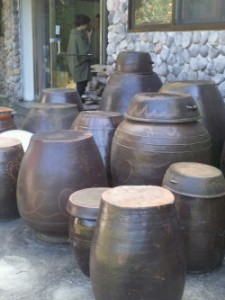
We then headed down the road to a traditional folk museum, restaurant and chestnut dyeing complex.  It has been run by the same family for the last 200 years, who still live, farm and dye with chestnuts (no pun intended), in the same farming area in Gongju.


Treated to a traditional Korean lunch, we experienced lotus steamed rice (covered in lotus leaf, with
Gongju Folk Museum
Gongju Folk Museum

herbs), an array of unique Banchan (side dishes) special to the Gongju region, makgeolli (rice wine) and mushroom water (like ice tea, but made from mushroom juices); all this served in the traditional low Korean tables, sitting on flat cushions on the wooden floor, with legs folded under us.

Since the restaurant and surrounds were all things chestnut, chestnuts appeared as an ingredient in the vast majority of the dishes served. Even the servers clothes and restaurant furnishings were dyed with chestnuts.

Traditional Folk Art Museum

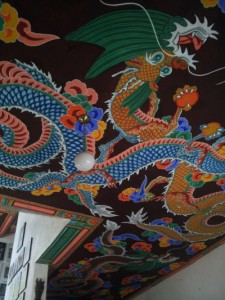
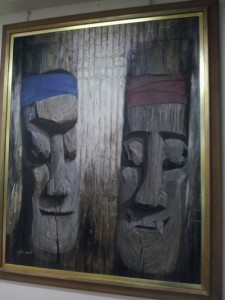
The ‘chestnut’ family has also collected artifacts from the neighbouring farmers over many years, as well as the collection of dramatic art pieces used by the current owner’s father, who was a well-loved traditional Korean puppeteer in his spare time.  It includes farm implements, cultural pieces, masks, paintings, shamanistic symbolism, farm life cooking tools and many other interesting things to see and experience.
Gongju Museum
Gongju Museum

My highlight was seeing an actual South Korean funeral carrier, a colourfully decorated box that traditionally holds the coffin and is carried to the burial mound by about 12 men.  These days, it is rare to see one in use as, our host joked that, Koreans are now taller than in the past and so don’t fit in the carrier very well. The carrier at the museum was retired only a couple of years ago.

The next week at school, I was surprised and very privileged to see one of these coffin carriers actually in use, as a funeral procession passed the school and headed down the road; singing, clapping and mourning the loss of a 75-year old lady that had lived in this community.

Chestnut Dye

The last activity of the day was a handkerchief dyeing lesson.  We were shown the crushed chestnut husks that are used to make the dye and different ways to tie-dye our handkerchiefs.  We dipped it in the hot dye (hands and arms covered in rubber gloves) and took turns to “massage” the dye into the handkerchiefs in the pot.  Then out into the cold solution that sets the colour. This process was repeated two or three times; ending with a cold water rinse and then handkerchiefs were hung out dry.Gongju Museum
Mine was sadly unremarkable, as it was lost in the dye pot for a while and lost all its strings, but a few of the other teachers managed to produce some seriously impressive dye patterns.

Take a trip

If you are headed to Gongju, you can find more information about the museum and the area at this link.  It’s a great day trip for those interested in learning a little more about traditional Korean life.

Finally! Korean Driver’s Licence acquired.

30 September 2013

After 18 months of procrastination, I finally put in the (small amount of) effort and voila! One times Korean driver’s licence valid for 10 years, placed in my hands by lunch time.  For all South Africans living in Korea who, like me, need a little bit of motivation to brave the Korean administrative processes alone, here’s how as of September 2013:

1. Documents to prepare:

  • 3 x passport photos (colour)
  • 1 x verification/certified letter for driver’s licence
  • Original Passport
  • Original Alien Registration Card
  • Original South African licence
  • 12,000KRW (eye test and licence fee)

2. Embassy visit:

  • The South African embassy is in Yongsan, Seoul; and in ten minutes, assisted me with a certified copy of my South African Driver’s licence, officially stamped and signed.
  • Also, the fully bilingual receptionist was extremely helpful in directing me to helplines and advising bus routes.

3. Seoul Global Center

  • This is a fantastic center for foreign visitors in general. I received professional service from everyone; including the helpline, staff and administrative assistants.
  • It’s very easy to find, on Line 1 (blue) in front of the Jonggak subway station, Exit 6.  If you’re taking a taxi, ask for “Jonggak yok” and look for Exit 6 as a reference point.  Go up to the 5th floor to the licence desk (first desk on the right).
  • Present documents, original licence and photos; sign forms and then proceed to the eye test via the subway. (The assistant gives you detailed directions, with a map).
  • Return with completed eye test (5,000KRW) and surrender South African licence.  Pay 6,000KRW and receive Korean licence.
  • NOTE: I was concerned that my address was not in Seoul or Gyeonggi-do, but this was not an issue.

Tips:

  • Try and reach the Seoul Global Center early because lunch is from 11.30a.m. to 13.00pm.  Having arrived in Seoul by 9.30am, I was lucky enough to visit the embassy, take a taxi to the center, fill out all the paperwork, take subway (2 stops) to and from eye test clinic and make it back by 11.27am to be issued my Korean licence.  Working it!
  • Passport photos can be taken at any photography studio. It cost me 7,000KRW for 4 and because I took my own photo on my USB, they gave me a discount.
  • If you are lucky enough to have someone who can help you out (e.g. your director, a trustworthy friend etc), the embassy also provides service to a proxy in possession of your licence, passport, ARC and a signed letter of permission from you to collect the copy on your behalf. You do have to visit the Seoul Global Center in person, however, to take the eye test.
  • I briskly walked (about 20 minutes) from Oksu station (orange line 3) to the South African embassy.  Be warned, the (1.5km) walk consists of steep wooden steps up to the very top of the hill and then downhill Dokseodang-ro to the embassy.  Great exercise but, do factor in the time and effort, or take a taxi.
  • NOTE: If you are not a South African Citizen, I advise phoning the Seoul Global Center for information to check details.  South Africans do not have to take any written test, but this may be different for other nationalities. 

Good to know:

  • You have up to 3 years to reclaim your South African licence from the Global Center before it is destroyed. You need your airticket, Korean licence and ARC.
  • The eye test clinic is about 200m from the Jongno5 subway exit 1. It’s a tiny door that leads up to the 2nd floor so keep your eyes open.  Be prepared for little to no English levels here.

Good luck! It’s well worth a day trip for out-of-towners!

www.crossed-flag-pins.com

===================================================

Location and contact details:

South African Embassy

  • Mon to Thurs, 8:00 to 16:45; Fri, 8:00 to 15:30; (Lunch: 12:45 ~ 13:30).
  • 104 Dokseodang-ro (Hannam-dong), Yongsan-gu, Seoul 140-884
  • http://www.southafrica-embassy.or.kr/eng/embassy/contact.php
  • Nearest subway stations are Oksu (Line 3 orange) and Hannam (Jungang Line).  It is about a 20 min walk (or 5 min taxi) from Hangangjin Station (Line 6 brown).

Seoul Global Center

  • 5th Floor of Seoul Global Center Building (“Driver’s licence” desk), Jong-ro 38-gil, Jongno-gu, Seoul (it’s directly outside Exit 6 of Jonggak (Line 1), just walk straight about 100m and you’ll see the logo and “Seoul Global Centre”)
  • http://english.seoul.go.kr/lh/support/scof1.php
  • For information call: +82-2-2075-4130~1 (Seoul Global Center 5th floor) or 1330 (Korea’s tourist information call center) or 1588-5644 (BBB Korea)

Caribbean Bay

25 September 2013

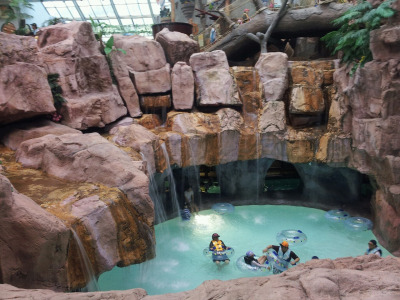
On Saturday we decided to head to Caribbean Bay, the waterpark side of the Everland resort we visited in July.  It was the Chuseok weekend and we expected it to be very busy, however, we were pleasantly surprised to find that we did not have to queue for hours or fight our way too much through crowds during the day.  It wasn’t busy by Korean standards anyway.

There are 5 sections of the park but 3 of the sections (with the big rides) are only open for one month of the year (in July, for the summer holidays).  The other two sections were less exciting but nevertheless, a lot of fun.  We were able to have a fun-filled day at a discounted rate, thanks to the Chuseok discount for foreigners that happened to coincide with our trip.

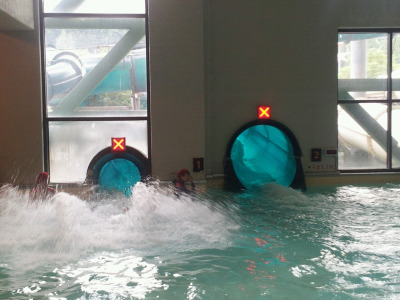
When we arrived, we went on the indoor tube and body slides with almost nobody waiting in the queues.  Later in the day, this section had filled up so much that we had to wait up to 45 minutes to take a ride!

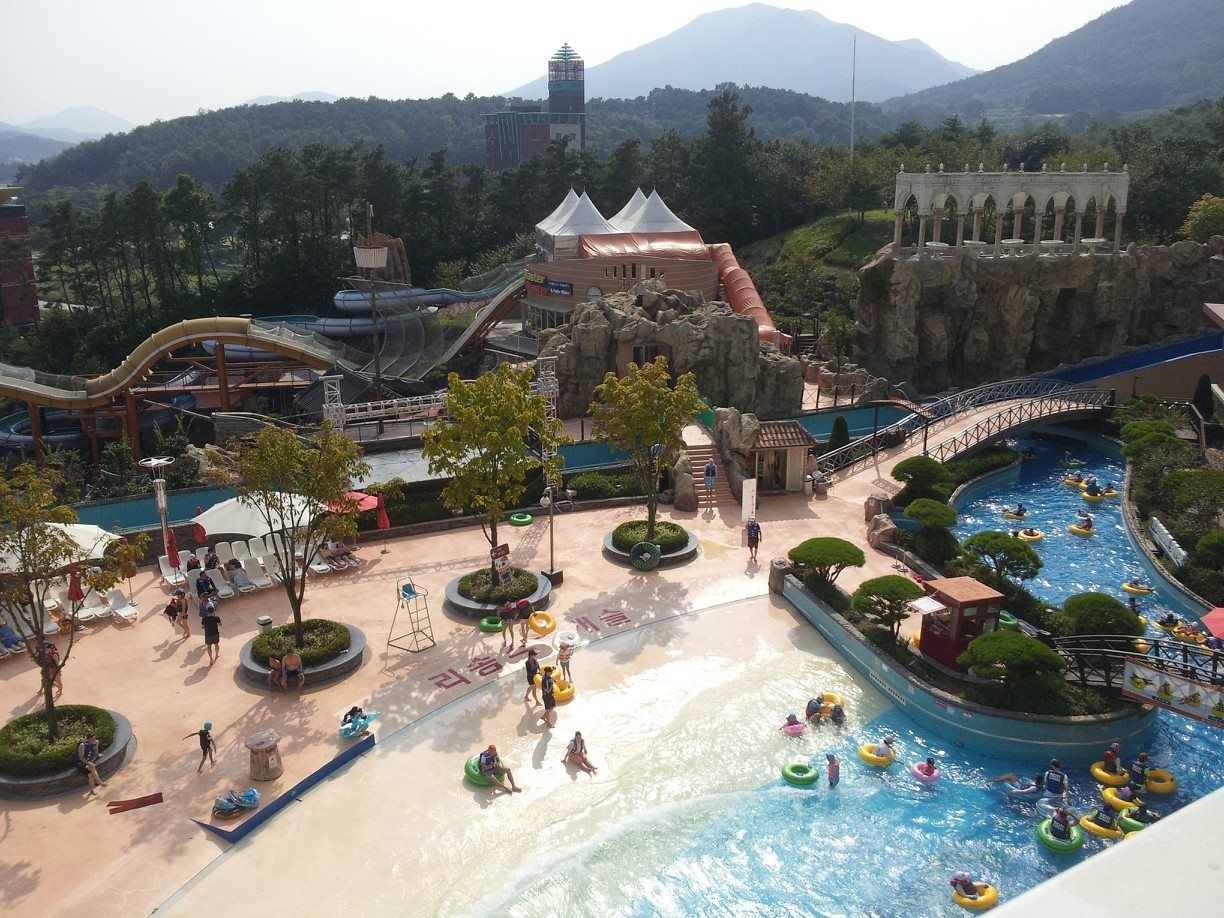
The riverway (a lazy river where we you jump on a tube and float around the course) was really good.  Apparently, it’s the longest lazy river in the world.  We spent a lot of our day lazing on the long riverway and again and marvelling at how the Koreans stuck in their “ppali ppali” (hurry hurry) mentality, who would rather run and push their tubes, and anyone else in their way, to get around the course faster.  It’s called a “lazy” river for a reason people!

The riverway connects to most attractions in the park.  It’s great to jump on a tube (or run pushing your tube if you wish), ride for a little way and then jump off again at the next place.  You can go to almost every ride this way without walking anywhere.  Always a bonus.

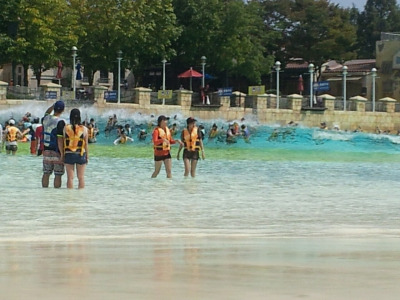
The other attractions open were the wave pool, the bade pool and the rest and relaxation area with a few jacuzzis and hot pools.  The Miracle spa is another stop along the riverway and consists of three jacuzzis and a foot spa.  The foot spa was great.  Fill it up with hot water from the tap, soak for 10 minutes, pull the plug, fill up with cold water, soak and then repeat.  The contrasting temperatures help to promote blood flow and also, apparently, healthy organs.  It was very relaxing, even if not quite a miracle.

It was a great day enjoying the last of the summer sun!

If you have a chance, check out the Siam Cafe and Restaurant on your way home. It’s on the road towards the Maseong exit out of Everland, past the GS 25. They have great Thai food.

Caribbean Bay Indoor Pool
Caribbean Bay Wave Pool
Caribbean Bay slide
Caribbean Bay slide

Chuseok

25 September 2013

This year, Chuseok (추석) was celebrated on Thursday, 19 September 2013.  Chuseok is a public holiday for all South Koreans (and, thankfully, all English teachers, too).  It is celebrated on the 15th day of the 8th Lunar month. The widely-followed tradition is to go back to one’s hometown to spend time with family and to visit ancestral graves.  It is also referred to as “Korean thanksgiving” or “Autumn/Harvest Festival”.

Families come together to share some quality time, make traditional Korean food and honour the ancestors.  There are worship rituals, visits to the graves, weeding of the grave area and offerings of harvest to the ancestors.  Christians in South Korea, for the most part, still visit the graves and keep the area trimmed, but they do not worship the ancestors or engage in offering rituals.

The families eat traditional food and drink rice wine during this time.  The most famous traditional food is songpyeon (송편).  This is small rice cake with stuffing, which is steamed over pine needles (“song” 송 means pine).  The stuffing ranges from sesame seeds, black beans, mung (yellow sprout) beans, cinnamon, pine nuts, walnuts, chestnuts, jujubes (Chinese dates), and honey.  There are many folk tales around songpyeon and the significance revolves around the shape of the rice cake.  One old wives’ tale says that, for the women of the family, if they make a well-shaped rice cake then they will have a very beautiful daughter.

Since it is one of the two big holidays, the other being the Korean Lunar New Year, it is inevitable that travelling during this time is both busier and considerably more expensive.  Flights to Korea’s Jeju island and also out of the country, are sold out months in advance, at premium prices.  Roads are heavily congested and local resorts, pensions and inns are usually fully booked.

With the weather at this time of year being almost perfect, it’s no wonder that Chuseok is such a popular holiday.  “High sky”, only occasional rain, cooler but comfortable temperatures and beautiful landscapes transforming under autumn colours.  It’s perfect weather for hiking, camping, outdoor activity, picnics or spas.

Chuseok – Korean tradition at its best.

Resom Resort Spa Castle

24 September 2013

This Chuseok, we had an invitation to join some Korean friends at the Resom Resort Spa Castle in Deoksan.  We arrived on the first day of Chuseok and were surprised by the buzzing atmosphere of the resort as guests streamed in to enjoy the long weekend.

We stayed 2 nights in a small condominium.  Ironically, we slept in the Korean style room (Korean mattress on the floor) and the Koreans slept in the Western style room (with a double bed).  There are two beautiful parks on the grounds where you can picnic or walk.  There was also a buffet breakfast to enjoy and of course, the main attraction of the hotel, the spa.

Unaware of the facilities, we had assumed that going to a ‘spa’ meant that we would find a salon style spa with massage, facial therapy, mud baths, jacuzzis and skin treatments.  We could not have been more wrong! As it turns out, Korean ‘spas’ are actually more like waterparks!

At this one, there was an indoor public bath area (women and men seperate), an indoor pool area and an outdoor waterpark area with slides and pools.  You had to pay for a day pass to enter the ‘sauna’ (indoor public bath area) or, a full day pass for all the facilities.  It was also compulsory to hire life jackets if you wanted to use any of the slides (as most Koreans cannot swim) and you also had to wear a cap (swimming or baseball cap are both acceptable)!

Of course, we had to take advantage of staying at a waterpark and so we spent a full day enjoying all that it had to offer.

The indoor public bath area was like a normal jimjilbang (public bath house) that can be found anywhere in Korea.  It was however, a little fancier than the average jimjilbang found in the cities.  Women and men are completely seperated and there are towels and powder room amenities provided free of charge in this area.  Also, everybody is naked.  Completely naked, together, in full view of everyone else.  The towels are more like hand towels and barely cover one cheek let alone a body.  In this area there are saunas, pools of varying temperatures, showers, scrub rooms, hot rock decks and massage rooms.  The powder rooms have moisturisers, hair gel, hair dryers and other consumables, which can be used free of charge.  Secretly, I actually enjoy the jimjilbang, once I’ve forgotten about everyone staring (openly) at the foreigner who looks quite different from the skinny Koreans.

Once you leave the jimjilbang, you need to be fully clothed again to enter the indoor and outdoor swimming areas.  The indoor pools were a combination of jacuzzis, swimming pools, hot and cold paddle pools and also a huge “bade pool”.  The Bade pool is so relaxing!  You move around the pool at your leisure and visit different areas to enjoy different types of hydrotherapy.  For example, there were sections with a neck massage spray, foot spa bubbles, back and leg spray, jacuzzi style pool, individual bubble bays and even a “therapy walk way” for relaxing walking.  All inside one pool. Amazing!

The outside pool area included a torrent river (70cm deep, still required life jackets), tube rides, body slides, speed slide and also a few different pools and jacuzzis to relax.  There were attentive life guards at every station and they got very grumpy if you didn’t wear your life jacket, or a cap.  It seems that it’s ok for a lady to walk around naked in front of every lady in the jimjilbang but when she goes outside she must have clothes on over her swimming costume – t-shirt, shorts, pants suit, whatever.  And the men also have long t-shirts and big shorts on most of the time.  A few exceptions were jaw-dropping bikinis and banana hammocks but these were either fashionistas or tourists.

We had a superb time at this resort and a good few laughs at the strange differences from what we’re used to back home.  I hope to return here one day soon.

Travelinds visit Everland

07 July 2013

I won free tickets to Everland resort through Korea Tourism Organization on Twitter last week! Obviously, we used our first opportunity to take advantage of the free entry to this theme park about an hour south of Seoul.

We headed out on Saturday morning full of anticipation and unsure of what to expect. We got there before opening time, found out our tickets were “comprehensive” and so completely covered our entrance fees and all the facilities, rides and fun! Whoopee — a great start to the day!

Everland Isn’t Just a Theme Park With Great Rides

South Korea’s Everland turned out to be a huge resort of sorts, including an impressive theme park, plenty of entertainment, a zoo, global themed ‘villages’, sky rides, gardens and lots more to experience. It was a struggle to decide what to do so we tried to do everything! And just about succeeded.

Never Underestimate the Scope of Everland

Pro Tip: Wear comfortable shoes when you’re going to this massive entertainment location. Everything is a long walk away.

Our highlights at Everland were the rides, animals, sky lifts and candy floss. We also enjoyed the bird show and the African exhibit hall, even thought it had its own lonely meerkat.

The Living Residents Were Endearing

The zoo was impressive – Korea’s largest zoo – but being South African, our hearts are always happiest when animals are free. There’s something unbeatable about seeing a creature in its natural environment and being treated with the awe and respect that all wild creatures deserve!

That said, the monkey enclosures were interesting. My favorites to watch were the tiny marmosets. During the bird show we saw everything from a Golden Eagle to an owl and guinea fowls. The birds looked in great condition, which made the show seem more acceptable somehow.

The Rest of Everland Was Better

On the theme park side of things, we splashed through the flume ride, bumped each other’s Dodge ‘Ems, and spun around while swinging on the “Hurricane.” Then, we finally braved the HUGE wooden T-Express — a rollercoaster. It was H’s first time on one, and whew! It was a proud day for wimpy me!

Grateful for our free tickets, we made the most of the time at Everland. We arrived at opening time and left almost at closing time. Exhausted, we then realised that we’d likely need a couple more days to cover every inch of this “resort.” We definitely gave it our best effort, though.

The best of our Everland memories will always be the rides. There was also plenty of queues, constant walking to and from places, water spray fans to cool off and friendly Everland employees. The happy children everywhere also reminded us that there was loads of fun to be had in all directions here.

Thanks Korea Tourism Organization for the awesome day!

Picnic. Sunshine. Jellybellys. Love.

06 June 2013

A little afternoon picnic was on our minds as we headed out today, not too far down the road from our place.

What You’ll Find in Sapgyoho

Sapgyoho is referred to as a ‘beach resort.’ It’s more like a fishing village. There are quite a few fish restaurants, a ferry, some little curio shops, a mini funfair, a park to sit under trees and a wooden walkway. If you are feeling energetic, you can follow this path right across the seawall (a couple of kilometres long). You’ll do so with some bicycles, motorized wheelchairs and even a few walkers.

We didn’t do the sea wall on this particular day, but we ambled around and tried some street food. We also marvelled at the endless supply of live sea creatures in buckets and tanks. You might have to dodge some cut-throat business ladies trying to lure you into their restaurants for lunch, but otherwise, it’s a wonderfully relaxed atmosphere.

Just Have a Picnic and Look Out at the Sea

When we were tired of exploring the little village, we headed to the park. This area overlooks the bay and the seawall. There were quite a few families eating their picnic food, like gimbap (seaweed rice rolls). We settled down to our own picnic on the grass (on our genuine Korean silver picnic mat that looks like one of those shiny windscreen car shades).

It was nice to rest under some shady trees for a while and take in the scene. In fact, the most active thing we managed after that was a simple jellybelly tasting competition — guess the flavour! This is a surprisingly captivating (and delicious) game. It’s also a lot more difficult than it sounds with flavours like toasted marshmallow, crush pineapple and pina colada!

A great spot for future summer picnics to be sure!

Discovering Hagampo Paradise

June 2013

On 6 June 2013, South Korea celebrated Memorial Day. The celebration remembers all those who died in military service. To enjoy the break from school, as well as take advantage of the start to a beautiful summer, Travelinds headed to Hagampo beach in Taean-gun, Chungcheongnam-do.

A Beach Worth Seeing on the West Coast of South Korea

From our house, it is a drive of about 1 hour 30 minutes, and we we were not disappointed. This West coast beach is beautiful! When we arrived, the beach itself was almost deserted, despite it being a public holiday. It welcomed us with clean sand, blue water and an island to explore at low tide on the one side. On the other side, there were some rocks to clamber over. What a gem it is hidden in this Taean National Park site!

Hagampo

Finding a shady spot on the far side of the beach, we settled in for the day like good South Africans do.  Why not? There was perfect weather (about 26 degrees Celsius), a slight breeze to keep us cool, sunshine, peace and quiet and even a few South African snacks left to keep us fed (acquired on my recent trip back home!). All in all, it was an absolutely perfect beach day not too far from our tiny apartment!

Lunch Around the Corner from Hagampo Beach

After a nice, quiet time to relax on the beach, we needed to find some lunch at about 3pm. We ventured into the small village made up of mostly small restaurants, tiny shops, a camping area  and guesthouses (called pensions). Eventually, without really reading anything right because it’s all in Korean, we settled on some mool naeng myeon (물냉면). This is a summer-only noodle soup containing kimchi, radish and fresh veg — with big pieces of ice in the soup. So refreshing after a hot, sweaty beach day!

We even watched the day end with a beautiful sunset over Hagampo at 19.50pm. Then, we headed home.

Memory Maker on Hagampo Beach, Taean

We can’t leave it at that without mentioning the highlight of the day! On this particular trip, it was seeing a group of seals — yes, real and wild ones — swimming up and down in the bay! You read that right, living and sea-wild seals right there in the Yellow Sea of Korea.

We love animals of all kinds, so we went over to another family on the beach and asked them if they had seen the seals. We also wanted to check that we had the right name for them: mool-gae. Mool (물) means water and gae (게) means dog. The direct translation is “water dog,” which makes sense I guess.

The other family looked at us as if we were absolutely crazy. They said, “No! No animals. No animals. Barrier.” They had pointed to the “net barrier” that was about five metres off the shore. Is that supposed to be a shark net of sorts? We laughed heartily, and promptly drew their attention to the actual seals playing about 25 meters offshore.

It was great to see the amazement and disbelief on their faces. They slowly realised that these Westerners were not, in fact, crazy. They, too, really saw the seals swimming in the bay.  The lady looked so shocked and said, “My first time to see this! Thank you!”

Wow! Nature-loving South Africans educating Koreans about their local sea-life? It was a proud and happy moment.

Travelinds recommends visiting Hagampo for all who love the beach, nature, forest walks and camping. It’s a perfect spot, and there are quite a few other beaches along this same coastline. If you have a car and want to explore, the Taean coastline has over 30 beaches, including Mallipo beach, which is over 3km long. This one is still on our must-see list!

tumblr_mo2leySsnN1s64282o1_500

Travelinds’ Night in Seoul, South Korea

26 May 2013

Rushing to Seoul after a rugby tournament at the Osan US Airbase, we hoped to reach our destination on time. Umoja, the South African musical, was showing at Chungmu Art Hall in Jung-gu. It’s right in the centre of Seoul.

Seoul Expressway at Rush Hour

Having left a little later than planned, the 60km took more than two hours thanks to the heavily congested expressway (as usual). Still, we saw a few weird and wonderful sights along the way. One was a motorcycle with a dragon tail and merry-go-round horse head. The man riding it was selling rice cakes on the expressway to all the traffic jam victims.

We saw a Porsche or two, as well. Maybe it wouldn’t have helped to have a faster car than our hand-me-down.

Just in Time for the Musical and a Spot of Homesickness

Despite the traffic, we made it to the show with twenty minutes to spare. That meant a deodorant bath, a splash of lipstick and getting there just a few minutes before the curtains rose to find our seats.

It was worth it. That night, we really enjoyed the vibrant taste of our homeland, South Africa. With all that dancing, singing and relatable humorous moments from home, leaving with happy souls and exhausted bodies felt amazing.

Since we’d rushed in, there had been no time to eat or look for a place to sleep, so we made our way out into the big city that never seems to sleep. At 10.30pm, we managed to find a bed and some food. Thankfully, you never have to look very far for these things in Seoul.

Twinkling Lights and Belly-Filling Food Before a Good Night’s Sleep in Seoul

Plus Motel was the first one we happened upon, right next to Chungmu Art Hall. For a reasonable price and fairly clean room, why not!

We tend to pick ‘love’ motels as a last resort. It’s often the most reasonable option for a private room (for two). We try not to think about the ‘main idea’ behind these establishments that offer rooms by the hour.

Having secured a bed for the night, we ventured out into Jung-gu to feed the hungry tummies. Again, not far from our motel we found a handful of coffee shops, Korean restaurants, fast food joints and, happily, an open market.

It’s wonderful being able to amble through the market on the lookout for delicious things. We settled on some kimchi mandu (Korean dumplings with kimchi inside them), a salad roll, some bananas and a little snickers bar for pudding. We passed on the pig trotters, live octopus and unidentifiable marinated meat.

Another Successful Journey for the Travelinds in Seoul

Tired bodies were in bed by midnight, and a good nine hours later we emerged from our blue and red neon-lit room to find some brunch. Tom ‘n Toms is one of H’s favourites because it has a delicious cream cheese pretzel and coffee combo. We headed to find one in nearby Dongdaemun, a vast shopping district.

We are always amazed at the hustle and bustle of this famous fashion and fabric shopping paradise. We sat sipping coffee and watching Seoul tour busses bring in load after load of tourists to Dongdaemun. Vendors lay out their wares, shoppers filled their bags and emptied their wallets, all with six lanes of traffic whizzing by.

Seoul is truly fascinating sometimes!

Asan Pinnacle Land for Spring

6 May 2013

All of a sudden it was here — beautiful spring! The season crept up on us out of nowhere, with the white cherry blossoms of Asan heralding the bright occasion for a mere two weeks or so. Then, bursts of red, pink, orange, white, yellow, purple and green appeared everywhere. Breathtaking!

Korean Spring is truly a special (though short) season. It is amazing how life is breathed back into a dead and barren land after the dreary winters here.

With warmer weather and beauty popping up all around us, there’s a promise of brighter days. Travelinds headed to Asan Pinnacle Land for the day to appreciate all the colour.

tumblr_mmf20mcm5U1s64282o5_1280tumblr_mmf20mcm5U1s64282o6_400tumblr_mmibvjnKWV1s64282o1_540tumblr_mmf20mcm5U1s64282o1_1280Asan Pinnacle Land - tulipstumblr_mmf20mcm5U1s64282o7_1280

Travelinds: Spring hike at Amisan

15 April 2013

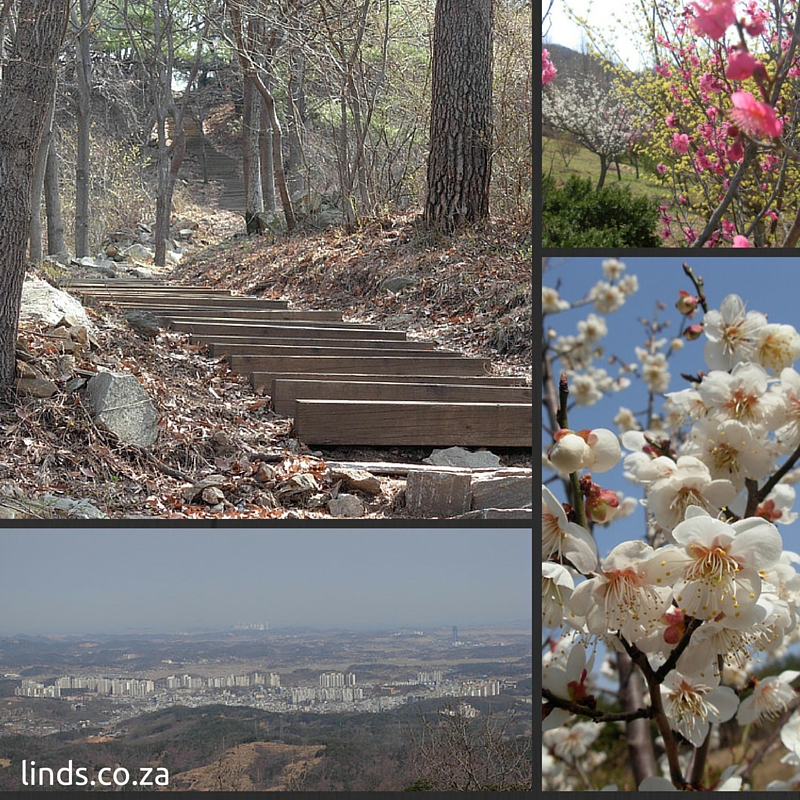
Travelinds took a short trip out to Amisan or Ami Mountain (아미산) on a crisp spring morning to see what all the fuss was about with the Dangjin locals. At 349m above sea level, it’s not exactly a long hike, but it’s steep and seems to have endless steps to the lookout point on top.

The national Korean pastime definitely seems to be hiking, in full name-branded gear of course. They head to the mountains in droves on weekends, in tour buses and hiking clubs, with serious hiking equipment, including hiking tracksuits, walking sticks, fancy hiking boots, head gear, iPods, sun protection, bandannas and day packs.

We felt a little conspicuous in our plain old pants, caps and tracksuit tops. Barely a three-kilometre walk, it wasn’t at all our typical hike in the vast South African Drakensberg mountains. But lovely, nonetheless.

Winding our way through the pine trees, admiring the emerging bird life and new buds, we had a wonderful morning connecting with nature and getting a little bit of exercise, too.  We’re hoping to return soon for another morning hike.

Travelinds: Amisan
Travelinds: Amisan