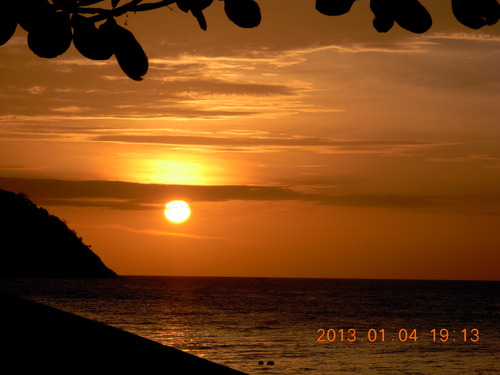
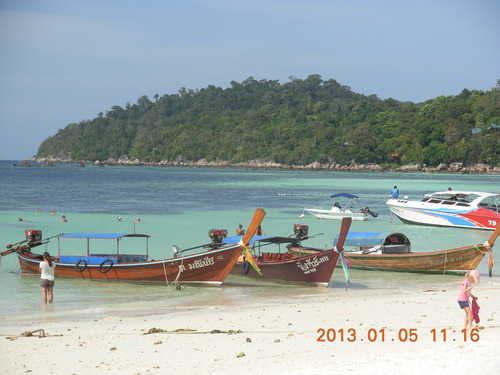
We had a short stopover in Phuket for only 2 nights. We chose to stay at Kata as this is known to be the quieter of the three main beach areas (Patong, Karon and Kata). The beach itself was so different to those in Phi Phi with big waves, slightly coarser sand and, believe it or not, more people. There were even ‘no swim’ zones due to rough currents.
We enjoyed a (windy) afternoon stroll on Kata beach and also a morning tanning session the next day. It was a slightly quieter vibe here and even though it was difficult to swim because of the very high Spring tide, we still enjoyed a few dips to cool off.
The excitement of the day was when R helped save a lady from the rip tide which had pulled her out to sea when her and her boyfriend were swimming in the ‘no swim’ zone. Even though she had passed out and collapsed from exhaustion by the time they got her on to the beach, she was fine and recovered with oxygen and lots of rest.
The wave house just next to the beach was very cool and reminded me very much of the Gateway wave house in Umhlanga, South Africa.
Kata had a huge selection of restaurants, hotels, shopping areas and travel agents. There is also a buzzing taxi industry taking tourists between Patong, Karon, Kata, Old Phuket town and the Phuket port and airport. Our taxi from Phuket port (from the Phi Phi ferry) took at least an hour to Kata which was not bad considering the heavy traffic.
The ClubMed Kata resort spans almost the full length of the beach front which means that anyone staying in a resort behind this has to go around in order to get to the beach on either end. We didn’t mind the walk though! So many interesting things to see in this little beach village.
We visited Karon beach for only one day as part of our two night stay in Phuket. The famous snake/dragon statue greeted us as we jumped out of the taxi and the long, sandy beach beckoned to us to come and enjoy this beautiful beach.
The long, sandy beach hid the number of visitors well as there was enough place for everyone to feel like they were actually alone on the beach. Most sources say that Karon is 4km long and it is also wide enough to give you a sandy or grassy spot to escape rising tides.
Our day was very relaxed, a little swimming, a little waboba for the boys, tanning, sleeping. We also were happy taking advantage of a vendor for a new bikini at only 150baht – WHAT A STEAL! She was part of the many who (conveniently) constantly walked up and down hoping for business for anything from eats to clothing to hammocks.
I hope to return someday to explore a bit more – I think a few early morning runs on Karon beach would be just the best way to start a day before exploring the rest of this lovely place.
We did a day trip from Aonang to the Phi Phi islands. A surprisingly short trip from Aonang on the speedboat, we were spoilt with great weather and beautiful scenery, as promised on the brochures.
The tour took us to all the major tourist spots around the Phi Phi islands and included lots of swimming, snorkelling and beach time as we’d hoped. Unfortunately and unavoidably we also had to contend with many tourists piled onto many boats and crowding the viewpoints. Expect this, in even greater numbers during the high season.
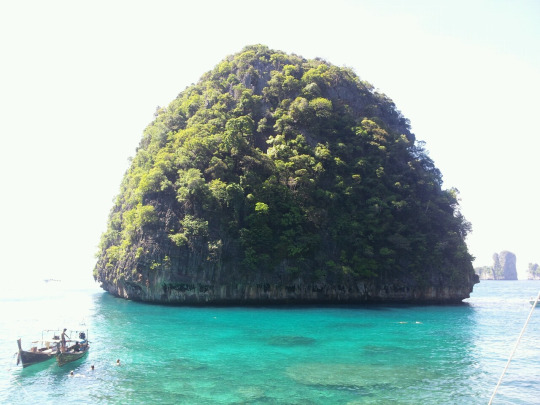
The spots where we explored were Maya bay (‘The Beach’ movie location), Pileh bay; Monkey beach and Viking cave on Phi Phi Leh; Tonsai beach on Phi Phi Don; 2 very nice snorkelling spots and the last stop at Bamboo Island before returning to Krabi. All locations provided many exquisite photo opportunities and a chance to take a dip to cool off.
The beautiful sunny day ended with a 30 minute thunderstorm that came out of nowhere, drenched everybody in the speedboat, caused an embarrassed passenger to be sick overboard and then, magically disappeared. The joys of travelling in the rainy season in Thailand. Definitely not enough to dampen our spirits after a fantastic day tour though.
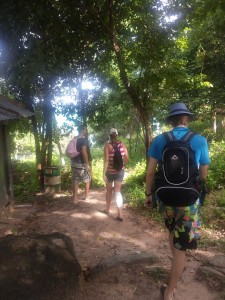
After reading Travelfish’s blog post called Koh Phi Phi Beach Getaways, we decided to try and find this “Secret Beach” while we were on Koh Phi Phi Don. It sounded simple enough to follow the instructions — walk here, turn there etc. However, in the end, we were glad to have taken along some lunch, water and gear on this “short hike.”
Coastline road after Sunflower Bar
Find Phi Phi’s Secret Beach
We began the journey by leaving from Phi Phi beach. This was from Loh Dalam Bay, the one on the opposite side to the main port of Tonsai Bay. We headed towards Sunflower Bar as directed.
The tide was at its highest, so there was not much beach visible at all in the direction we thought we were going in. The instructions said to walk past Sunflower Bar on the back road. So, we headed over the bridge and kept along the coastline road up quite a steep hill.
The instructions then said to find a small path beyond the thatch buildings, but this seemed somewhat impossible with all the new construction happening. Someone was building a whole new resort here. It’s understandable, as the traveller had written the blog two years before.
Navigating these buildings with care, we reached the top of the hill and found ourselves in the middle of a new resort. We had to turn around. It was only when we got about half way back down the hill that we found our route to the Secret Beach — maybe.
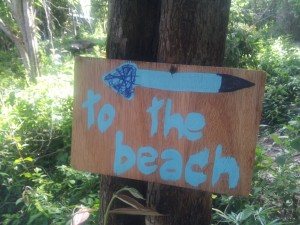
Secret Beach Hunt: Updated Instructions (and Some Tips)
As at August 2013, here’s how we got to Secret Beach on Phi Phi Don in Thailand:
Head up the steep hill after Sunflower Bar. Be sure to look for a left turn about midway up the hill. For us, this left turn was sign-posted by a small “Phi Phi Sea Sky” sign, nailed to a tree.
Head through a well-hidden pathway on the left. At the time, this path went between two building constructions towards the beach. Let it take you parallel to the beach.
Look for signs to Sunset Bay and Sunwaree Resort. Somewhere along this path to Secret Beach was where Travelfish mentioned that “a road appears out of nowhere.” It did,quite literally.
Note: We never did come across the 10 foot high rocky ridge that Travelfish mentioned. Maybe we missed something.
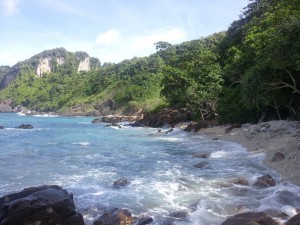
The rugged coastline at high tide.
Once you’ve located this path, keep to it. You’ll be walking alongside the ocean until you reach Sunset Resort. Here, we headed down towards the beach and turned right to keep going along the coastline.
At this point, we started walking on the rocks and sand. At low tide, it might have been possible to walk the whole way to Secret Beach over rocks. However, at high tide, we had to go back up onto another steep pathway into the grass.
Keep Going: Secret Beach in Sight
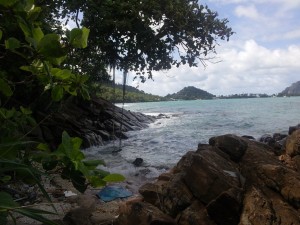
Up the hill, we passed a sign that said, “Tonsai bay 20 minutes Phi Phi Outrigger.” When we reached a small Thai shack at the top of the hill, there was a meditating monk. We tried not to disturb him and carried on down another small path to the beach. There was a swing in a tree here!
Swing in the tree before the coral-covered beach
We clambered over some rocks at the bottom to get onto a coral-covered beach. We had been walking for about two hours, mostly on the cliffs and pathways.
Just after the coral-covered beach, we breathed a sigh of relief. At last, we found Secret Beach. Of course, it only really opened up once the tide subsided. Then, it was absolutely beautiful! As described by our informative Travelfish guide, this discovery was so worth the tedious hike!
Finally! Time To Cool Down On our Secret Beach and Enjoy Phi Phi Don
We were the only people around and enjoy ourselves snorkelling, picnicking and relaxing in the shade provided by the only small tree on the beach. With so many cowries and other interesting shells to be found, time flew by. Reluctantly, we headed back to the main beach later that afternoon.
On the way back to Loh Dalam Bay, the trip was about a million times easier. We knew our way, so it was much quicker. Plus, it was low tide, so we could walk most of the way on the sand and rocks rather than going on and off of steep pathways or through the bush.
Do you only have a few days in Phi Phi? Make this a day trip for some great photo opportunities and some exercise.
Phi Phi Don is fun to say, to be sure, but it isn’t all about the partying.
Phi Phi consists of a group of 6 islands in the Andaman sea which belong to the Krabi province in Thailand. “Koh” means “island” in the Thai language so many of the Andaman sea locations begin with this word. In this case, Koh Phi Phi Don is the largest of the six islands and Koh Phi Phi Leh is the second-largest one.
Both are very popular tourist destinations and accessible by boat. Another of the six islands is Koh Mai Pai (Bamboo island), a stunning little island with turquoise and emerald waters along the white sandy beach. This place is almost guaranteed to be packed with tourists, and that’s on any given day, even in the low season.
The other islands are Koh Yung (Mosquito island), Koh Bida Nok and Koh Bida Noi. These other three are not much more than limestone cliffs stretching up out of the water.
Koh Phi Phi Don Fun in the Sun
With Koh Phi Phi Don being the biggest of the islands, all the excitement is concentrated in this little spot. There are hotels, motels, inns, resorts, hostels and a village. You’ll also find all sorts of restaurants to satisfy any craving and a buzzing stream of tourists day in and day out to sustain all these small businesses.
The lifeblood of Phi Phi Don would be its boat tours, which start lining up on Tonsai beach from the early morning until the evening hours. If you’d like to go on a boat tour or get to your boat-access-only hotel, there are an abundance of longboat operators available as long as there’s daylight.
What To Expect From Phi Phi Year-Round
The vibe here definitely feels like that of a ‘party island’ and it seems like this is what attracts so many people of all walks of life from all around the world. The island’s hotels and bars compete heavily. We wondered if there was a championship cup for who could play the loudest music.
As you walk around, you’ll see “special prices” available all week, every week. We also saw an abundance of foreigners advertising and handing out flyers for the various restaurants and bars on Phi Phi Don. No doubt, these are travellers who need to make an extra buck so that they can fund their dives, travel plans and endless parties. That’s what a few of them told us, anyway.
On the other side of the coin, there were a few reminders that the tsunami of 2004 devastated the Phi Phi islands. Still, it was quite astounding to see how well the administration has been able to recover and rebuild in just over a decade. When you look at photos after the tsunami that reveal the extent of the damage, it’s quite accurate to say that everything was well and truly flattened. Many people lost their lives and these names appear at the Tsunami Memorial, which Phi Phi’s community has put near Sunflower Bar.
To Phi Phi or Not?
Overall, Phi Phi is a beautiful place. Its natural locations will make you think you’ve landed in heaven when the sunshine hits that water just right. It wasn’t difficult for us to take photos that looked like they belonged in National Geographic — no special skill required!
If you love sparkling water that varies along the entire spectrum of blues and greens, amazing sea life, white beaches and sunshine, go to Phi Phi once in your life.
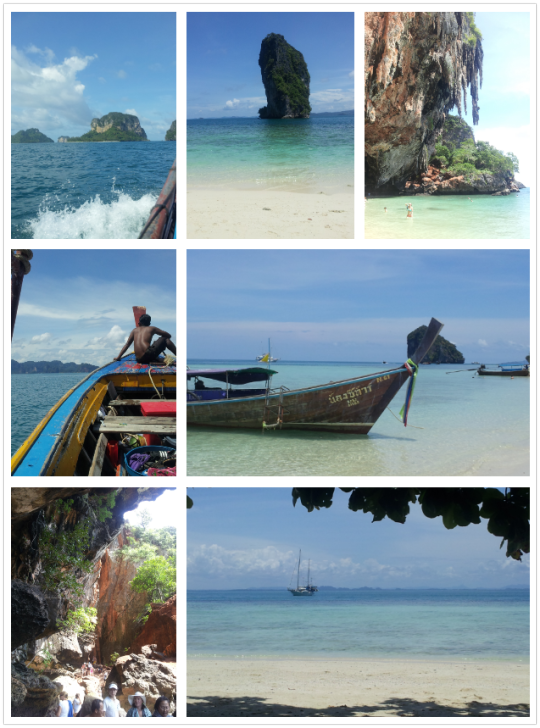
Amazing day enjoying a “Four Island tour” in Krabi, Thailand, including a longtail boat, snorkeling, sunshine, beach time and plenty of photo opportunities!
Krabi 4 islands tours
The Four Island tour took us from Aonang Beach to these lovely stops:
1. Seal island
This limestone cliff stretches out of the water near Poda island and makes for a good snorkeling spot. Beautifully clear water.
2. Poda island
Stunning! The snorkeling right off the beach was beautiful, there are limestone cliffs in the sea like on postcards and there are ’ Langkawi’ eagles soaring at the top of the cliffs. Fine white sand and turquoise water made for fantastic photo quality too!
3. Chicken island and Tup island
Very nice water quality, fun sea path walk/wade between the two islands, lots of shady nap spots and great scenery for photos.
4. Phranang cave
Interesting, busy, beautiful and impressive. Highlight definitely the cave and sheer limestone cliffs with of varied colours and textures. Phranang beach is far more beautiful than the popular Railay West and East beaches.
The Final Take on Four Island Tour
We’re not usually prone to taking touristy tours if we can help it. However, after some local research and weighing the other options, this one seemed like a good way to see the islands and have a day of snorkeling. As it turned out, it was so worth the 300 baht!
If you don’t mind a few boats in one location at one time, you’ll be okay. We’d recommend the Four Island tour to anyone who is spending a few days in the Krabi area. If you’re wanting a more relaxed day out on a boat and a chance to really take in what the ocean has to offer here, this is a good opportunity to do so.
Snorkeling, sunrise over Malapascua, mangrove paddling, massages, some boys climbing a tall palm tree to steal baby birds from the nest, great food, flying fish, pool bar and bussing through Cebu — wow!
Did Travelinds love Cebu in the central Philippines? We absolutely did. Here’s why our six days on this island was one of our best trips yet.
Day 1
After overnight flights through Manila, Travelinds flew into Mactan airport on Cebu island at sunrise. Tentatively, we made our way to the north bus terminal in Cebu City, based on some sketchy directions.
After a few minutes of checking things out at this busy location, we found ourselves taking part in pass-the-tourist games with competing bus companies. Eventually, we settled on an air-conditioned bus to Daanbantanyan toward the north of the island.
A four-hour bus ride in 35 degrees Celsius and with 90% humidity outside was a breeze. It turned out to be much more comfortable in an air-conditioned bus. Fortunately, the fare was only about 20 pesos more than the regular bus (only ZAR4 more!). So, we arrived at Virgin Beach Resort cool, calm and collected.
Day 2
We chilled, swam and then went on an hour-long kayak paddle by the resort. The flat, blue ocean was incredible. We were actually searching for snorkeling spots along the coast but only managed to find some pretty scenery and a few mangrove swamps.
After lunch, we found a comfortable hammock and socialised with two American tourists. We also played battleships as we watched the afternoon thunderstorms pass by.
Day 3
We decided to travel up to Malapascua Island, which is off the very northern tip of Cebu. The locals advise taking the calm ferry from Maya port that was only 30 minutes from our accommodation.
After some negotiations with local boat captains, who were trying to get as much as they could out of the small group of tourists wanting to hop over the bay, we made our way to the small island. The ferry ride included seeing these amazing flying fish all along the way —bonus!
Once we reached Malapascua, we met a charming local hotel manager who promptly convinced us to check out his place. We hadn’t pre-booked anything, as usual. His kind manner and persistence paid off, and we booked into Malapascua Legend, his beautiful resort with a rather magnificent swimming pool.
That first day on the island, we enjoyed a one-hour full body massage in our airconditioned room for only 600 pesos. We also had ‘Fish Tropicana’ at La Vida restaurant nearby, a dish of fish fillet cooked in coconut milk with lemon grass and topped with fresh pineapple pieces. So delicious!
That particular restaurant had beanbags and love nests right on the beach by candle light every night. It also has an upstairs balcony for those rainy evenings. The restaurant manager, a friendly gentlemen from Denmark, was so efficient and professional that it was hard not to notice. That’s not something we’d come across yet anywhere on Cebu.
Day 4
Mostly, we spent the day lounging around the poolside while looking at the bay a few metres beyond. We enjoyed the morning rain while we had our American-style breakfast. How long it’s been since we’ve had REAL bacon!
We also found a lovely lunch restaurant with all meals at only 95 pesos. This time, we enjoyed mango banana pancakes, thick mango shakes and yummy fresh veg and pork in coconut milk.
That evening, we headed out to find Happy Hour cocktails and dinner, so a very relaxed island day in all.
Day 5
At about 7am, after taking some lovely sunrise pictures, R inadvertently stepped on a log sticking up and was injured. It was bleeding quite a bit. He needed a trip to the island doctor — luckily there was one — to clean the wound properly and bandage up his foot.
Other than that, we spent the day relaxing at the beach and the pool. We needed to start researching accommodation for our last night in Cebu. That way, we’d have a place booked when we reached Cebu City. The 30-minute ferry ride from Malapascua followed by a five-hour bus ride down to the airport felt like a big ask after such a relaxing few days in the sunshine.
The Last Day in Cebu (Until Next Time)
After a very long day of travelling back down from the very north of Cebu, we reached Cebu city. We had decided to stay at Pacific Cebu resort on Mactan Island in Lapu-Lapu. Then, after a restful night, we flew back home to carry on working a little — before another vacation.
On 6 June 2013, South Korea celebrated Memorial Day. The celebration remembers all those who died in military service. To enjoy the break from school, as well as take advantage of the start to a beautiful summer, Travelinds headed to Hagampo beach in Taean-gun, Chungcheongnam-do.
A Beach Worth Seeing on the West Coast of South Korea
From our house, it is a drive of about 1 hour 30 minutes, and we we were not disappointed. This West coast beach is beautiful! When we arrived, the beach itself was almost deserted, despite it being a public holiday. It welcomed us with clean sand, blue water and an island to explore at low tide on the one side. On the other side, there were some rocks to clamber over. What a gem it is hidden in this Taean National Park site!
Finding a shady spot on the far side of the beach, we settled in for the day like good South Africans do. Why not? There was perfect weather (about 26 degrees Celsius), a slight breeze to keep us cool, sunshine, peace and quiet and even a few South African snacks left to keep us fed (acquired on my recent trip back home!). All in all, it was an absolutely perfect beach day not too far from our tiny apartment!
Lunch Around the Corner from Hagampo Beach
After a nice, quiet time to relax on the beach, we needed to find some lunch at about 3pm. We ventured into the small village made up of mostly small restaurants, tiny shops, a camping area and guesthouses (called pensions). Eventually, without really reading anything right because it’s all in Korean, we settled on some mool naeng myeon (물냉면). This is a summer-only noodle soup containing kimchi, radish and fresh veg — with big pieces of ice in the soup. So refreshing after a hot, sweaty beach day!
We even watched the day end with a beautiful sunset over Hagampo at 19.50pm. Then, we headed home.
Memory Maker on Hagampo Beach, Taean
We can’t leave it at that without mentioning the highlight of the day! On this particular trip, it was seeing a group of seals — yes, real and wild ones — swimming up and down in the bay! You read that right, living and sea-wild seals right there in the Yellow Sea of Korea.
We love animals of all kinds, so we went over to another family on the beach and asked them if they had seen the seals. We also wanted to check that we had the right name for them: mool-gae. Mool (물) means water and gae (게) means dog. The direct translation is “water dog,” which makes sense I guess.
The other family looked at us as if we were absolutely crazy. They said, “No! No animals. No animals. Barrier.” They had pointed to the “net barrier” that was about five metres off the shore. Is that supposed to be a shark net of sorts? We laughed heartily, and promptly drew their attention to the actual seals playing about 25 meters offshore.
It was great to see the amazement and disbelief on their faces. They slowly realised that these Westerners were not, in fact, crazy. They, too, really saw the seals swimming in the bay. The lady looked so shocked and said, “My first time to see this! Thank you!”
Wow! Nature-loving South Africans educating Koreans about their local sea-life? It was a proud and happy moment.
Travelinds recommends visiting Hagampo for all who love the beach, nature, forest walks and camping. It’s a perfect spot, and there are quite a few other beaches along this same coastline. If you have a car and want to explore, the Taean coastline has over 30 beaches, including Mallipo beach, which is over 3km long. This one is still on our must-see list!
The trip that we discovered mangosteens — the most delicious fruit ever!
January 2013
After receiving news of an extended holiday period for our winter vacation, Travelinds headed to Malaysia for our Christmas and New Year’s break for 14 days. This was only two weeks after we’d returned from our crazy busy South African wedding trip and a week after we’d had to move apartments unexpectedly (within 24 hours). We were ready to relax and unwind.
First stop: Penang
First impression of Penang:Diverse community, skyscrapers juxtaposed with bamboo houses, centered around food, laid back, and puts “African time” to shame.
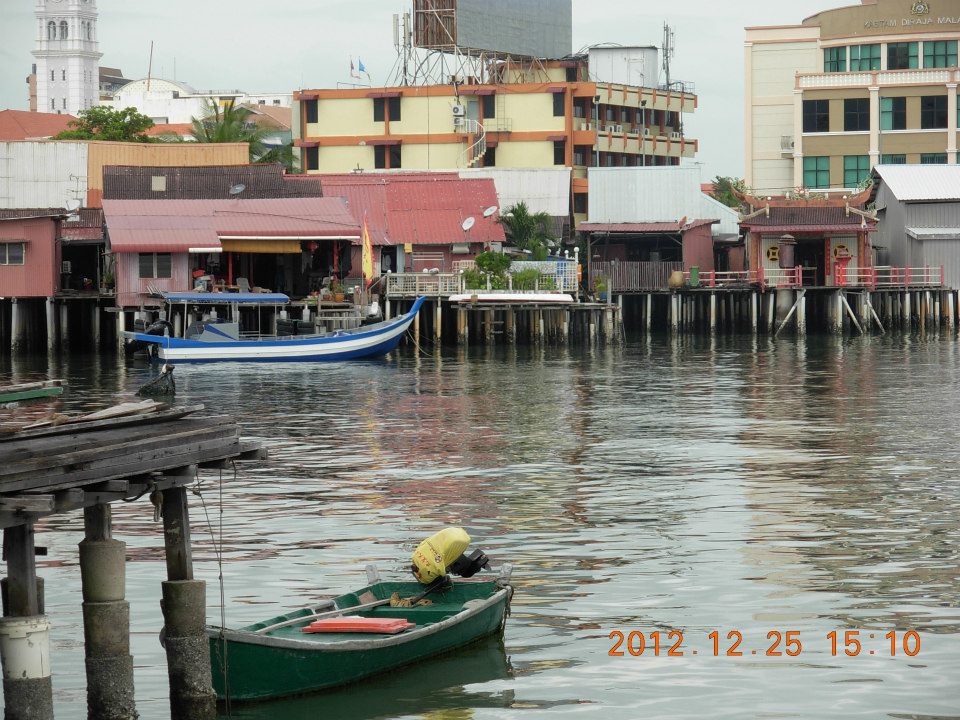
Chew Jetty, Penang
Penang is one of the most popular islands off the coast of Malaysia. It is known for its delicious (and cheap) local food, a rich cultural heritage and great holiday atmosphere for tourists. It has many places to explore, including several UNESCO World Heritage Sites. We visited a few of these, such as Chew Jetty (a Chinese fishing village with houses in narrow alleys built over the sea) and Fort Cornwallis, built by the ‘founder’ of the Penang British colony Captain Francis Light.
The country has a rich history and Malaysians are made up of several people groups, the majority of which are those of Malay, Indian and Chinese descent. This dynamic makes for a rich food culture, not to mChew Jetty, Penangention the very friendly, helpful people in general.
There was such a mixture of religions in Penang that it was hard to say which is the majority without looking at some statistics. There is a fascinating mixture of Muslim, Buddhist, Hindu (Tamil) and Christian places of worship (sometimes right next to each other!). There are little pockets of communities (China town, Indian Town etc.,) where you can see the traditional way of life still continues, even through this modern backdrop of Malaysian development.
Travelinds’ Highlights of Penang
The food!! Amazing Malay and Indian food, especially the “street” food. Noodles, rotis, soups, curries etc., and we ate to our heart’s delight!
The variety!! The beaches were fairly average compared to South Africa. Still, there were so many interesting markets (where bargaining is the favourite pastime), tourist sites (Georgetown and other areas, too) and other things to keep you busy that you can forget about a little bit of litter on the beaches.
The markets!! Our favourite pastime in the evenings was the Batu Ferringhi night market. You can bargain for cheap goods until you drop. Anything from clothing, cologne and curios to massages or food stuffs. And boy are the prices different from each stall to the next!
Memory Maker in Penang, Malaysia
The doctor fish eating our feet
We found a fish spa in one of the massage parlours. We paid the equivalent of around ZAR6.00 for 30 minutes for these tiny fish to nibble at our feet.
It’s great fun. It kind of feels like pins and needles at the time but your feet feel fantastic the next day. The doctor fish especially loved H’s dry heels over R’s softies!
R also loved his long ocean swim out to the small island nearby, despite jellyfish stings along the way. He got to catch his own big shellfish right off the rocks.
Travelling Companions for the Travelinds
In Penang, we met a couple from Shanghai, a couple from Canada and even one man (while we had our fish spa) from Sudan. Also, there were a whole lot of others who we could talk to easily and for extended periods by being our usual friendly selves.
Next stop: Langkawi
Pentai Tengah bay
First impression of Langkawi: Beach atmosphere, small tourist-centered island, simple living for locals, and beautiful natural sights, including animals and bird life far richer than in Penang.
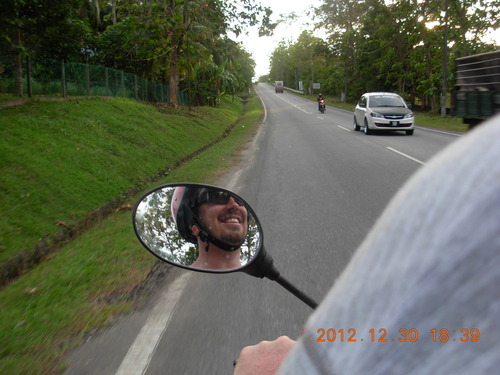
Langkawi is known for its beaches, easy accessibility to and from the southern Thai islands in the Andaman sea and eagles. We managed to do a scooter tour (H’s first time on any sort of motorbike!) in one day. This trip covered just about the whole island of Langkawi (for only about R90).
The long white beaches are absolutely beautiful, with soft sand and an abundance of interesting crabs. There is a great variety of restaurants to cater to the great variety of tourists (Russian, Italian, German, Spanish, American, British, Australian, Polish, Arabic, Chinese… the list goes one).
Travelinds’ Highlights of Langkawi
The nature. Birds, monitor lizards, crabs, monkeys, eagles, trumpeter hornbills, and a large variety of other things could be seen almost on a daily basis. We really enjoyed watching the tiny sand bubbler crabs making extra tiny sand balls all the way around their holes. So interesting! There were thousands of them along the beach that you wouldn’t even notice if you didn’t look closely.
The beaches. All the beaches were beautiful here; busy, but still enjoyable. The ocean was much cleaner than in Penang.
The hotels. We really were privileged to stay at Holiday Villas Resort for our first four nights in Langkawi. This was SUCH an amazing resort to be at – reasonably priced rooms (for a resort). It was an awesome location and the facilities included a beautiful pool, jacuzzi, semi-private beach and sports facilities!
Memory Maker in Langkawi, Malaysia
Scooter time
A day on the scooter together exploring the whole island was bliss. We saw almost all that it has to offer and remains one of our fondest memories.
With soft rain every now and again, the trip also made for a very romantic day together. We saw lots more of island life and of nature this way and could stop where we wanted to explore more.
Travelling Companions
In Langkawi, we met so many people. “Uncle” was one who started his own restaurant or food stall (great local cuisine!). He used to work in a 5-star resort but quit because he wanted to play paintball, his other passion. We enjoyed many chats with Uncle and his crew as we ate at their food stall most nights.
Another interesting couple were some British journalists based permanently in Kazakstan. We chatted to them for most of New Year’s Eve because they were our neighbours at the motel. We also met up again with the Canadians whom we had met in Penang. It was so lovely getting to know them a little more.
Last stop: Koh Lipe, Thailand
Koh Lipe
Our last two nights on this vacation, we decided to take a speedboat over to Koh Lipe. In Thai, this is literally “Island Lipe” so they all start with “Koh.”
Thailand is another country but only an hour away from Langkawi to the north. Thankfully, R was keeping an eye on the weather forecasts. We chose two sunny days to spend in Koh Lipe when we did the trip there. However, it was pouring with rain on our trip over to Thailand.
The speedboat was not closed off, hence we were all soaking wet! It calmed for the evening, and the next two days were absolutely beautiful weather. That surely made up for the first afternoon’s downpours and very wet luggage.
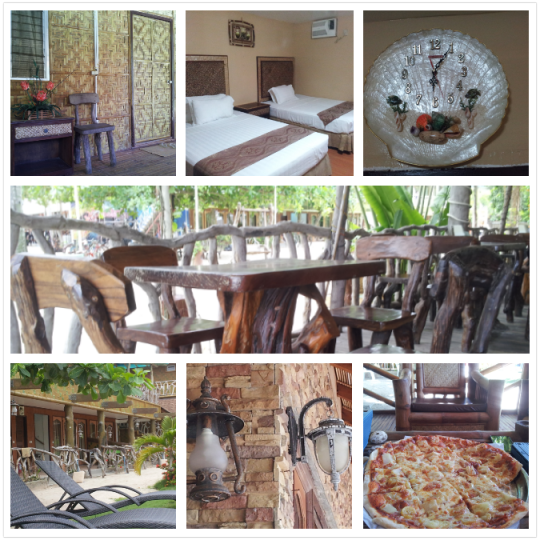
Koh Lipe is also absolutely beautiful! It is a tiny island (walking distance to go all the way around it) and referred to as “The Maldives of Thailand”. It is known, as is the rest of Thailand, for its beautiful beaches, turquoise-coloured clear water, great snorkelling and diving and cheap but quality massages! We stayed in a small bamboo bungalow (with fans). There were mozzi nets over the bed and a little Asian-style bathroom. The sign on the door said, “Beware of leaving shoes outside on the deck as the dogs love to steal them and bury them!!” Actually, this happened to the German couple staying in the bungalow next door!
Travelinds’ Highlights of Koh Lipe
We only had one full day, so we decided to do a snorkelling trip. It was very reasonably priced and included equipment and lunch for a full day trip. Great decision!
We saw so many beautiful fish and sea creatures in the snorkelling spots and got to see a few little Thai islands along the way. The lunch spot (a deserted white beach) had amazing snorkelling right off the beach. We even saw a scary looking black spider sneaking past us on the beach to go back to the forest.
Travelling Companions
Again, we met up with the Canadians. They had taken our advice and ferried up to Thailand from Langkawi, stopping in at Koh Lipe for a couple of days first. We had a meal or two with them and sunset drinks. We also taught them a few South Africanisms, like “Mozzi”, “Lekker”, “Slops” and “Mielies.”
It was great to make some new friends who are doing what we still dream of doing one day. They have backpacked through Nepal, India and Sri Lanka so far. Now, they’re heading through Malaysia, Thailand, Laos, Cambodia, Vietnam and then Australia.
We also had a lovely chat on the “fast” boat back to Langkawi to Swedish, German and Australian couples, which we enjoyed!
Another Funny Travelinds’ Memory From Koh Lipe, Thailand
On the last evening at about 11pm, we went for a couples massage (one-hour full body). This was something we’d both looked forward to when visiting Thailand! It was amazing, as promised by all the tour guides.
Unexpectedly, the massage was also entertaining. We were bent, prodded, squeezed and stretched —like pretzels — by our tiny masseurs. At one stage, R even had the Thai lady jumping on him with her full body weight. As you can imagine, this was hilarious (and painful for him). It also did the trick to ease the sore muscles!
Final Reflections: Travelinds in Malaysia and Thailand
Tip: Ignore anything that says ‘rapid’, ‘speed’ or ‘fast’ in Malaysia and Thailand – there is nothing rapid about the local transport (or food service). The “rapid” bus that “takes 45 minutes” took us about three hours, and the speed boat of “only 55 minutes” took us 2.5 hours.
Reflecting on this trip reminded us once again, how amazing God’s provision for us has been. He promises to provide for His people. He continues to shower us with most undeserved blessings despite our sinful shortcomings and constant lack of gratitude. We are so very grateful that we have had this opportunity to enjoy a wonderful two-week summer holiday in the middle of the Korean winter with little fuss and a whole lot of fun together!



 Secret Beach Hunt: Updated Instructions (and Some Tips)