Kinabatangan River Tour

31 January 2014

After a friend travelled to Borneo a few months ago, she told us about these ‘jungle river tours’ that are available in Sabah.
The tours travel along the Kinabatangan River where the rainforest creatures still live in the wild.  I must admit that this was the main thing that drew me to Sabah itself, as my passion for wildlife exceeds much else in my life.  My hope was to find orangutans, proboscis monkeys, pygmy elephants, rhinoceros hornbills and a clouded leopard – and I’d say that having seen 4 of these 5 wasn’t a bad track record for only five nights in the jungle.

Kinabatangan means ‘china, long river or tree’ and again, it is uncertain where this name originated, but it sure is a very long and rather wide river.  It twists and turns back on itself in several places, creating ox-bow lakes; and the river boasts an impressive total length of about 560 kilometres.  The area is teeming with wildlife but there are also many parts in Upper-Kinabatangan that have been badly affected by encroaching palm oil plantations.  There are conservation efforts to protect the remaining wildlife but clashes between man and nature are often unavoidable.

Lodges are based mainly in the Sukau town area, but Bilit village also has a few which are on the quieter end of things. We ended up enjoying the first tour so much, that we came back to Bilit Adventure Lodge for a second time, after a week in Semporna. During our tours (in mid-February 2014, still technically ‘monsoon season’ for this area) we managed to get thoroughly soaked at least twice on each tour but the rewards were so much greater than a few hours of driving rain.  Read a few Kinabatangan River TripAdvisor reviews for more information.

Our wildlife sightings over the five days were: mouse deer (at our lodge!), proboscis monkey, silver leaf monkey, orangutan, long-tailed macaque, short-tailed macaque, crocodile, monitor lizzards, kettle fish, pygmy elephants, python, yellow ring snake, black squirrel, mudfish (no gills!), red velvet dragonflies, one dead black cobra (huge!) and leeches.

With a vast array of beautiful birds in this area, some of our special bird sightings (those we actually knew the names of anyway) were: stork-billed kingfisher, rhinoceros hornbill (so impressive!), oriental pied hornbill, wrinkled hornbill, black hornbill, bushy-crested hornbill, blue-eared kingfisher, red coucal, lily hens, black and red broadbill (stunning!), blue-throated bee eaters, lesser fish eagle, serpent eagle, ashy tailorbird, egrets, herons and so many other feathered friends!

Sadly, we didn’t see: Sumatran Rhinoceros (not seen by our guide in 16 years on the job), clouded leopard, slow loris, tarsiers, sunbear, mongoose and read leaf monkeys.

Overall, it was a fantastic trip and we really appreciated that this could be a once in a lifetime experience.  We hope that one day our children may also be given the chance to see these amazing creatures in their natural habitat, provided environmental conservation efforts can keep them protected that long in to the future.  It would be such a shame to lose yet another part of God’s wonderful creation to man’s destruction.

Read more about our adventures in the jungle here.

Jungle Adventures

31 January 2014

The Borneo jungle beckoned to us long before we finally reached it and the experience of finally being there was truly spectacular! The wildlife was incredible and the scenery like something out of a dream – it is almost too beautiful to describe!

Our jungle destination was the Bilit Adventure Lodge, which is nestled quietly alongside the great Kinabatangan River.  We did a two night stay here and then, a week later, returned for another three nights in specifically in search of the elusive pygmy elephants who had managed to evade us on the first two nights.

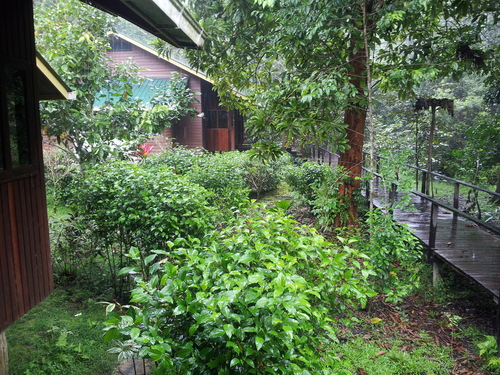
Bilit Adventure Lodge itself is a real slice of heaven in this already dream-like place, with dark wooden cabins and wooden boardwalks blending perfectly in to the surrounding jungle. Monkeys, tortoises, deer and hornbills were regular visitors within the lodge area and the sounds of the jungle gave us both a frog-lined lullaby in the evenings and a refreshing wake up call in the early mornings.

Bilit Adventure Lodge
Cabin at Bili Adventure Lodge tucked into the rainforest.

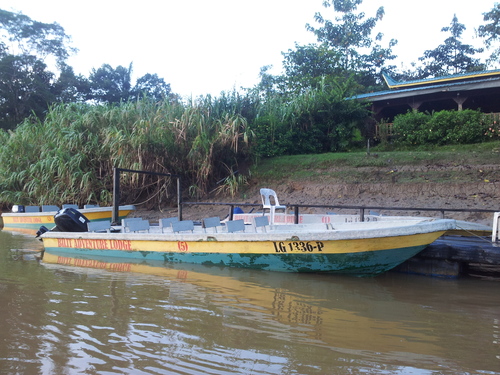
The river cruises are mornings (1 hour) and evenings (2 hours) as this is when the most animals are up and about alongside the river.  Despite being a completely open motorboat (with place for only 8 people), regular rain did not deter us from venturing out in search of the fascinating wildlife of the Kinabatangan jungles.

TIP: We wore clothes that could get wet and that would dry easily.  We left all valuables locked at the lodge and took only cameras (in waterproof bags).  Caps also help to shield eyes from the rain.  No shoes needed in the boat, so leave them at the lodge under the dry cover of the communal dining room.

Kinabatangan
The tour boat where we spent mornings and evenings searching the riverbanks for wildlife and birds.
LAUGH: While preparing for our trip, I came across this hilarious review on TripAdvisor by wiredfrog.  Read this review if you want to have a good laugh; and also to get a sense of what the river cruises can be like if it’s raining heavily.  Please note however, that this was a very over-dramatic rendition of what we actually experienced during our five days (which were still in the Nov-Mar monsoon season) and that the superb wildlife spotting is sure to make up for any discomfort experienced.

The meal times at the lodge were also a real highlight for us, with delicious cuisine inspired by Malay, Indonesian and Western methods.  Tea times were even better, with little cakes, buns or sweet local delicacies that tickled our taste buds and filled the gap for our two hour cruise before dinner.

TIP: Take a pair of (quick dry) long pants and long shirts for evenings to avoid getting attached by mosquitoes.  We didn’t use any repellents (brave or stupid?) but have not picked up any illnesses from the thousands of mosquitoes we donated blood too during our month long stay in Borneo (supremely grateful)!

We did the jungle trek one morning which took us out to one of the ox-bow lakes.  We were relieved to have hired gumboots though as we had mud up to our ankles in so many places. Also, with hungry leeches all around (in trees, plants, mud and grass), we were also so glad to have had long sleeves and long pants (everything tucked in tightly to avoid leech bites) as many of the other tourists got nice fat leech surprises when they checked under their clothes! Lucky for us, the leeches ignored us completely.

Kinabatangan
The trek through the rainforest requires sturdy gumboots for the deep mud.

At the time (February 2014), the dormitory-style rooms were almost fully completed, but lucky for us, we got to stay in the fancy cabins (air conditioning, double beds, en-suite bathrooms, lounge overlooking the jungle, kettle and shower).  It was far more than we were expecting and made for a rather wonderful few days enjoying the jungle in luxury. We stayed in the cabins that have names such as ‘Proboscis Monkey’ and ‘Western tarsier’ – the one with the best view was Cabin number 3 (the front-facing room) as this is where I watched a comical pair of Oriental Pied Hornbills who danced along the water tower every morning after tea.

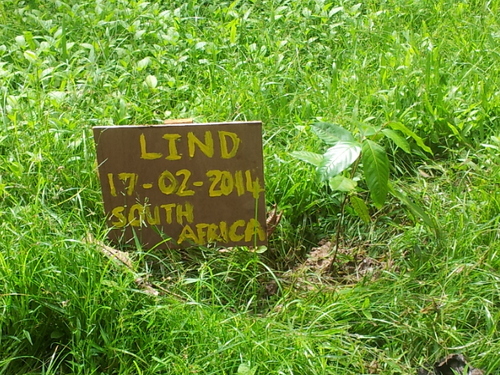
Bilit Adventure Lodge also offered us a chance to plant a tree in their property (at MYR 10) to help replenish the loss of vegetation that is caused each year from flooding.  We proudly contributed a small little tree somewhere next to Cabin number 3 and hope to return one day to see if it survives long enough to do its part for the Kinabatangan jungle.

Plant a tree
Travelinds planted a tree in the rainforest.

Read more about the tour package here.

Tanjung Aru

30 January 2014

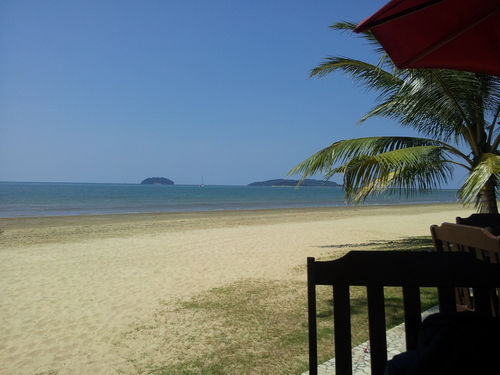
Tanjung (Beach) Aru is the long, flat beach between the Kota Kinabalu International airport and the Sutera Harbour.  It looks out on to the four islands off the coast (Manukan, Sapi, Mamutik and Gaya island).

We spent one morning here just sunbathing, reading and swimming; and then left after lunch.  It was a lovely, quiet place, although the sand looked a little dirty (oily) in some patches. The water was surprisingly clear and from the amount of people swimming, didn’t seem to pose any health threats.

There is also a small park with benches and places to picnic. The one or two restaurants on the beachfront seemed reasonably priced and good enough for a lunch on the run.

Getting here:

  • Take (big) Bus Number 16 from Wawasan Bus Terminal.
  • MYR 1.50 each, ask for Tanjung Aru beach.
Note: There is a small bus (minibus) 16 that also goes to this area, but it drops you at Tanjung Aru town, not at the beach. So it is about a twenty-five minute walk to the beach from the town bus stop.

Kota Kinabalu Wetland Centre

29 January 2014

Kota Kinabalu Wetland Centre (KKWC) is a few minutes by bus from the Likas Mosque. You can also easily walk to it from Signal Hill and from Likas Square.

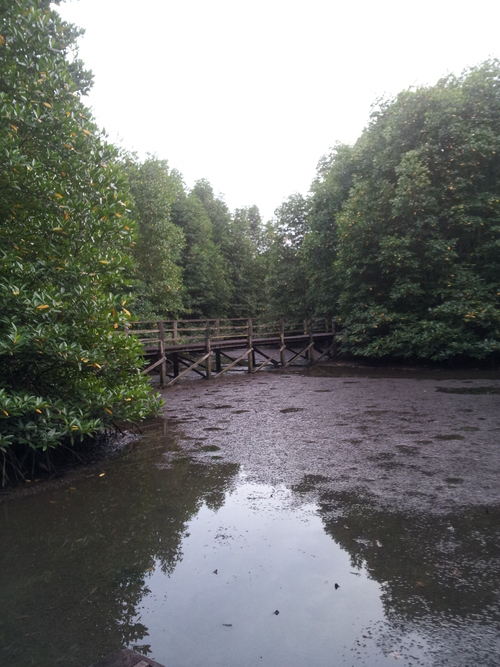
The area consists of low-lying mangrove vegetation, lots of mud, muddy creatures and quite a nice variety of birdlife.  There are board walks, viewing platforms, benches and look out points.  Entrance was MYR 15 per person. The centre closes around 6pm.

We enjoyed an afternoon here on our way back from a visit to Likas Mosque.  It was peaceful, not busy at all and there were educational posters and informational boards all around the walkways.  The only disappointment was the amount of litter everywhere which comes in when the waters rise. See more reviews on TripAdvisor.

Worth a visit for an afternoon stroll and some bird watching.

Getting here:

Take a local (big) bus from the Shangri-la Bus Terminal (in front of the Shangri-la motel, NOT the fancy one out of the city), near KFC.  Ask for the Likas bus (purple colour) and tell the driver you want to get off at Likas Square (about ten minutes walk from here to the wetland, follow the tourism boards). MYR 1 each.

Gaya Street Sunday Market

28 January 2014

As informed by the brochures on Kota Kinabalu, we headed over to the Gaya street Sunday Market relatively early on Sunday morning.  We had heard plenty of positive things about this bustling street market and wanted to check it out.  With it being the weekend of Chinese New Year, there was also a lot of excitement around the area with loads of lantern decorations and dancing dragons gliding through the streets.

True to form, the market did not disappoint with its vast array of goods for sale and the whole of Gaya street was blocked off with several rows of stalls. Some of the things we spotted were: clothing, puppies, plants, juice, gadgets, curios, pots, lasers, baskets, fish, fresh produce, fake jewellry, nailpolish, handbags, turtles, musical instruments, canvas artworks and coconut carvings.

Not being too fond of close contact with hundreds of people, we only lasted about an hour and then headed back to find some brunch. The only purchases for the day were a mango juice and matching caps with ‘Sabah Borneo Malaysia’ embroidered on the front.

Getting there:

Coming from Centre Point side, you cross the main intersection at Centre Point heading away from the ocean.  You then head towards the city hall park area (you’ll see a KFC on your right at some point and a bus terminal on your left) and keep walking until you see the colourful Gaya street market decorations. There is a big hotel and a bird statue just before the entrance to Gaya street.  It is the street where a lot of the lower-end backpackers are located.  The traffic and amount of people should also guide you to the right area.

There’s more information about the Gaya Street market here.

Kota Kinabalu Islands

28 January 2014

Huddled together off the coast of Kota Kinabalu, the group of five islands, which makes up the Tunku Abdul Rahman Marine Park, serves as a popular tourist zone for those visiting Sabah’s capital city.  There are hundreds of boat operators to choose from that offer standard or special tours, as well as diving or snorkelling.  It is a wonderful place to go if you need a day at the beach where the only thing to do is enjoy the scenery and breathe in the fresh sea air (once you’ve dodged the busy tourist gatherings).

The five islands – Gaya Island (big), Sulug Island (Sulu people), Manukan Island (fish), Mamutik Island (shell collection) and Sapi Island (mowing buffalo), lie about three kilometers off shore.  The Park was founded in 1974 as a national reserve to protect the marine life in the area.

After reading reviews on TripAdvisor, we decided to visit Manukan and Mamutik on one day trip, with snorkelling.  The islands were pretty much the same in terms of natural scenery except that Mamutik had amazing shells (as it name suggests) and was a lot quieter without the groups of Chinese tourists that thronged the open spaces on Manukan’s beaches and park areas.

Manukan

Manukan Island was our afternoon destination and we spent a lot of time eating lunch in the shade of the trees, sun-tanning and resting.  We saw a lot of monitor lizards here but were feeling too lazy to do the jungle walks where you can explore the rest of the island. There are a few places to eat here but not enough to keep prices competitive. We also saw a couple of people camping here (tents) and barbecuing, which looked like it might be a fun thing to do; especially since most of the tourists go home after 4 pm.  This leaves you ample time to enjoy the sunset and then the sunrise too, without the hoards of foreigners blocking the view.

Mamutik

Mamutik

Mamutik Island was our first stop and we spent the morning here snorkelling, sun-tanning, reading and admiring the birdlife around the island. It was a lot of quieter than Manukan and had good snorkelling around the far end of the beach (furthest from where the pier is) which was less damaged and had a quiet part of the beach to enjoy.  There are also lockers available for a day at the Borneo Divers offices (on the far side of the beach) if you need to lock up your things, for a small fee.

Mamutik

Getting here:

We found a boatman somewhere along the way to the Jessleton Point (just after the market, but before the main piers) who hustled us into buying a trip from him for MYR 100 (for two people, snorkelling equipment, boat trip return).   We then also had to pay a further MYR 10 for a conservation fee when we arrived at the island.  Based on some of the other tour packages we’d looked at this didn’t seem like a bad deal.

A few days afterwards, we did see a flyer somewhere for a package deal, including the above, plus KFC lunch and INCLUDING conservation fee, for only MYR 50 per person.  So I guess we could have saved about MYR 20 plus lunch costs had we found a deal like this earlier.  But it was not too much difference considering our busy schedule.

*Some information was taken from Sabah Parks website.*

Likas Floating Mosque

27 January 2014

An afternoon outing in Kota Kinabalu took us to the Likas Mosque (better known as the ‘Floating mosque’ in KK).  Being our first visit to a mosque, we read up a bit on dress code/etiquette required and figured long sleeves, long pants and a headscarf for H would suffice.

Upon arrival, we were directed to the small shop/reception office outside where a kind lady helped us to dress appropriately.  There were kaftans, scarfs and head gear available there (for free) so that non-Muslim visitors would be allowed in to the mosque.

Outside the mosque, you are required to remove shoes and a guide then takes you through the mosque giving information about its construction, use and history.  We were informed that the mosque was built over 11 years (1989 – 2000), construction cost MYR 40 million and the building can comfortably fit between 9,000 to 12,000 worshipers.

The fifteen-minute tour concludes and visitors can take a couple of pictures inside and outside the mosque, provided no worshipers are disturbed.

At the same reception office, you can pay MYR 5 each and go on the peddle-boats in the water around the mosque. This is great for some fun and for getting a different angle on photos of the mosque. There is no time limit on using the peddle boat as far as we could tell.

Read the reviews on TripAdvisor. Be aware that some travellers have confused the floating mosque (Likas) with the Kota Kinabalu State Mosque, which are two different locations.

Likas Floating Mosque

Getting here:

Take a (big) bus from in front of the Shangri-la Motel (NOT the same as the fancy hotel complex far out of town). Ask for the Likas bus (it has a purple stripe) and ask the driver to drop you at the Likas Mosque. MYR 1 each.

Favourite memory:

We finished a nice afternoon exploring the mosque and riding the peddle boat and decided to catch a bus to the next stop, the Kota Kinabalu Wetland Centre.  We were told that it was an hour’s walk from the mosque, so thought the bus would be best.  First, the bus drivers told us ‘no bus, no bus’ (of the three busses standing there), then after some deliberation they decided it would be best to do a bus trip after all.  The few tourists and locals were herded on to the one bus and, after a push start, the wonky old bus started going, in the wrong direction from where we needed to go… In fact, it did a full circle and came back past the mosque bus stop before finally continuing on to the route we needed to go. The delay was only about 40 minutes, no big deal.


Kota Kinabalu State Museum

27 January 2014

The Kota Kinabalu State Museum complex is a most interesting place to visit if you want to learn more about the intriguing culture and history of Sabah. We spent an entire day here and still didn’t get to see all that the complex has on offer.

The first stop was the Main Museum building and this kept us busy for a very long time! Natural history, Sabah special ‘Then and Now’ display and the ‘Our culture’ sections were the most interesting and it took a lot of time to work through all that valuable information.  We also watched a video (about an hour) in the natural history section titled ‘Borneo’ (1937) – an old black and white movie travelogue shot by famous explorers Martin and Osa Johnson.

We found some local Malaysian lunch at the small cafe called Zureen’s cafe (located just outside the heritage village, in the parking lot). This included our favourite ‘Char Keow Teoy’(fried flat noodles with chicken or prawns), ‘Mee Goreng’ (fried yellow noodles) and Horlicks/Nestum (milky sweet drink, served hot or with ice cubes).  I think the total lunch came to only MYR 12 for both of us.

After lunch, we finished up at the main building and then headed to the Heritage Village.  Here you can see all the different kinds of houses/huts/structures/transport/machinery/equipment used by the different tribes that can be found in Sabah.  It was a very interesting experience to see the vast differences in lifestyles, building designs and practical day-to-day instruments employed in these different tribes.  There was everything from a Chinese farm house to a Rungus longhouse. The Murut longhouse was my favourite, with its huge porcelain jars, wooden rhinoceros hornbills hanging from the ceiling and a trampoline-like floor that is used for entertaining guests.

There were not enough hours in our day to see everything so unfortunately we had to leave before we had seen the science museum, islamic museum and the ethnobotanical garden.  Read more about the Sabah Museum here.

Marina Court Vacation Home – Kota Kinabalu

26 January 2014

Wanting to spend a couple days in Kota Kinabalu, we found an amazing place to stay called Marina Courts.  It is a complex of high rise apartment buildings with a swimming pool, gym and a prime KK waterfront location.

The particular deal that we found was listed as the Marina Court Vacation Home (Kota Kinabalu).  It was a room for rent (not the whole apartment like some of the other options mentioned on TripAdvisor) and it was set up similar to a hostel where the guests shared the living area, kitchen, washing machine and dryer.  One of the rooms has an en-suite bathroom, the other three rooms share a common bathroom. You can book it on Agoda.com.

There are showers, air conditioners and basic kitchen facilities.There’s a big swimming pool downstairs for guests to use at their leisure and also a gym.

Marina Courts’ location is perfect for exploring Kota Kinabalu.  It is within walking distance of most major tourist points and has a local bus terminal right in front of the complex for catching buses to areas that are further away from the city center.

Walking distances from Marina Court:

  • 25 – 30 minutes: Jessleton point (the ferry and boat jetty), Museum, Signal Hill,
  • 15-20 minutes: Shangri-la Bus terminal, Express bus to Kudat,
  • 5-15 minutes: The Night market, Gaya street Sunday market
  • Right outside: Wawasan Bus Terminal (intracity busses), Centre Point shopping centre is across the road,
TIP: There is an Arabian restaurant across the road from Marina Courts (on Centre Point side) called ‘Al Andalus’ – visit it! It has delicious, well-priced food, excellent service and an authentic Arabian vibe to it.  The extra Arabic Set was enough for two of us and the Baba Ganoush was fantastic! We ate here for at least one meal every day, for eight days.

Kota Kinabalu

Kota Kinabalu,

Sabah, Malaysia Borneo

This vibrant city is the largest city in the eastern Malaysian province of Sabah, on Borneo.  As in most other parts of Malaysia, Kota Kinabalu is home to a wide variety of cultural groups, including some special people groups specific to Borneo, like the Rungus. This province includes 33 indigenous groups speaking 50 different languages and up to 80 different ethnic dialects. Talk about an administrative nightmare for local government!

The province of Sabah has a wide range of attractions that make it a very alluring spot for tourists from all over the world. Beaches, islands, reefs, mountains, parks, nature reserves, museums, temples, mosques, markets, hot springs and rainforests – and Kota Kinabalu is the doorway to it all!

Named for its proximity to Mount Kinabalu, the city of Kota Kinabalu lies on the north-western coast of Sabah and boasts the largest port and population in Sabah. Kinabalu means ‘Chinese/China’ (kina), ‘Widow’ (balu), which perhaps explains why the mountain itself is held in such awe by the local inhabitants. It soars above the rest of the landscape, often swathed in a thick layer of white clouds and stands a lofty 4,101 metres above sea level.

With so much to see and not enough time to see it in, Sabah offers tourists a jam-packed holiday filled with endless activities and interesting places. You will need to take some time out to help it all sink in!

Read more about the following attractions in Kota Kinabalu (NOTE: these are just a few of them that we managed to see):

Travelinds also saw these interesting places in Sabah, Malaysia:

Bohol’s Tarsiers

25 January 2014

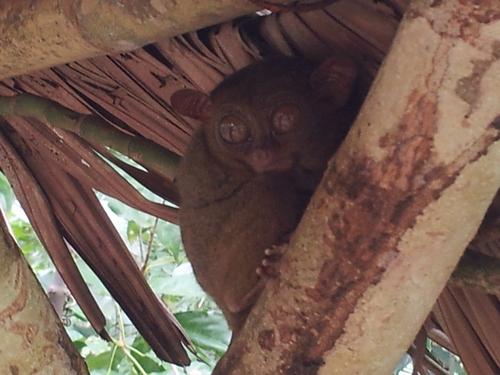
Big round eyes, sticky little toes, ruffled brown fur and strange pointy ears was my first glimpse of the tarsier, a tiny creature that I have been dying to see since starting our travels in South East Asia. Nocturnal by nature, the tarsiers are sleepy during the day and these mostly insectivorous primates spend the daylight hours fast asleep.  At night, it is a completely different story with jumping, shrieking and feasting on whatever they can find.

The Philippine Tarsiers, like their cousins the Western Tarsiers, are the cutest, tiniest, weirdest-looking animals ever!  Tarsiers are only found in South East Asia and are critically endangered.

Bohol island in the Philippines is home to some of the only Philippine tarsiers left in the world and there are conservation efforts happening on the island to increase the dwindling numbers of this lovely little creature.  Many of those animals kept at the conservation centres have been rescued from illegal trade and can never survive again in the wild.  Others have been successfully bred through carefully guarded breeding programmes and then successfully released into their natural habitat.

Travelinds was forced to visit the Carmen Tarsier Sanctuary (in Loboc) instead of the Corella sanctuary which I’d read so much about, because the road had been severely damaged by the October 2013 earthquake and made it impossible to get to Corella from where we were staying in Panglao, Alona Beach.  It was great to finally meet these amazing little monkeys, but I felt guilty once again that captivity is no place for wild creatures.  Even though I so badly wanted to see one of these animals, I would still have preferred to see one at a far distance knowing it was free and wild!

Loboc Tarsiers