To celebrate the origins of the Korean language (Hangeul), Korea celebrates a national holiday on 09 October each year, known as “Hangeul” day. Since it was a day off from school, we ventured out with friends.
We drove into Dangjin for brunch and ended up at Lunar Rich (loo-nah-lee-chee), an Italian style restaurant opposite from the Art and Culture Centre. A delicious meal (we had the lunch set) with salad, pizza, pasta and coffee or cola. A lovely ‘authentic’ Italian meal was a nice surprise from the usual ‘Kor-talian’ options that are usually available at these “Italian” restaurants.
We then headed off to the seaside village of Sapgyoho (only 20 minutes from Dangjin), to find the new circus being advertised. The new building (which can be seen from the expressway) resembles a circus tent both on the outside and the inside. It is not the ‘travelling’ circus concept we were used to from South Africa, but in fact, a troupe of Chinese acrobats that have apparently committed to performing at this venue for the foreseeable future. It opened on 03 October 2013.
After the first act, we were both thinking this was more of an amateur show. However, by the end of the 90 minute performance we were absolutely stunned by the talent and professional, jaw-dropping routines of the young acrobats. Truly, the most amazing performance of acrobatic feats and fearless commitment to excellence I’ve ever seen. Contortionists, swan dance acrobatics and so many other fascinating routines kept us rivetted throughout the show.
Head on over to the show (13.30, 16.30, 19.30 – every day) – it’s easy to get to Sapgyoho (by bus) from Dangjin.
Today marked the annual Korean Formula 1 Grand Prix. The race began at 15.00pm with a colourful opening cermony kicking off at 2 p.m. The opening parade, with participants dressed to the nines in traditional Korean ‘hanbok’ and ‘Samulnori’ clothing, showcased true Korean drama and legendary story-telling, through Korean dance.
The crowd was then treated to a daring display of fighter jet formations by the Korean Black Eagles flying squad. Death-defying manouvers and colourful smoke creations (even a red heart with a blue arrow through it) kept everybody entertained. The sound of the jet flying over us at close proximity was enough to give everybody a huge fright and a taste of the noisy car engines to come (although the fighter jet engine felt about a hundred times louder than the cars!)
The weather was surprisingly good, if just a little windy, despite ominous predictions earlier in the week of a typhoon touching down on Sunday. Our seats were in Grandstand G this time, with a good view of the cars coming out of the first straight and then a view of turns 7,8,9 and 10, which is luckily where some of the action happened during the Formula 1 race.
We support Sebastian Vettel (Red Bull) and Kimi Raikkonen (Lotus) and this is the second year we have enjoyed great performances from both of these drivers at the Korean circuit. Vettel came first (again), led every lap and also got the fastest lap of the race, much to the
disgust of some of the Italian Ferrari fans sitting nearby us; a
nd Raikkonen came in at second position by overtaking his teammate (Grosjean) late in the race.
The race was pretty exciting with blown out tyres, appreciative crowds drowned out by the deafening drone of the powerful Formula 1 car engines and even a dramatic fire, caused by a bump earlier in the race that must have ignited something.
Mark Webber was the unlucky driver whose car caught fire and he had to escape before flames engulfed it in a cloud of black smoke.
Incidentally, this happened right at the end of the straight where we could watch all the action live from our seats, with a little help from the big screen for the details.
Today we went on a teacher’s outing to Gongju, with some of the Asan Board of Education public school teachers. It really was an interesting look into some of the ‘rural’ traditions and the cultural legacy that still lives on in South Korea.
Hunting for Chestnuts
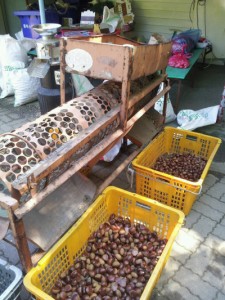
The first task was a thorough chestnut collection, which was actually a lot more fun than it sounded on the itinerary. Chestnuts (밤 ‘bahm’) are traditionally eaten roasted, or peeled and frozen to be eaten raw.
Gongju Roasted Chestnuts
We were shown how to break open the spiky pod and extract the shiny brown chestnuts with tongs. Armed only with tongs and an orange net bag, we were led up the steep pathways and sides of hills to tackle the chestnut plantations.
Aside from minor injuries from chestnut pod spikes, the other exciting event of the morning was finding a small brown snake on the grassy bank (Google later revealed it was a ‘rat snake’ of some sort), which a brave Australian soul rescued from certain death, by flinging it as far into the bush as possible, away from the Korean tour guide.
We headed back with orange bags overflowing with chestnuts and enjoyed some roasted and frozen, raw chestnuts as a reward for our efforts.
Traditional Korean lunch
We then headed down the road to a traditional folk museum, restaurant and chestnut dyeing complex. It has been run by the same family for the last 200 years, who still live, farm and dye with chestnuts (no pun intended), in the same farming area in Gongju.
Treated to a traditional Korean lunch, we experienced lotus steamed rice (covered in lotus leaf, with
Gongju Folk Museum
herbs), an array of unique Banchan (side dishes) special to the Gongju region, makgeolli (rice wine) and mushroom water (like ice tea, but made from mushroom juices); all this served in the traditional low Korean tables, sitting on flat cushions on the wooden floor, with legs folded under us.
Since the restaurant and surrounds were all things chestnut, chestnuts appeared as an ingredient in the vast majority of the dishes served. Even the servers clothes and restaurant furnishings were dyed with chestnuts.
Traditional Folk Art Museum
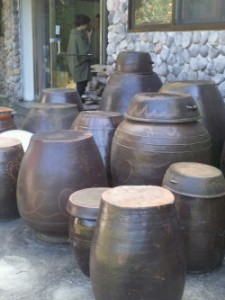
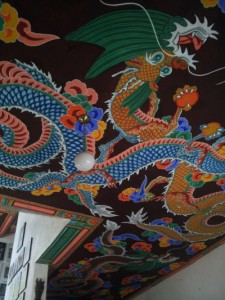
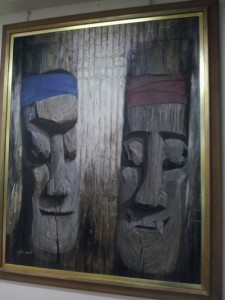
The ‘chestnut’ family has also collected artifacts from the neighbouring farmers over many years, as well as the collection of dramatic art pieces used by the current owner’s father, who was a well-loved traditional Korean puppeteer in his spare time. It includes farm implements, cultural pieces, masks, paintings, shamanistic symbolism, farm life cooking tools and many other interesting things to see and experience.
Gongju Museum
My highlight was seeing an actual South Korean funeral carrier, a colourfully decorated box that traditionally holds the coffin and is carried to the burial mound by about 12 men. These days, it is rare to see one in use as, our host joked that, Koreans are now taller than in the past and so don’t fit in the carrier very well. The carrier at the museum was retired only a couple of years ago.
The next week at school, I was surprised and very privileged to see one of these coffin carriers actually in use, as a funeral procession passed the school and headed down the road; singing, clapping and mourning the loss of a 75-year old lady that had lived in this community.
Chestnut Dye
The last activity of the day was a handkerchief dyeing lesson. We were shown the crushed chestnut husks that are used to make the dye and different ways to tie-dye our handkerchiefs. We dipped it in the hot dye (hands and arms covered in rubber gloves) and took turns to “massage” the dye into the handkerchiefs in the pot. Then out into the cold solution that sets the colour. This process was repeated two or three times; ending with a cold water rinse and then handkerchiefs were hung out dry.
Mine was sadly unremarkable, as it was lost in the dye pot for a while and lost all its strings, but a few of the other teachers managed to produce some seriously impressive dye patterns.
Take a trip
If you are headed to Gongju, you can find more information about the museum and the area at this link. It’s a great day trip for those interested in learning a little more about traditional Korean life.


 Today marked the annual Korean Formula 1 Grand Prix. The race began at 15.00pm with a colourful opening cermony kicking off at 2 p.m. The opening parade, with participants dressed to the nines in traditional Korean ‘hanbok’ and ‘Samulnori’ clothing, showcased true Korean drama and legendary story-telling, through Korean dance.
 The sound of the jet flying over us at close proximity was enough to give everybody a huge fright and a taste of the noisy car engines to come (although the fighter jet engine felt about a hundred times louder than the cars!)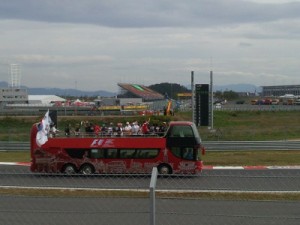


 Today we went on a teacher’s outing to Gongju, with some of the Asan Board of Education public school teachers. It really was an interesting look into some of the ‘rural’ traditions and the cultural legacy that still lives on in South Korea.